
Photo: Wikipedia
Personal Sovereignty in Greene County
Viable for self-reliance. Generally workable, though some barriers may limit total independence.
What does Personal Sovereignty tell us?
Personal Sovereignty measures your capacity for self-reliance and independence with minimal government friction. Higher scores mean fewer barriers between you and the way you want to live... but it assumes you have the space you need and good neighbors.
What does this tell us?
Personal Sovereignty measures your capacity for self-reliance and independence with minimal government friction. Higher scores mean fewer barriers between you and the way you want to live... but it assumes you have the space you need and good neighbors.
State Policy
Energy independence: Importer (12% of energy produced in-state)
Personal Liberty
Homesteading

Personal Liberty Analysis
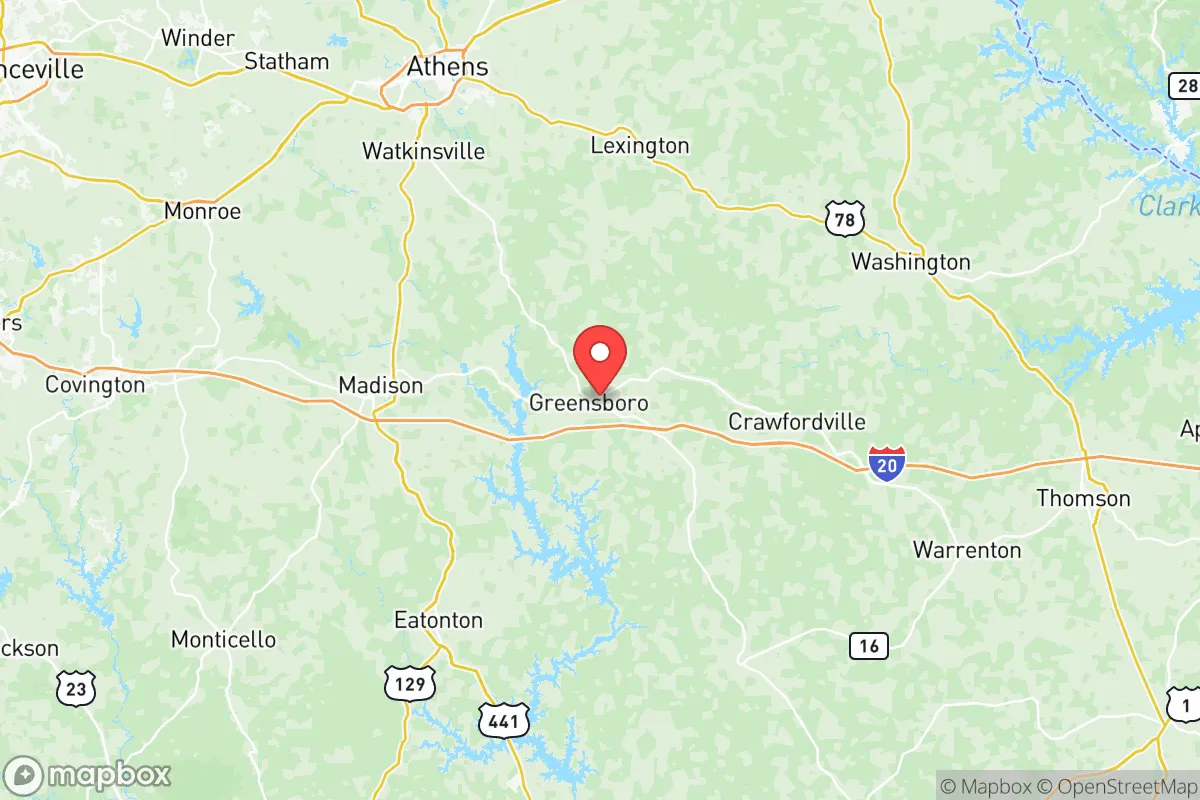
Greene County, Georgia offers a notably high degree of personal sovereignty, grounded in a state-level legal framework that prioritizes limited government, strong property rights, and individual autonomy. Located roughly 75 miles east of Atlanta, the county blends rural self-reliance with a growing exurban population, creating an environment where residents can exercise significant control over their daily lives. The county’s political climate leans conservative, with local officials generally favoring low taxes, minimal regulatory interference, and a hands-off approach to personal choices, making it a compelling option for those who value independence over convenience.
Tax burden and regulatory posture in Greene County
Georgia’s state-level tax structure is among the most favorable for personal sovereignty in the Southeast, and Greene County aligns closely with that philosophy. The state has a flat income tax rate of 5.49% as of 2026, with no local income tax, and the county’s property tax millage rate is relatively low—around 12.5 mills for the unincorporated area, compared to higher rates in nearby metro counties like Clarke (Athens) or Fulton (Atlanta). The county’s regulatory posture is light-touch: there is no county-wide zoning in most unincorporated areas, meaning residents in places like Greensboro (the county seat) and Union Point can build structures, keep livestock, or operate home-based businesses without extensive permitting. However, the town of Greensboro itself has a modest zoning code for commercial and residential density, while Siloam and Woodville maintain even fewer restrictions. Business licensing is straightforward, and the county does not impose additional sales taxes beyond the state’s 4% and the local option sales tax (LOST) of 2%, totaling 6%—lower than many Georgia counties. This regulatory environment allows residents to pursue economic self-sufficiency without bureaucratic hurdles.
Self-defense and gun law specifics in Greene County
Georgia is a constitutional carry state, and Greene County fully embraces that framework. As of 2026, any legal resident 21 or older can carry a concealed firearm without a permit, and open carry is permitted for those with a valid weapons carry license. The county sheriff’s office, led by Sheriff Donnie Harrison, is known for a pro-Second Amendment stance, with no local ordinances restricting firearm possession beyond state law. In Greensboro and Union Point, gun ownership is common, and there are no local magazine capacity bans or waiting periods. The state’s “stand your ground” law applies, meaning residents have no duty to retreat before using deadly force in self-defense if they are lawfully present. For those seeking training, the Greensboro area has multiple private ranges and the Oconee River Gun Club in nearby White Plains. The county’s rural character means that firearm use for hunting and pest control is routine, and local law enforcement rarely interferes with responsible gun owners. This legal environment provides a high degree of personal security autonomy, particularly for those living on larger parcels in areas like Lake Oconee’s outskirts.
Self-reliance and homesteading viability in Greene County
Greene County is one of the more homestead-friendly areas in Georgia, thanks to minimal zoning and affordable land. In unincorporated areas, there are no county-wide restrictions on keeping chickens, goats, or even larger livestock like cattle or horses on parcels as small as one acre. The county’s soil is generally well-suited for gardening, with the Oconee River floodplain providing fertile loam, and the climate supports a long growing season (April through October). Off-grid living is feasible: the county does not require connection to municipal water or sewer in rural areas, and many residents rely on wells and septic systems. Solar panels are permitted without special permits, and the county’s building codes are limited to basic structural safety, not aesthetic or energy mandates. In Siloam and Woodville, land prices are notably lower—often under $5,000 per acre—compared to the lakefront areas near Lake Oconee, where prices can exceed $20,000 per acre. The town of Union Point has a more suburban feel but still allows backyard gardens and small livestock. For those seeking true self-reliance, the northern part of the county, near the Oglethorpe County line, offers larger tracts (10-50 acres) with minimal neighbors and no HOA restrictions. The county’s agricultural exemption for property taxes further supports homesteading, reducing the tax burden on land used for farming or forestry.
Personal liberties in Greene County: parental rights, medical autonomy, speech, and property
Greene County’s personal liberties environment is shaped by Georgia’s broader legal framework, which emphasizes parental rights and property freedom. The state’s “Parents’ Bill of Rights” law, enacted in 2022, gives parents explicit authority over their children’s education, healthcare, and religious upbringing. In practice, this means that schools in the Greene County School District (which includes Greensboro Elementary and Greene County High School) cannot implement policies on gender identity or medical decisions without parental consent. Medical autonomy is similarly strong: Georgia does not have a state-level vaccine mandate for adults, and the county’s healthcare system, anchored by St. Mary’s Good Samaritan Hospital in Greensboro, respects patient choice. Free speech is robust, with no local ordinances restricting public expression, and the county’s public meetings are open and accessible. Property rights are protected by Georgia’s “right to farm” law, which shields agricultural operations from nuisance lawsuits, and the county’s lack of zoning in rural areas means residents can use their land as they see fit—whether for a workshop, a shooting range, or a small business. The only notable limitation is in the Lake Oconee area, where some subdivisions have HOA covenants that restrict exterior modifications or livestock; buyers should check deed restrictions carefully. Overall, the county’s legal culture respects individual choice, with minimal government intrusion into personal decisions.
Compared to other areas in Georgia and the Southeast, Greene County offers a balanced sovereignty profile—stronger on property and self-defense than metro Atlanta or coastal counties, but with fewer off-grid opportunities than more remote areas like Rabun County in the mountains. The county’s proximity to Athens (30 minutes) and Atlanta (90 minutes) provides access to urban amenities without sacrificing personal autonomy. For those prioritizing low taxes, gun rights, and the ability to live self-sufficiently, Greene County ranks among the top choices in the state, particularly for families seeking a conservative, freedom-oriented lifestyle. The key trade-off is that the county’s growth, especially around Lake Oconee, is bringing more development and some HOA restrictions, so early adoption in areas like Siloam or Woodville offers the highest degree of long-term sovereignty.

* Values derived from national, state, county, city and local statistics and may differ in a specific area. Last updated: 2026-08-21T02:24:49.000Z
Narrative content on this page is AI-generated and may contain mistakes. Verify any details that matter before acting on them.
ReloMaps may earn a commission from affiliate links at no extra cost to you.

