
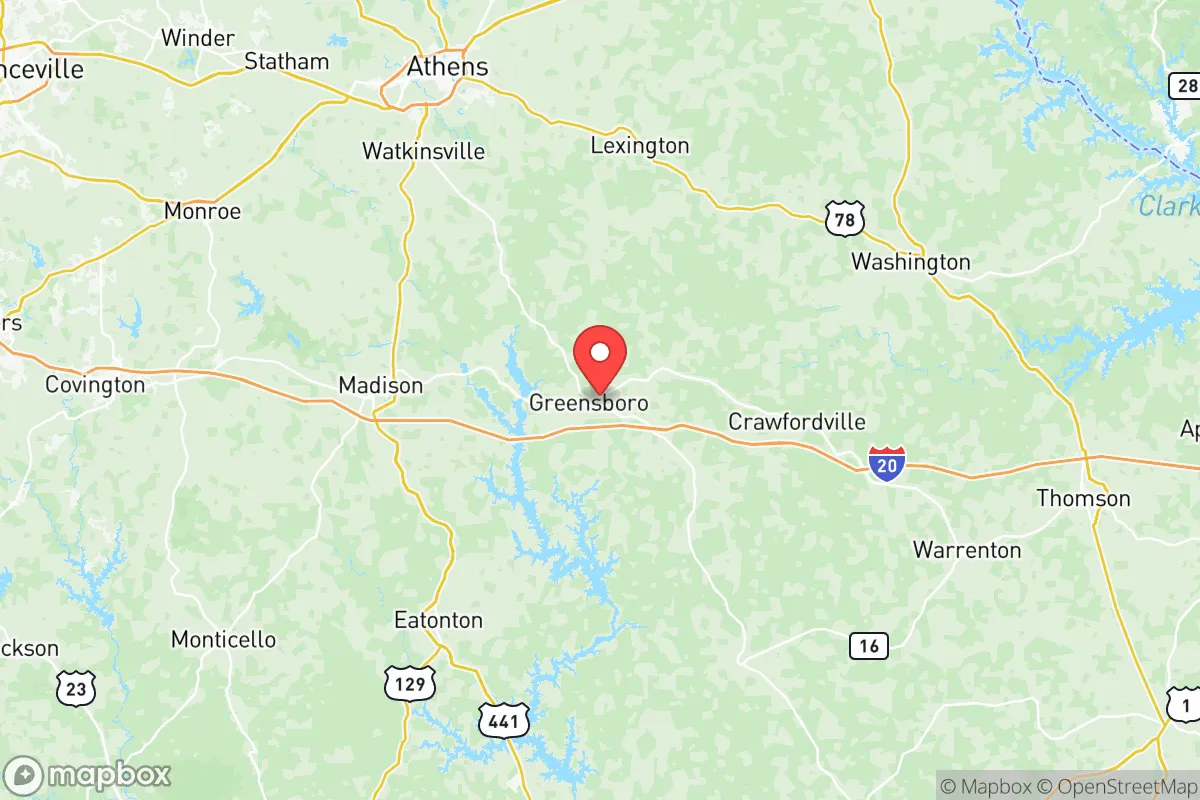
Photo: Wikipedia
Demographics of Greene County
Affluence Level in Greene County
An upper-middle-class area. Household wealth, education levels, and homeownership run ahead of national benchmarks.
People of Greene County
Greene County, Georgia, is a rural community of 19,586 residents where the population is roughly 59% white and 30% Black, with a small but growing Hispanic presence at 6.9%. The county’s character is defined by its deep agricultural roots, the recreational economy of Lake Oconee, and a quiet, family-oriented lifestyle that attracts retirees and second-home owners from metro Atlanta. With only 1.6% foreign-born and a college attainment rate of 36.4%, Greene County remains a predominantly native-born, Southern community where tradition and land ownership are central to local identity.
Settlement & growth (pre-1960)
Long before European settlement, the area that is now Greene County was part of the ancestral homeland of the Creek (Muscogee) Nation, who lived in scattered villages along the Oconee River and its tributaries. The Creeks ceded this land to the state of Georgia in the 1802 Treaty of Fort Wilkinson, opening the territory to white settlement. Greene County was officially created in 1786, named for Revolutionary War General Nathanael Greene, and its earliest white settlers were primarily of Scots-Irish and English descent, migrating from the Virginia and Carolina Piedmont in search of fertile cotton land.
These early settlers established small farming communities such as Greensboro, the county seat, and Union Point, which became a trading hub. The invention of the cotton gin and the expansion of slavery transformed Greene County into a wealthy cotton-producing region by the 1820s and 1830s. Enslaved Black people made up a majority of the county’s population by 1840, working the large plantations that dominated the landscape. After the Civil War and emancipation, many freedmen remained in the area as sharecroppers and tenant farmers, forming the foundation of the county’s enduring Black communities in places like Woodville and White Plains.
From the 1880s through the early 1900s, the railroad spurred modest growth. The Georgia Railroad line connected Greensboro and Union Point to Augusta and Atlanta, allowing local farmers to ship cotton and timber. A small number of German and Irish immigrants arrived to work on the railroad and in the region’s sawmills, but their numbers were never large enough to form distinct ethnic enclaves. The boll weevil infestation of the 1910s and 1920s devastated the cotton economy, leading to a prolonged period of economic stagnation and outmigration, particularly among Black residents who joined the Great Migration northward to cities like Chicago and Detroit.
By 1960, Greene County’s population had fallen to roughly 12,000, a decline from its peak of over 16,000 in 1900. The economy had shifted from cotton to timber, cattle, and small-scale farming. The county remained deeply segregated, with Black residents concentrated in rural pockets and the town of Siloam, while white residents dominated the political and economic life of Greensboro and Union Point.
Modern era (post-1965)
The 1965 Hart-Cellar Act had minimal direct impact on Greene County, as the area attracted very few international immigrants. The foreign-born population remains at just 1.6% today, one of the lowest rates in Georgia. The most significant demographic shift since the 1960s has been domestic: the construction of Lake Oconee in 1979 by Georgia Power created a 19,000-acre reservoir that fundamentally reshaped the county’s economy and population.
The lake drew affluent retirees, second-home buyers, and golf resort developers, particularly to the Lake Oconee shoreline and the gated communities around Reynolds Plantation (now part of the Ritz-Carlton Reynolds). This influx was overwhelmingly white and affluent, raising the county’s median income and home values while creating a sharp economic divide between the lakefront communities and the older inland towns. The Black population, which had been a majority in 1970, declined as a share of the total as white newcomers moved in, falling to roughly 30% by 2020.
Hispanic residents, now 6.9% of the population, began arriving in the 1990s and 2000s, primarily as laborers in construction, landscaping, and the service industries tied to the lake economy. They are concentrated in and around Greensboro and Union Point, often living in mobile home parks and rental housing. East/Southeast Asian residents (1.1%) and Indian-subcontinent residents (0.1%) are present in very small numbers, mostly professionals employed in healthcare or hospitality management. No distinct ethnic enclaves have formed for these groups.
Suburbanization from metro Atlanta has crept into the county’s western edge, with new subdivisions appearing near the I-20 corridor. However, Greene County remains overwhelmingly rural, with no incorporated town exceeding 3,500 residents. The county’s political character has shifted rightward as the lake-area retirees, many from Republican-leaning metro Atlanta suburbs, have joined the traditionally conservative white farming population.
The future
Greene County’s population is projected to grow modestly, driven by continued lakefront development and the expansion of the Augusta-to-Atlanta commuter corridor along I-20. The county is becoming slightly more diverse, with the Hispanic share expected to rise toward 10-12% over the next decade as service-sector jobs multiply. The Black population share is likely to remain stable or decline slightly, as younger Black residents continue to leave for urban job markets in Atlanta and Athens.
The white population will remain the majority, but the cultural divide between lakefront newcomers and long-time inland residents may deepen. The county’s school system, which serves the entire population, is becoming more diverse and faces the challenge of integrating children from affluent lake families with those from lower-income rural households. No major new immigrant enclaves are expected, as the county lacks the industrial or urban job base to attract significant foreign-born populations.
For someone moving in now, Greene County offers a quiet, family-oriented lifestyle with strong community ties, low crime, and access to Lake Oconee’s recreational amenities. The trade-off is limited economic opportunity outside of tourism, construction, and healthcare, and a social landscape that remains sharply divided by race, class, and geography. The county is becoming a more affluent, whiter, and politically conservative place, but its deep-rooted Black communities and small-town Southern character remain intact.

* Values derived from national, state, county, city and local statistics and may differ in a specific area. Last updated: 2026-08-21T02:24:49.000Z
Narrative content on this page is AI-generated and may contain mistakes. Verify any details that matter before acting on them.
ReloMaps may earn a commission from affiliate links at no extra cost to you.

