
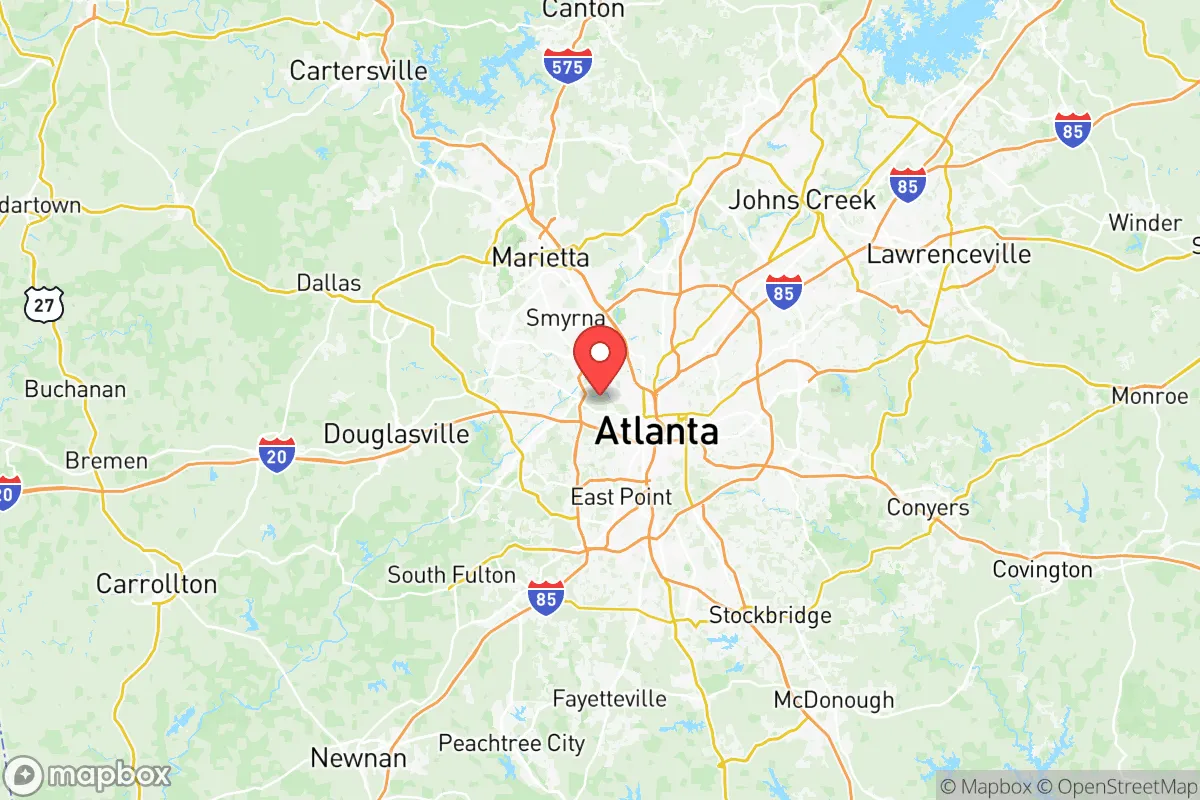
Photo: Wikipedia
Political ClimatePolitical Climate in Fulton County
Showing district-level results — no local-only data available.
Local Political AnalysisPolitical Analysis of Fulton County
Fulton County is the deep-blue heart of Georgia politics, carrying a Cook PVI of D+25 that makes it one of the most reliably Democratic counties in the entire South. That wasn't always the case — as recently as the 1990s, the county was a genuine battleground, but the last two decades have seen a steady and accelerating shift to the left, driven overwhelmingly by the explosive growth of Atlanta's urban core and the diversification of its northern suburbs. In 2024, Kamala Harris carried Fulton by roughly 40 points, a margin that essentially decides statewide elections before the rest of Georgia has finished counting.
How it compares
Comparing Fulton County to the rest of Georgia is almost a study in two different states. While Georgia as a whole has no official Cook PVI, it's widely considered a toss-up or lean-Republican state at the presidential level — Trump won it by 5 points in 2016, Biden flipped it by 0.2 in 2020, and Trump narrowly retook it in 2024. Fulton County, by contrast, votes more like a deep-blue urban county in California or New York. The county's Democratic margin is so large that it single-handedly offsets Republican votes from dozens of rural counties combined. Inside Fulton itself, the political geography is stark: the city of Atlanta and close-in suburbs like Decatur, East Point, and College Park are overwhelmingly blue, often exceeding D+40 margins. Meanwhile, the northern exurbs — places like Milton, Alpharetta, and Johns Creek — are more competitive, with Milton and Johns Creek trending blue in recent cycles but still hosting significant Republican pockets, especially in older neighborhoods and around country clubs. The true swing precincts are in the central-north corridor around Sandy Springs and Dunwoody, where you'll see races decided by single-digit margins in a county that otherwise feels like a Democratic stronghold.
What this means for residents
For liberal residents, living in Fulton County means your vote is part of a reliable bloc that shapes state and national policy. You're represented by Democratic officials at every level — from the county commission to the state legislature to Congress — and local policies reflect that, with robust public transit investment (MARTA expansion), progressive zoning reforms, and strong tenant protections. For conservative residents, the reality is more complicated. You're in a clear minority in countywide elections, which means your preferred candidates rarely win local office. However, that doesn't mean you're without influence: in the northern cities like Milton and Alpharetta, local city councils and school boards often have Republican majorities or strong conservative voices, and those municipalities have pushed back on some county-level initiatives, like density mandates and tax increases. The practical trade-off is that conservatives in Fulton get a high level of public services — excellent parks, well-funded schools in the north, and responsive emergency services — but pay for them through higher property taxes and sales taxes than they'd face in neighboring Cherokee or Forsyth counties.
Culturally, Fulton County is the epicenter of Georgia's progressive shift, but it's not a monolith. The county is home to the Martin Luther King Jr. National Historical Park, the Carter Center, and a thriving LGBTQ+ community centered in Midtown Atlanta, but it also contains deeply traditional Black church communities in Southwest Atlanta and affluent, family-oriented suburbs in the north where the culture is more about soccer games and HOA meetings than political activism. The biggest policy distinction you'll notice living here versus the rest of Georgia is in housing and transportation: Fulton has some of the state's strongest renters' rights ordinances, a county-wide affordable housing trust fund, and a transit system that actually connects suburbs to the city. If you're moving from a redder part of Georgia, the sticker shock on property taxes and the density of development can be jarring — but for many residents, the trade-off is access to the state's best job market, cultural amenities, and a political environment that reflects their values.

State Political ClimatePolitical Climate in Georgia
State Political AnalysisPolitical Environment in the State
Georgia has transformed from a reliably Republican stronghold into the nation’s most competitive swing state over the past two decades, a shift driven by explosive growth in the Atlanta metro and a diversifying electorate. The state’s partisan lean is now a razor-thin margin, with Joe Biden winning by just 0.2% in 2020 and both Senate seats flipping Democratic in 2021, while Republicans still control the governorship and both legislative chambers. This 10-20 year arc has seen the GOP’s dominance in the exurbs and rural areas deepen even as the suburbs and urban core have swung hard to the left, creating a state that is perpetually up for grabs and deeply divided along geographic and demographic lines.
Urban vs. rural divide
The political map of Georgia is a story of three distinct zones. The core of Democratic power is Metro Atlanta, particularly the city itself and the close-in suburban counties of DeKalb, Fulton, Cobb, and Gwinnett. Cobb and Gwinnett, once Republican bastions, flipped decisively blue in the Trump era, driven by an influx of college-educated professionals and a growing Asian-American and Hispanic population. Atlanta itself is overwhelmingly Democratic and progressive, providing a massive vote bank. The second zone is the "Black Belt" stretching across the central and southwestern part of the state, including cities like Albany, Macon, and Augusta, where predominantly African-American populations deliver lopsided Democratic margins. The third and largest zone is rural and exurban Georgia, which has become intensely Republican. The state’s northern mountains and southern wiregrass regions, including areas around Dalton, Gainesville, and Valdosta, vote heavily GOP. The key battlegrounds are now the fast-growing exurbs like Forsyth County (north of Atlanta) and Columbia County (near Augusta), which remain deeply Republican but are seeing slow demographic shifts as Atlanta’s sprawl pushes outward.
Policy environment
Georgia’s state-level policy is firmly conservative, reflecting Republican control of the legislature and governor’s mansion. The state has a flat income tax rate of 5.49%, which is scheduled to drop to 4.99% by 2029 under recent legislation. There is no state-level property tax, but local rates vary significantly. Georgia is a "right-to-work" state with a business-friendly regulatory climate, consistently ranked among the top states for doing business. On education, the state has a robust charter school system and a school choice program that includes tax-credit scholarships, though it does not have a universal voucher program. Healthcare policy is a major point of contention: Georgia has not expanded Medicaid under the Affordable Care Act, leaving a coverage gap for roughly 300,000 low-income adults. The state operates a limited "Pathways to Coverage" program with work requirements. Election laws have been a flashpoint, with the 2021 SB 202 law adding voter ID requirements for absentee ballots, limiting drop boxes, and restricting third-party ballot collection, while also expanding early voting hours in many counties.
Recent policy direction
The last five years have seen Georgia’s legislature move decisively on a range of liberty-related issues that relocators weigh carefully. On gun rights, Georgia is a "constitutional carry" state as of 2022, allowing permitless carry of firearms for legal residents 21 and older. On parental rights and education, the state passed the "Parents’ Bill of Rights" (SB 377) in 2022, codifying parental oversight of curriculum and library materials, and has banned instruction on "divisive concepts" related to race in schools. On speech and privacy, Georgia has no broad shield law for journalists and has seen debates over social media regulation, but has not passed a major state-level privacy law like California’s. On medical and bodily autonomy, Georgia enacted a "heartbeat" abortion ban (HB 481) in 2019, which took effect in 2022 after the Dobbs decision, banning most abortions after roughly six weeks. The law includes exceptions for rape, incest, and to save the mother’s life. On property rights, Georgia is a "title theory" state with strong lender protections, and has no statewide rent control (which is preempted by state law). On voting and ballot access, the 2021 SB 202 law shortened the runoff election period from nine weeks to four, added a photo ID requirement for absentee ballots, and made it a crime to hand out food or water to voters waiting in line. These policies collectively signal a state that is moving right on cultural and regulatory issues, even as its electoral politics tighten.
Civil unrest & political movements
Georgia has been a focal point for national political movements on both sides. The 2020 election cycle saw massive "Stop the Steal" protests in Atlanta and at the state capitol, culminating in the January 2021 Senate runoff elections that drew national attention. On the left, the 2020 George Floyd protests in Atlanta were among the largest in the country, leading to significant property damage and a heavy police response, including the deployment of the Georgia National Guard. The state has seen organized activism around voting rights, with groups like Fair Fight Action (founded by Stacey Abrams) and the New Georgia Project focusing on voter registration and turnout, particularly in communities of color. Immigration politics are less visible than in border states, but the 2018 "Sanctuary City" controversy saw the state legislature pass HB 452, which penalizes local governments that adopt sanctuary policies by withholding state funding. Clayton County and the city of Atlanta have been the most vocal in resisting cooperation with federal immigration enforcement. Election integrity remains a live issue, with ongoing litigation over the 2021 voting law and continued claims of fraud from some Republican activists, though no evidence of widespread fraud has been found in any court. A new resident would notice the political polarization most acutely in the Atlanta suburbs, where yard signs and bumper stickers are common, and in the stark contrast between the political culture of metro Atlanta and the rest of the state.
Projection
Over the next 5-10 years, Georgia is likely to remain a competitive swing state, but the trajectory favors Democrats in presidential elections due to continued in-migration of college-educated and diverse populations to the Atlanta suburbs. The state is adding roughly 100,000 new residents per year, with most settling in the metro area. However, Republicans are likely to maintain control of the state legislature through 2030 due to gerrymandering and the concentration of Democratic voters in a few urban counties. The wild card is the exurban and rural vote: if the GOP continues to consolidate these areas while Democrats fail to turn out their base in non-presidential years, the state could remain bifurcated — blue in presidential races, red in state-level contests. A relocator moving in now should expect to live in a state where the political culture is deeply divided, where the Atlanta metro becomes more progressive and diverse, and where rural and exurban areas become more conservative and culturally homogeneous. The policy environment at the state level will likely remain conservative, with incremental moves on tax cuts, school choice, and cultural issues, while the cities and inner suburbs will continue to push in the opposite direction on housing, transit, and social policy.
For a new resident, the bottom line is that Georgia offers a genuinely mixed political experience. If you are conservative, you will find a state government that largely reflects your values on taxes, guns, and education, and you will have plenty of like-minded communities in the exurbs and rural areas. If you are liberal, you will find a vibrant and growing progressive coalition in Atlanta and its inner suburbs, with a city government that is among the most progressive in the South. The practical takeaway is that your daily experience of politics in Georgia will depend almost entirely on which county you choose to live in, and that the state’s national importance means you will never be far from the political spotlight. Choose your county carefully, because in Georgia, your local government and school board will often feel more consequential than the statehouse.
* Values derived from national, state, county, city and local statistics and may differ in a specific area. Last updated: 2026-07-08T02:38:01.000Z
Narrative content on this page is AI-generated and may contain mistakes. Verify any details that matter before acting on them.
ReloMaps may earn a commission from affiliate links at no extra cost to you.

