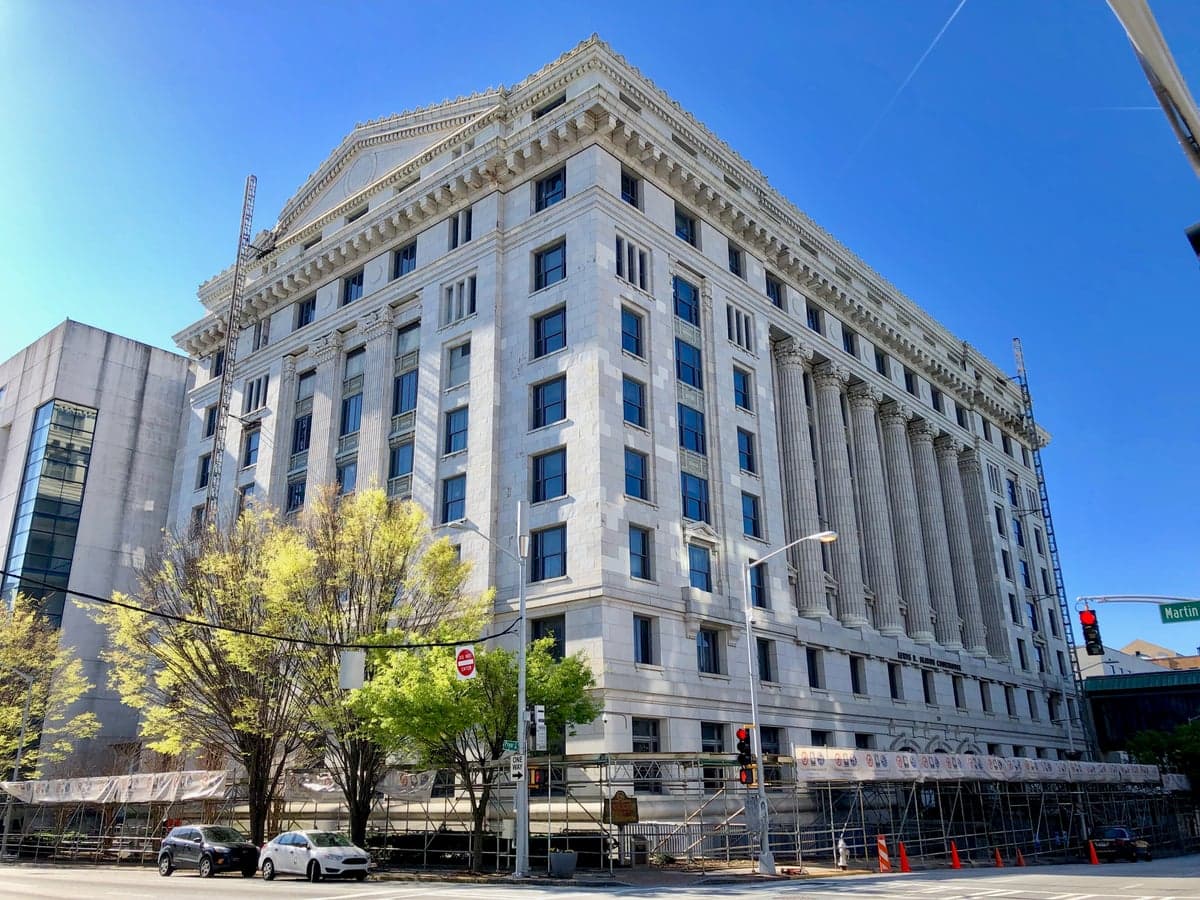
Photo: Wikipedia
Demographics of Fulton County
Affluence Level in Fulton County
A middle-class area roughly in line with national averages across income, home values, education, and employment.
People of Fulton County
Fulton County, Georgia is home to over 1 million residents, making it the most populous county in the state and the anchor of the Atlanta metropolitan area. Its population is characterized by a Black majority (42.6%), a substantial White population (37.4%), and growing Hispanic (8.1%) and Asian (3.5%) communities, alongside a notable Indian-subcontinent population (4.1%). With 58% of adults holding a college degree, Fulton County is a highly educated, economically dynamic hub where historic Southern roots intersect with modern global migration, creating a dense, diverse, and politically influential urban-suburban corridor.
Settlement & growth (pre-1960)
Long before European settlement, the area now known as Fulton County was inhabited by the Creek and Cherokee nations, who used the land for hunting and established trails that later became key transportation routes. The first European settlers were primarily of English and Scots-Irish descent, arriving in the late 1820s and 1830s after the forced removal of Native peoples via the Trail of Tears. These early settlers established small farming communities and trading posts, with the most significant being the settlement that grew into Atlanta, originally named Terminus in 1837 as the endpoint of the Western & Atlantic Railroad.
The railroad's arrival triggered Fulton County's first major population wave. By the 1840s and 1850s, the area attracted a mix of white Southern farmers, merchants, and skilled laborers, as well as enslaved African Americans who were forcibly brought to work on plantations and later in the growing rail and cotton industries. After the Civil War and Reconstruction, the county's population surged as freed African Americans moved into Atlanta and surrounding areas like Roswell and East Point, seeking economic opportunity and establishing vibrant communities such as the historic Sweet Auburn district in Atlanta, which became a center of Black commerce and culture.
The early 20th century brought a second major wave: the Great Migration. Between 1910 and 1960, hundreds of thousands of African Americans from the rural Deep South moved to Fulton County, particularly to Atlanta, College Park, and Hapeville, drawn by industrial jobs in textile mills, railroads, and the emerging Coca-Cola and Delta Air Lines headquarters. This period also saw an influx of white Appalachians and rural Georgians seeking work in the city's expanding manufacturing and service sectors. By 1960, Fulton County's population had grown to over 600,000, with a significant Black minority and a white majority that was increasingly suburbanizing into areas like Sandy Springs and Buckhead.
Modern era (post-1965)
The 1965 Hart-Cellar Act fundamentally reshaped Fulton County's demographics. While the county had long been a destination for domestic migrants, the post-1965 era opened the door to significant international immigration. The first major new groups were East and Southeast Asian communities, particularly Chinese, Korean, and Vietnamese immigrants, who began settling in the 1970s and 1980s. Many were drawn by professional opportunities in Atlanta's booming tech, healthcare, and academic sectors, with a notable concentration forming in Johns Creek and the northern suburbs of Alpharetta and Milton, areas that now have substantial East Asian populations.
Simultaneously, the Indian-subcontinent population began to grow rapidly after 1990, driven by the expansion of Atlanta's IT, pharmaceutical, and engineering industries. Today, Indian Americans make up 4.1% of Fulton County's population, with a strong presence in Johns Creek and Alpharetta, where Indian-owned businesses, temples, and cultural centers are prominent. The Hispanic population, now 8.1% of the county, grew steadily from the 1990s onward, with Mexican, Central American, and Puerto Rican communities settling in Atlanta's Buford Highway corridor and in southern Fulton County areas like Union City and Fairburn, drawn by construction, hospitality, and service jobs.
Domestic migration also continued to reshape the county. The 1970s through 2000s saw a significant "white flight" from Atlanta's city limits to northern suburbs like Sandy Springs, Roswell, and Alpharetta, a trend that reversed somewhat after 2010 as young professionals and empty-nesters began moving back into intown neighborhoods like Midtown and Old Fourth Ward. Meanwhile, the Black population, which had long been concentrated in southern Fulton and Atlanta's southwest side, began to suburbanize into areas like South Fulton (a city formed in 2017) and College Park, creating a new wave of Black-majority suburbs. The county's foreign-born population stands at 6.7%, a figure that understates the cultural impact of these communities, which have transformed Fulton into a genuinely global hub.
The future
Fulton County is projected to become more diverse and more educated over the next two decades. The non-Hispanic white share is expected to continue its gradual decline, while the Hispanic and Asian populations are likely to grow, driven by both immigration and higher birth rates. The Indian-subcontinent community, already a significant 4.1%, is poised for further expansion as Atlanta's tech and biotech sectors attract skilled professionals from India. The Black population, while remaining the largest single group, may see its share stabilize or slightly decrease as other groups grow faster.
Geographically, the county is experiencing a dispersal of new communities. The northern suburbs—Johns Creek, Alpharetta, and Milton—are becoming increasingly diverse, with growing Asian and Indian populations alongside white and Black residents. Southern Fulton, including Union City and Fairburn, is seeing a rise in Hispanic and Black families seeking more affordable housing. Intown Atlanta is attracting a mix of young professionals, empty-nesters, and international migrants, driving a resurgence of urban density. The county's cultural identity is evolving from a historically Black-white binary into a multi-ethnic, multi-racial mosaic, with new festivals, restaurants, and religious institutions reflecting this shift.
For someone moving in now, Fulton County offers a dynamic, fast-changing environment where opportunity is high but affordability is a growing challenge, especially in the northern suburbs and intown neighborhoods. The county's future is one of increasing complexity—more diverse, more educated, and more connected to global flows of people and capital, but also facing the pressures of gentrification, traffic congestion, and the need to integrate new arrivals into a historically Southern social fabric.

* Values derived from national, state, county, city and local statistics and may differ in a specific area. Last updated: 2026-07-08T02:38:01.000Z
Narrative content on this page is AI-generated and may contain mistakes. Verify any details that matter before acting on them.
ReloMaps may earn a commission from affiliate links at no extra cost to you.

