
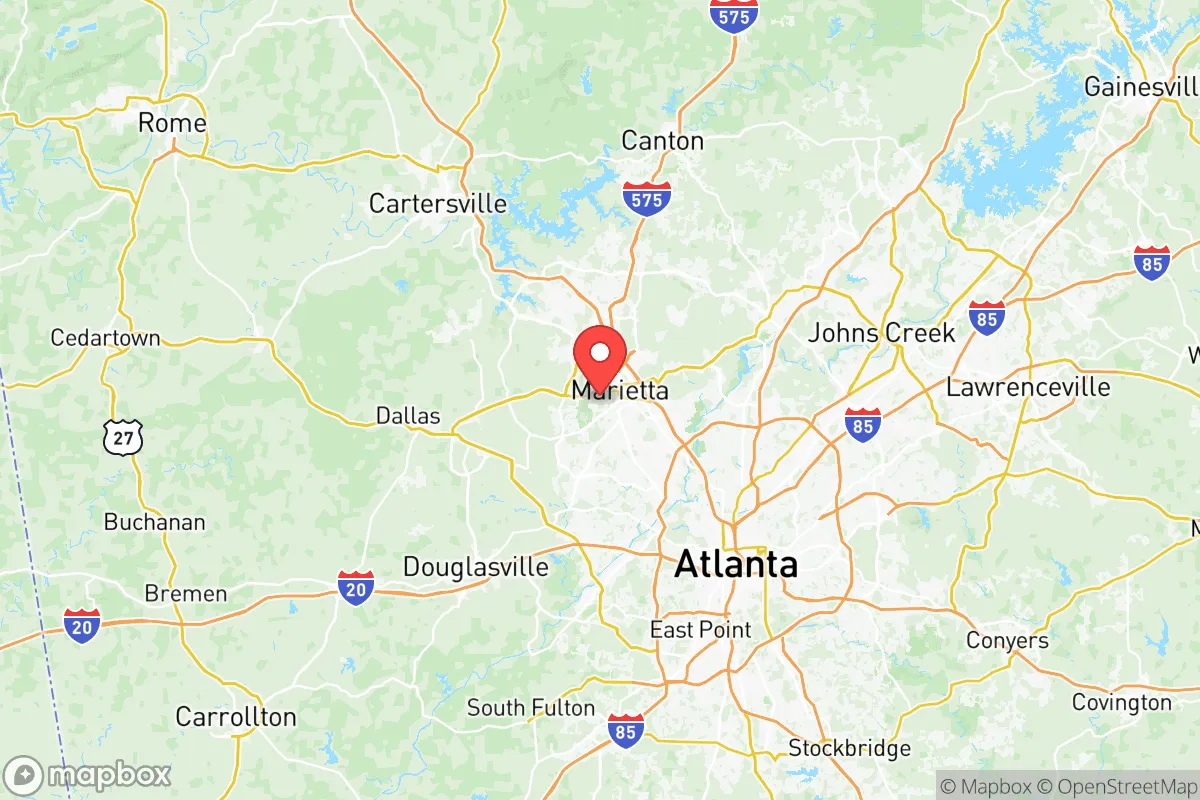
Photo: Wikipedia
Political ClimatePolitical Climate in Cobb County
Showing district-level results — no local-only data available.
Local Political AnalysisPolitical Analysis of Cobb County
Cobb County has undergone a dramatic political transformation over the past decade, shifting from a reliable conservative stronghold to a competitive battleground that still leans right but is increasingly purple. The Cook Partisan Voting Index (PVI) rates Cobb at R+12, meaning it votes 12 points more Republican than the national average, but that number masks a fast-moving trend. In 2012, Mitt Romney carried Cobb by 13 points; by 2020, Joe Biden won it by 14 points. That’s a 27-point swing in just eight years, driven largely by explosive growth in the southern and eastern parts of the county, particularly around Smyrna, Vinings, and the Cumberland/Galleria area, where transplants from blue states and younger professionals have reshaped the electorate. Meanwhile, the state of Georgia as a whole sits at a Cook PVI of EVEN, reflecting its own shift from solid red to a true toss-up, but Cobb’s trajectory has been even more pronounced and is a bellwether for the state’s future.
How it compares
Compared to Georgia’s statewide EVEN rating, Cobb County is still notably more Republican-leaning on paper, but the gap is closing fast. The key difference is internal geography: northern Cobb—places like Kennesaw, Acworth, and parts of Marietta—remains deeply conservative, with precincts routinely voting 65-70% Republican. These are the areas where you’ll find strong support for Second Amendment rights, school choice, and limited government. In contrast, south Cobb, including Mableton, Austell, and the Powder Springs corridor, has become a Democratic stronghold, driven by a growing minority population and younger families priced out of Atlanta. The swing precincts are in central Cobb, around East Cobb and the Marietta city limits, where moderate suburbanites are increasingly voting split-ticket—Republican for local races, Democrat for national ones. That’s a huge shift from even ten years ago, when Cobb was a lock for GOP candidates up and down the ballot. The state, meanwhile, has seen its own suburban shift in metro Atlanta counties like Gwinnett and Henry, but Cobb’s internal divide is starker because of its size and the sheer speed of demographic change.
What this means for residents
For longtime residents who remember when Cobb was the heart of conservative Georgia, the change feels jarring. The county commission flipped to Democratic control in 2020, and with it came a wave of progressive policies that many locals see as government overreach. The most contentious issue has been the county’s push for stricter zoning and land-use regulations, which critics argue limits property rights and drives up housing costs. There’s also been a steady expansion of county-level bureaucracy, from diversity initiatives to climate action plans, that feels out of step with the values of many in north Cobb. On the flip side, the tax burden remains relatively low compared to neighboring Fulton County, and the school system—while facing pressure over curriculum debates—still offers strong options for families who want to avoid Atlanta Public Schools. The real concern for conservative residents is the trajectory: if current trends hold, Cobb could flip to a solidly blue county within the next two election cycles, bringing with it the same kind of one-party rule that many fled Atlanta to escape.
Culturally, Cobb still feels more Southern and family-oriented than intown Atlanta, but the policy battles are intensifying. Kennesaw’s long-standing ordinance requiring heads of households to own a firearm remains on the books, a symbolic stand for Second Amendment rights that would never survive in a fully progressive county. Marietta’s historic square still hosts conservative rallies, while Smyrna’s Market Village feels increasingly like a Brooklyn transplant hub. The bottom line: if you value personal freedoms, low taxes, and a government that stays out of your life, northern Cobb is still a great bet, but you need to pay close attention to local elections—because the county-level shift is real, and it’s accelerating. The next few years will determine whether Cobb remains a place where conservative values can thrive or becomes another Atlanta suburb where progressive policies are the new normal.

State Political ClimatePolitical Climate in Georgia
State Political AnalysisPolitical Environment in the State
Georgia is a true battleground state, with a Cook PVI of EVEN, meaning it is perfectly split between the two major parties after a dramatic 20-year shift. The state has moved from a reliably Republican stronghold—where George W. Bush won by 17 points in 2004—to a dead-even toss-up by 2020, when Joe Biden narrowly carried it by 0.2%. This swing has been driven by explosive growth in the Atlanta metro area, particularly in the diverse, highly-educated suburbs of Cobb, Gwinnett, and Henry counties, which have flipped from red to blue. Meanwhile, the rest of the state—from the rural pine forests of South Georgia to the conservative exurbs north of Atlanta—has remained deeply Republican, creating a stark urban-rural divide that defines every election.
Urban vs. rural divide
The political map of Georgia is a tale of two Georgias. The Atlanta metro, home to roughly 60% of the state’s population, is the engine of Democratic growth. Inside the Perimeter (ITP) neighborhoods like Buckhead, Midtown, and Decatur are overwhelmingly liberal, but the real shift has been in the once-suburban, now-diverse counties ringing the city. Gwinnett County, which voted for Mitt Romney by 10 points in 2012, flipped to Hillary Clinton in 2016 and gave Biden a 14-point margin in 2020. Cobb County, a former GOP stronghold, has followed the same trajectory. South of Atlanta, Henry County and Clayton County are reliably blue, driven by African American and suburban voters. Outside the metro, the political landscape is solidly red. Rural South Georgia counties like Brooks, Colquitt, and Tift routinely vote 70-80% Republican, while the exurban ring north of Atlanta—Cherokee, Forsyth, and Pickens counties—is among the most conservative territory in the country. The only other blue pockets are the college towns of Athens (home to UGA) and Savannah, plus the small city of Macon, which leans Democratic. This geographic split means that statewide races are decided by turnout in the Atlanta suburbs, making those counties the most contested ground in American politics.
Policy environment
Georgia’s policy environment is a mixed bag for conservatives. On the positive side, the state has a flat income tax rate of 5.39% (down from 6% in 2022, with a scheduled decline to 4.99% by 2029), no estate tax, and a relatively business-friendly regulatory climate. Governor Brian Kemp and the Republican legislature have passed significant tort reform and kept the state a right-to-work state. However, the state’s education policy is a flashpoint. Georgia has a robust school voucher program (the Georgia Promise Scholarship Act, passed in 2024) that allows students in low-performing schools to use state funds for private school, but the state also has a powerful teachers’ union and a Department of Education that has resisted parental rights legislation. On healthcare, Georgia did not expand Medicaid under the Affordable Care Act, but Kemp’s “Georgia Pathways” program, which requires work or community engagement for coverage, has been slow to enroll. Election laws have been a major battleground: the 2021 Election Integrity Act (SB 202) tightened voter ID requirements, limited drop boxes, and banned mobile voting, drawing fierce criticism from the left but support from conservatives who see it as necessary for security. The state also has a permitless carry law (HB 218, passed in 2022), allowing legal gun owners to carry concealed firearms without a license—a major win for Second Amendment advocates.
Trajectory & freedom
Georgia’s trajectory on personal freedom is a tug-of-war. On the plus side, the state has expanded gun rights significantly, as noted, and passed a parental rights bill (HB 1178) in 2023 that requires schools to notify parents of any changes to a student’s mental, emotional, or physical health—a direct response to the transgender movement in schools. The state also banned gender-affirming care for minors (SB 140) in 2023, a move that has been challenged in court but remains in effect. Property rights are strong, with no statewide rent control and a relatively low property tax burden (average effective rate around 0.87%). However, there are concerning trends. Atlanta’s city government has become increasingly progressive, passing a “sanctuary city” ordinance in 2023 that limits cooperation with federal immigration enforcement, though state law (HB 87, passed in 2011) prohibits such policies. The city has also raised its minimum wage for city contractors to $15/hour and pursued aggressive zoning changes to promote density. On medical freedom, Georgia did not impose strict COVID-19 vaccine mandates at the state level, but many private employers and Atlanta’s city government did. The biggest threat to freedom, from a conservative perspective, is the demographic shift: the Atlanta metro’s growth is overwhelmingly from domestic migration of left-leaning professionals and international immigration, which is slowly turning the state blue. If current trends hold, Georgia could become a solidly Democratic state within a decade, which would likely bring higher taxes, more regulation, and a less friendly environment for traditional values.
Civil unrest & political movements
Georgia has been a hotspot for political activism on both sides. The 2020 election cycle saw massive protests in Atlanta following the murder of George Floyd, with the city experiencing several nights of rioting, arson, and looting that damaged the historic Sweet Auburn district and the CNN Center. The “Stop Cop City” movement, which opposes the construction of a police training facility in DeKalb County, has led to violent clashes between activists and law enforcement, including the fatal shooting of a protester in 2023. On the right, the state has a strong grassroots conservative movement, with groups like the Georgia Republican Assembly and the Georgia Gun Owners pushing for more restrictive immigration laws and election integrity measures. Immigration politics are particularly heated in the Atlanta suburbs, where the Hispanic population has grown rapidly—Gwinnett County is now 20% Hispanic—leading to tensions over sanctuary policies and driver’s licenses for undocumented immigrants. Election integrity remains a live issue: the 2020 election saw a hand recount and multiple lawsuits, and the 2021 voting law was passed in response to widespread distrust among conservatives. A new resident would notice the political polarization in everyday life—yard signs, bumper stickers, and heated conversations at coffee shops are common, especially in the swing suburbs of Cobb and Gwinnett.
Projection
Over the next 5-10 years, Georgia is likely to continue its slow drift toward the Democratic column, driven by the Atlanta metro’s growth. The 2024 election will be a key test: if Trump wins the state again, it may slow the trend, but if Biden or another Democrat holds it, the state will be considered a lean-blue battleground. The most likely scenario is that Georgia remains a toss-up for the next two cycles, with the outcome determined by turnout in the Atlanta suburbs and the rural vote. The state’s in-migration is heavily from blue states like California, New York, and Illinois, which will continue to shift the electorate leftward. However, the exurban and rural areas are also growing, and the state’s Republican legislature is likely to continue passing conservative laws on guns, abortion, and education, creating a policy environment that is increasingly out of step with the Atlanta metro’s values. A new resident moving to Georgia in 2026 should expect a state that is politically divided, with a Republican state government that is fighting to hold the line against progressive encroachment, but with a growing Democratic presence that will make every election a nail-biter.
For a conservative considering a move to Georgia, the bottom line is this: the state offers a relatively low-tax, gun-friendly, and business-friendly environment, but you must be prepared for a political war zone. If you live in the Atlanta suburbs, you will be in the epicenter of the national political battle, with all the activism, protests, and polarization that entails. If you choose a rural or exurban county like Forsyth, Cherokee, or Harris, you can enjoy a deep-red community with strong schools and low crime, but you will still be subject to state-level policies that are increasingly contested. Georgia is not a safe red state like Alabama or Mississippi—it is a battleground where your vote truly matters, and where the outcome of the next decade will determine whether the state remains a bastion of conservative governance or becomes another California-style progressive experiment. Choose your county carefully, and get involved.
* Values derived from national, state, county, city and local statistics and may differ in a specific area. Last updated: 2026-05-12T08:57:48.000Z
Narrative content on this page is AI-generated and may contain mistakes. Verify any details that matter before acting on them.
ReloMaps may earn a commission from affiliate links at no extra cost to you.

