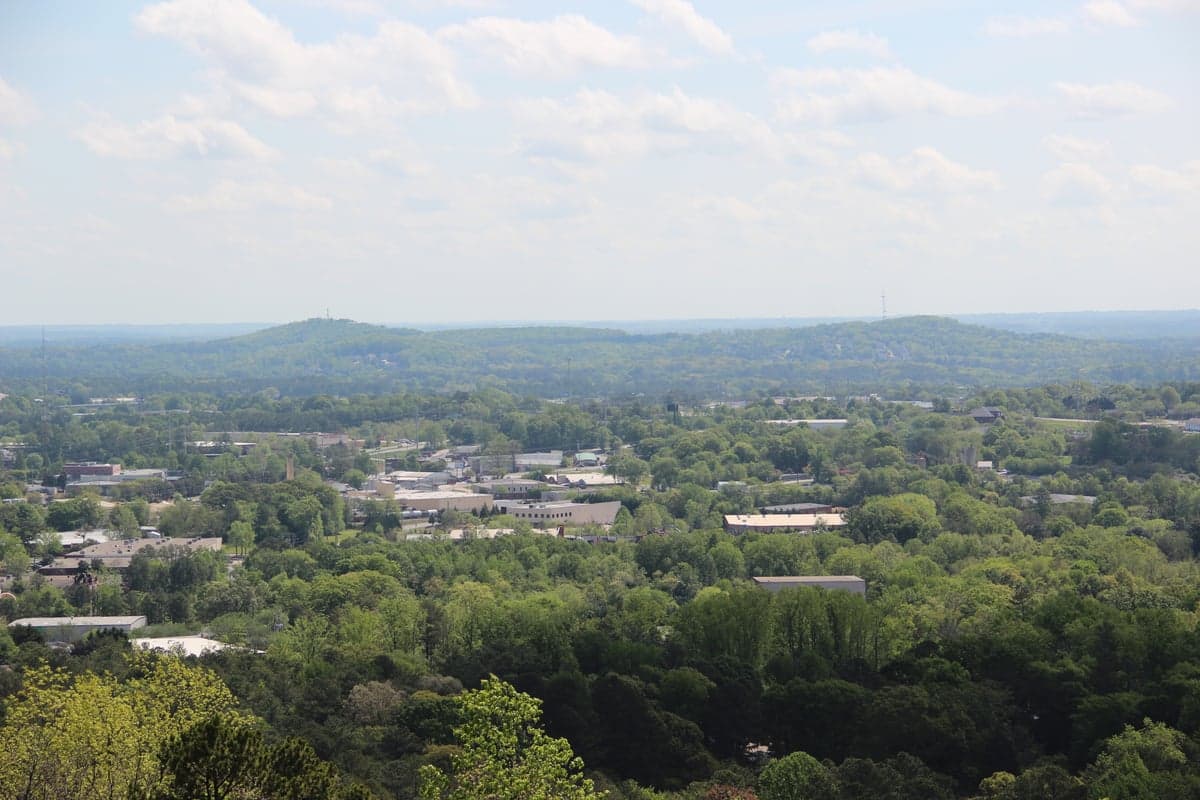
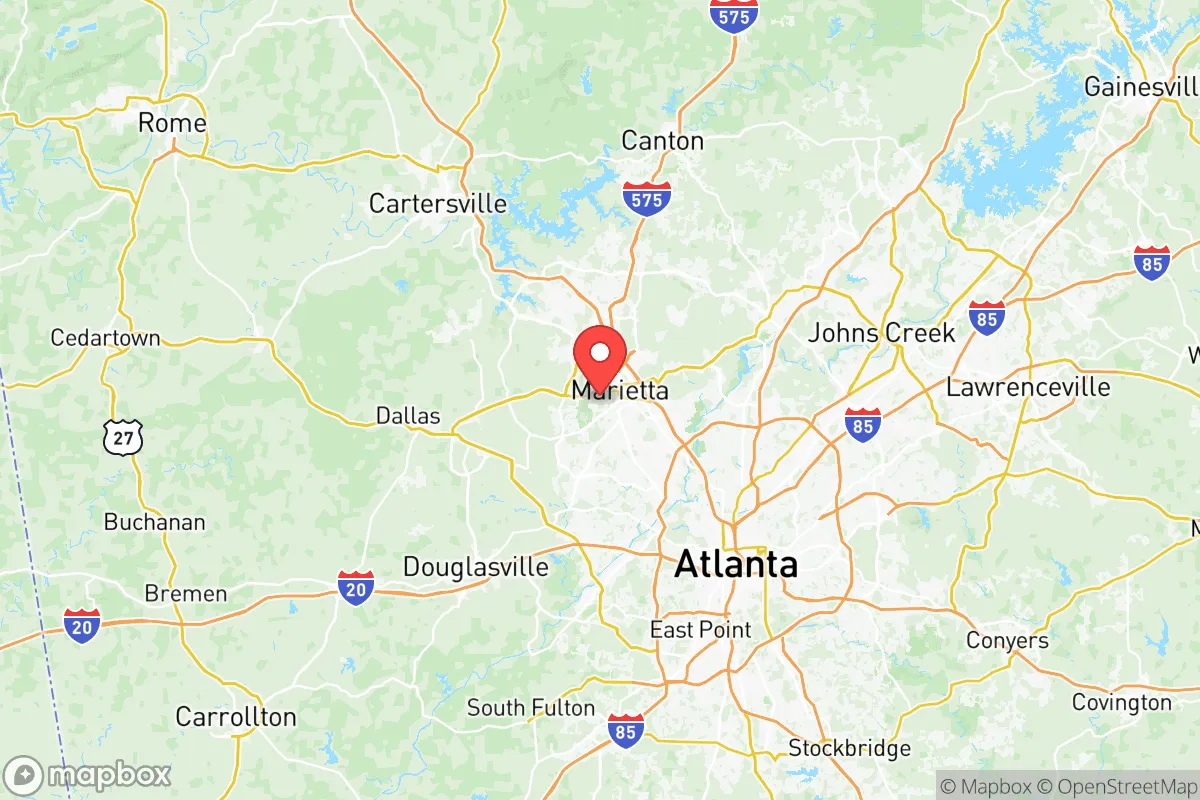
Photo: Wikipedia
Demographics of Cobb County
Affluence Level in Cobb County
An upper-middle-class area. Household wealth, education levels, and homeownership run ahead of national benchmarks.
People of Cobb County
Cobb County today is a densely populated, economically powerful suburban core of metro Atlanta, home to 769,152 residents who represent a striking blend of the Old South, the Sun Belt boom, and a rapidly diversifying immigrant gateway. Its character is defined by a white plurality of 47.8%, a substantial Black population of 26.5%, a growing Hispanic community at 14.7%, and notable Asian and Indian populations of 2.3% and 3.0% respectively. With over half of adults holding a college degree, Cobb is a highly educated, politically competitive county where historic Southern roots coexist with the modern, globalized economy of the Atlanta region.
Settlement & growth (pre-1960)
Before American settlement, the land that is now Cobb County was the heartland of the Cherokee Nation. The Cherokee had established towns, farms, and a written language here, with key settlements like Sand Town (near present-day Smyrna) and along the banks of the Chattahoochee River. This era ended abruptly with the forced removal of the Cherokee on the Trail of Tears in the 1830s, followed by a land lottery that opened the territory to white settlers.
The first major wave of American settlers were primarily of Scots-Irish and English stock, migrating from the older Piedmont regions of Virginia and the Carolinas in the 1830s and 1840s. They were drawn by the promise of cheap, fertile land for cotton cultivation. These families established the county seat of Marietta in 1834, along with smaller farming hamlets like Powder Springs and Acworth. The arrival of the Western & Atlantic Railroad in the 1840s transformed Marietta into a regional market town and a summer retreat for coastal planters fleeing malaria.
The Civil War devastated the county, with the 1864 Battle of Kennesaw Mountain leaving much of the area burned and depopulated. The post-Reconstruction period saw a slow recovery based on agriculture and small-scale manufacturing. A notable influx during this time was the arrival of freed African Americans, who established communities like the Marietta's Zion Hill neighborhood and rural settlements in the southern part of the county. These families worked as sharecroppers, laborers, and later as domestic workers and small business owners, forming the foundation of Cobb's Black population.
The 20th century brought two transformative changes. First, the Great Depression and New Deal spurred the construction of the Bell Bomber Plant (later Lockheed Martin) in Marietta in 1942. This massive factory drew tens of thousands of workers from across the rural South—both white and Black—for wartime manufacturing jobs. After the war, Lockheed remained a permanent anchor employer. Second, the post-war suburban boom, fueled by the 1950s construction of Interstate 75 and the expansion of Atlanta's white-collar economy, began to pull middle-class families into new subdivisions in Smyrna and East Cobb. This wave was overwhelmingly white and native-born, establishing the county's reputation as a prosperous, conservative, and largely homogeneous suburb.
Modern era (post-1965)
The 1965 Hart-Cellar Act and the subsequent rise of Atlanta as a global business hub fundamentally reshaped Cobb County's population. The first major post-1965 shift was the acceleration of domestic migration. From the 1970s through the 1990s, Cobb became a primary destination for white families leaving the city of Atlanta (white flight) and for corporate transferees from the Northeast and Midwest. This period saw explosive growth in Kennesaw and Woodstock, which transformed from small railroad towns into sprawling bedroom communities. The county's population more than doubled between 1970 and 2000, cementing its identity as a quintessential Sun Belt suburb.
Simultaneously, the Black population began to grow significantly, driven by two streams: the continued suburbanization of Atlanta's established Black middle class, and new migration from other Southern states. By the 2000s, areas like South Cobb (including parts of Mableton and Austell) and the Marietta city limits had become majority-Black or heavily Black, creating a distinct demographic geography where the county's southern half is far more diverse than its northern half.
The most dramatic recent change has been the surge in Hispanic and Asian immigration. The Hispanic population, now 14.7%, began arriving in the 1990s, drawn by construction, landscaping, and service jobs in the booming Atlanta economy. The primary enclave formed in Marietta, particularly along the Franklin Road corridor and in the Fair Oaks area, where Mexican and Central American families established a dense network of tiendas, churches, and restaurants. A smaller but significant Hispanic community also grew in Smyrna.
The Asian and Indian populations, while smaller in share, are highly concentrated and economically influential. East and Southeast Asian communities (2.3% of the county) are centered in East Cobb, particularly around the Walton High School and Pope High School clusters, where Chinese, Korean, and Vietnamese families have been drawn by top-ranked schools and tech jobs. The Indian subcontinent population (3.0%) is similarly concentrated in East Cobb and the Marietta area, with a notable presence in the professional and medical sectors. These groups arrived primarily after 2000, recruited by Atlanta's booming IT, biotech, and finance industries.
The future
Cobb County is not homogenizing; it is tribalizing into distinct, self-reinforcing enclaves. The northern half (East Cobb, Kennesaw, Acworth) is trending whiter and more affluent, with a growing but assimilated Asian and Indian professional class. The southern half (Mableton, Austell, South Marietta) is becoming more Black and Hispanic, with lower median incomes and a more working-class character. The Hispanic community is the fastest-growing demographic segment, projected to approach 20% of the county by 2035, and is likely to expand geographically from its Marietta base into Smyrna and South Cobb. The white population, while still the largest group, is declining in share as the county diversifies from below.
In-migration from other states continues, but the source has shifted. The old wave of Rust Belt and Northeastern white families has slowed; the new domestic migrants are more likely to be Black professionals from other Southern states or Hispanic families from California and Texas. International immigration, particularly from India and East Asia, is likely to remain steady but will not rival the scale of Hispanic growth. The county's cultural identity is becoming a contested space between its conservative, white suburban heritage and its increasingly diverse, Democratic-leaning present.
For someone moving in now, Cobb County offers a choice of distinct communities rather than a single character. East Cobb provides top-tier schools and a stable, affluent environment with growing Asian and Indian influence. South Cobb offers more affordable housing and a deeply multicultural, working-class atmosphere. Marietta city itself is a political and cultural battleground, balancing historic preservation with rapid Hispanic growth. The county as a whole is becoming a more complex, stratified place—less the homogeneous conservative suburb of the 1980s, and more a microcosm of the new American Sun Belt, where prosperity and diversity coexist with sharp geographic and economic divides.

* Values derived from national, state, county, city and local statistics and may differ in a specific area. Last updated: 2026-05-12T08:57:48.000Z
Narrative content on this page is AI-generated and may contain mistakes. Verify any details that matter before acting on them.
ReloMaps may earn a commission from affiliate links at no extra cost to you.

