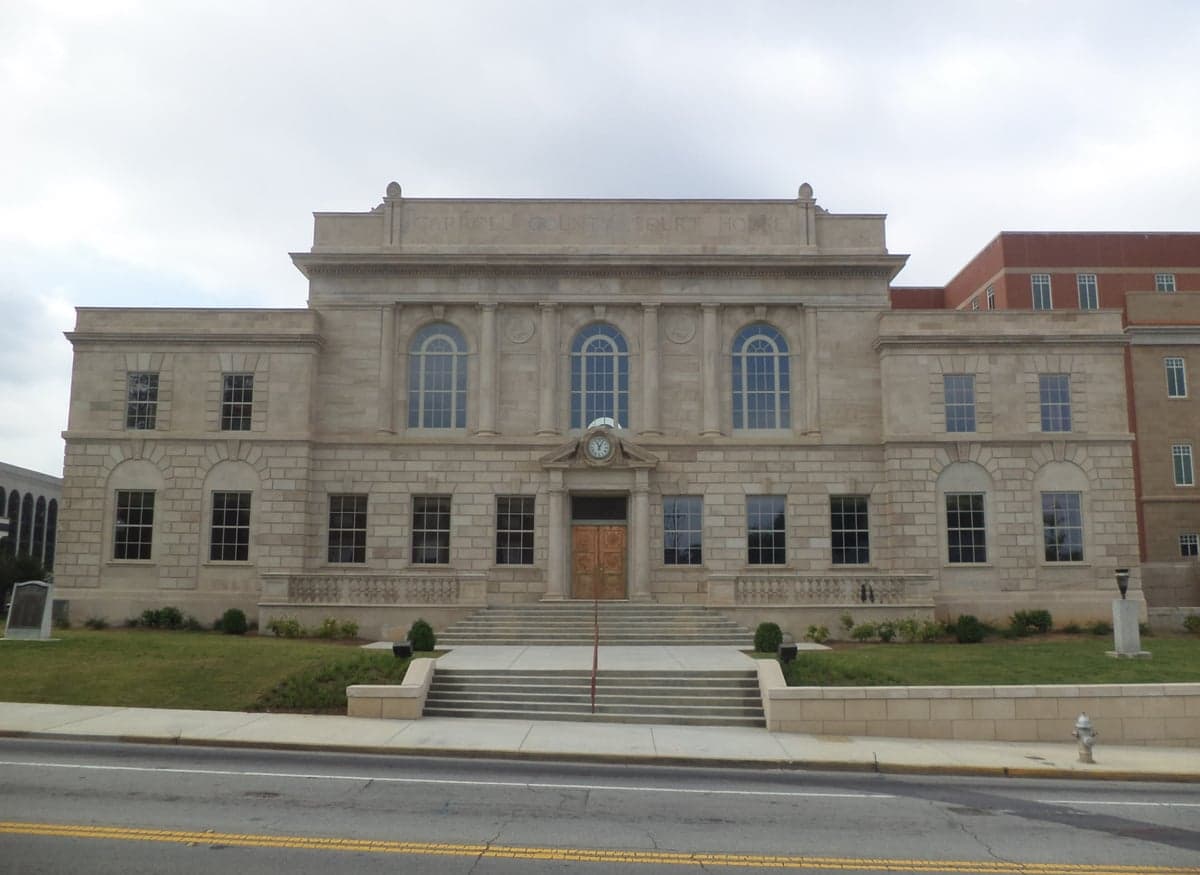
Photo: Wikipedia
Political ClimatePolitical Climate in Carroll County
Showing county-level results — no local-only data available.
Lean and PVI are calculated from this county’s 2020 and 2024 presidential results, Cook-style.
Political rankings in Georgia
- Most Conservative Cities in Georgia
- Most Liberal Cities in Georgia
- Best Liberal-Leaning Towns in the South
- Best Liberal-Leaning Towns in the Deep South
- Safest Liberal-Leaning Towns in the South
- Safest Conservative-Leaning Towns in the South
- Safest Conservative-Leaning Towns on the East Coast
- Affordable Small Towns for Conservatives
- Most Conservative Counties in Georgia
- Most Liberal Counties in Georgia
Local Political AnalysisPolitical Analysis of Carroll County
Carroll County, Georgia, is a reliably conservative area with a Cook Partisan Voting Index of R+15, meaning it votes about 15 points more Republican than the national average. The county has been trending even redder in recent cycles, with Donald Trump winning 68% of the vote in 2020 and 71% in 2024, up from 65% in 2016. This shift mirrors the broader rightward movement of exurban Atlanta counties, but Carroll County has always been a GOP stronghold—it hasn't voted for a Democratic presidential candidate since Jimmy Carter in 1976.
How it compares
Georgia as a whole is a competitive swing state with a Cook PVI of R+3, making it far more purple than Carroll County. While the state has seen Democratic gains in metro Atlanta and its inner suburbs, Carroll County has moved in the opposite direction. The county's R+15 rating places it among the most Republican counties in the western Atlanta exurbs, alongside Paulding (R+18) and Haralson (R+22). Within the county, political geography is not uniform. The city of Carrollton, home to the University of West Georgia, is the most Democratic-leaning area—Biden won the city's precincts by about 8 points in 2020, though Trump still carried the county overall by 30 points. Villa Rica, straddling the Douglas County line, is more mixed, with its eastern precincts trending blue while the western side remains solidly red. Bowdon, Temple, and Mount Zion are deeply conservative, often voting 75-80% Republican. The swing precincts are in the unincorporated areas around Carrollton and Villa Rica, where growth from Atlanta commuters has introduced more moderate voters.
What this means for residents
For conservative residents, Carroll County offers a political environment where their views are the clear majority. Local offices—from the Board of Commissioners to the school board and sheriff—are held by Republicans, and policy decisions reflect that, with low property taxes (the county millage rate is 9.9 mills) and a pro-business regulatory climate. For liberal residents, the reality is more isolating. While Carrollton provides a small blue bubble with progressive-leaning coffee shops and a university community, countywide elections are rarely competitive. Democratic candidates often struggle to break 35% in countywide races, and local Democratic clubs have limited influence. That said, the county's political homogeneity means fewer culture-war flashpoints than in more divided areas; most residents, regardless of party, share a focus on practical issues like road improvements, school funding, and public safety.
Culturally, Carroll County is distinct from both metro Atlanta and rural south Georgia. It has a strong evangelical Christian presence, with dozens of churches per square mile, and this shapes local policy on issues like alcohol sales (Sunday sales were only approved in 2011) and school curriculum. The county also has a notable libertarian streak—gun rights are widely supported, and there is little appetite for zoning or land-use restrictions. As the county grows—its population has increased by 15% since 2020, driven by Atlanta spillover—the political dynamic may shift slightly, but the R+15 lean is likely to persist for the foreseeable future. For now, Carroll County remains a place where conservative values are the norm, and newcomers should expect a community that prizes tradition, self-reliance, and a slower pace of life.

State Political ClimatePolitical Climate in Georgia
State Political AnalysisPolitical Environment in the State
Georgia has transformed from a reliably Republican stronghold into the nation’s most competitive swing state over the past two decades. The state’s current political climate is defined by a razor-thin partisan divide: in 2020, Joe Biden won Georgia by just 11,779 votes (0.2%), and in 2024, Donald Trump carried it by roughly 1.2 points. This near-50/50 split is driven by a coalition of fast-growing, diverse metro Atlanta suburbs and a deeply conservative rural and exurban base, creating a political environment that is both fiercely contested and increasingly unpredictable for anyone considering a move here.
Urban vs. rural divide
The political map of Georgia is a story of two Georgias. Metro Atlanta’s core counties — Fulton, DeKalb, Cobb, Gwinnett, and Clayton — are the engine of Democratic strength. Fulton County alone delivered over 400,000 votes for Biden in 2020, more than the entire population of many rural counties. The suburbs tell a more nuanced story: Gwinnett and Cobb counties, once Republican bastions, flipped to Biden in 2020 and have stayed blue, driven by an influx of younger, college-educated, and diverse residents from the Northeast and California. Meanwhile, the rest of the state is deeply red. Rural south Georgia counties like Brooks, Colquitt, and Tift routinely vote 70-80% Republican, as do exurban north Georgia counties like Pickens, Gilmer, and Fannin. The "flip" counties that decide statewide elections are the fast-growing outer-ring suburbs — places like Forsyth County (north of Atlanta) and Henry County (south of Atlanta). Forsyth, once a solidly red, predominantly white county, is now diversifying rapidly and voted for Trump by only 18 points in 2024, down from 40 points in 2016. Henry County, a majority-minority southern suburb, voted for Biden by 12 points. The political center of gravity is clearly shifting toward the Atlanta metro, which now casts roughly 60% of the state’s total vote.
Policy environment
Georgia’s policy environment reflects its divided politics. The state has a flat income tax rate of 5.39%, which is scheduled to drop to 4.99% by 2029 under a 2022 law. Property taxes are locally set and relatively moderate, with a statewide homestead exemption of $2,000. The regulatory posture is generally business-friendly, with a right-to-work law and no state-level minimum wage (federal $7.25 applies). Education policy is a major battleground: Georgia has a robust charter school system and a school voucher program (the Georgia Promise Scholarship Act, passed in 2024) that provides $6,500 per student for private school tuition in low-performing districts. The state also passed a Parents’ Bill of Rights in 2022, requiring schools to notify parents about curriculum changes and medical services. Healthcare policy is notably conservative: Georgia did not expand Medicaid under the Affordable Care Act, leaving roughly 300,000 low-income adults in the coverage gap. The state operates a limited "Georgia Pathways" program with work requirements, but enrollment has been minimal. Election laws have been a flashpoint: the 2021 Election Integrity Act (SB 202) added voter ID requirements for absentee ballots, limited drop boxes, and restricted third-party ballot collection. It also made it a crime to hand out food or water to voters waiting in line — a provision that drew national attention. The law has survived legal challenges and remains in effect.
Recent policy direction
Georgia’s recent legislative direction has been a mix of conservative priorities and pragmatic compromises. On gun rights, Georgia is a permitless carry state (HB 218, passed in 2022), allowing anyone 21 or older to carry a concealed firearm without a license. The state also has a "stand your ground" law. On education, the 2024 school voucher law and the 2022 Parents’ Bill of Rights signal a clear tilt toward parental control and school choice. On abortion, Georgia passed a "heartbeat" law (HB 481) in 2019, banning abortion after roughly six weeks, which took effect in 2022 after the Dobbs decision. The law includes exceptions for rape, incest, and medical emergencies, but has been controversial. On privacy and surveillance, Georgia has no comprehensive data privacy law, though a 2023 law (SB 36) restricts the use of facial recognition technology by law enforcement without a warrant. On property rights, Georgia is a "tax sale" state with a relatively short redemption period (12 months) for foreclosed properties, and it has no statewide rent control. On voting access, the 2021 law tightened rules but also expanded early voting hours in many counties. The overall direction is a conservative tilt on social and cultural issues, combined with a pro-business, low-tax posture that appeals to many relocators.
Civil unrest & political movements
Georgia has been a focal point for political movements on both sides. The 2020 election saw massive protests in Atlanta following the killing of George Floyd, with the city experiencing several nights of unrest that included property damage and arson at the Wendy’s on University Avenue. The "Stop the Steal" movement was also active, with a rally at the Georgia Capitol on January 6, 2021, and ongoing election integrity activism. In 2022, the state saw a wave of school board protests over critical race theory and mask mandates, particularly in Cobb and Cherokee counties. Immigration politics are heated but localized: Georgia has no sanctuary cities, and a 2009 law (HB 87) requires police to check immigration status of certain detainees. The state has seen a significant influx of migrants from Central America, particularly in the poultry-processing towns of Gainesville and Dalton. Election integrity remains a live issue: the 2020 election led to a controversial hand recount and a series of lawsuits, and the 2024 election saw Trump’s narrow win, which Democrats have challenged in court. A new resident would notice the intensity of political signage, the frequency of campaign mailers, and the presence of partisan poll watchers at early voting sites.
Projection
Over the next 5-10 years, Georgia is likely to remain a competitive swing state, but the demographic trends favor Democrats. The Atlanta metro is growing by roughly 100,000 people per year, and the new arrivals are disproportionately young, college-educated, and non-white — the core Democratic coalition. The rural population is aging and shrinking. However, Republicans are making gains among Hispanic and Asian voters in the suburbs, and the state’s conservative lean on cultural issues may hold as long as the GOP can keep the focus on education, crime, and the economy. The wild card is the 2026 gubernatorial election, which will test whether the state’s Republican majority can hold in a non-presidential year. For a new resident, the practical implication is that Georgia will continue to be a place where your vote matters — and where the political climate can shift quickly. If you’re conservative, you’ll find a state that is still broadly friendly to your values, but you’ll need to be comfortable living in a purple environment. If you’re liberal, you’ll find a state where your vote is increasingly powerful, but where the state government will remain conservative for the foreseeable future.
For someone moving to Georgia, the bottom line is this: you are moving to a state that is politically divided, but not dysfunctional. The partisan split means that neither side gets everything it wants, and the result is a policy environment that is moderate on economics (low taxes, business-friendly) and conservative on social issues (gun rights, abortion restrictions, school choice). The Atlanta metro is a blue island in a red sea, and the culture war is real — you’ll see it in school board meetings, in local elections, and in the constant stream of campaign ads. But the state’s economy is strong, the cost of living is reasonable, and the political drama is mostly confined to the ballot box. If you can handle the heat of a swing state, Georgia offers a lot of opportunity.
* Values derived from national, state, county, city and local statistics and may differ in a specific area. Last updated: 2026-10-23T22:04:32.000Z
Narrative content on this page is AI-generated and may contain mistakes. Verify any details that matter before acting on them.
ReloMaps may earn a commission from affiliate links at no extra cost to you.

