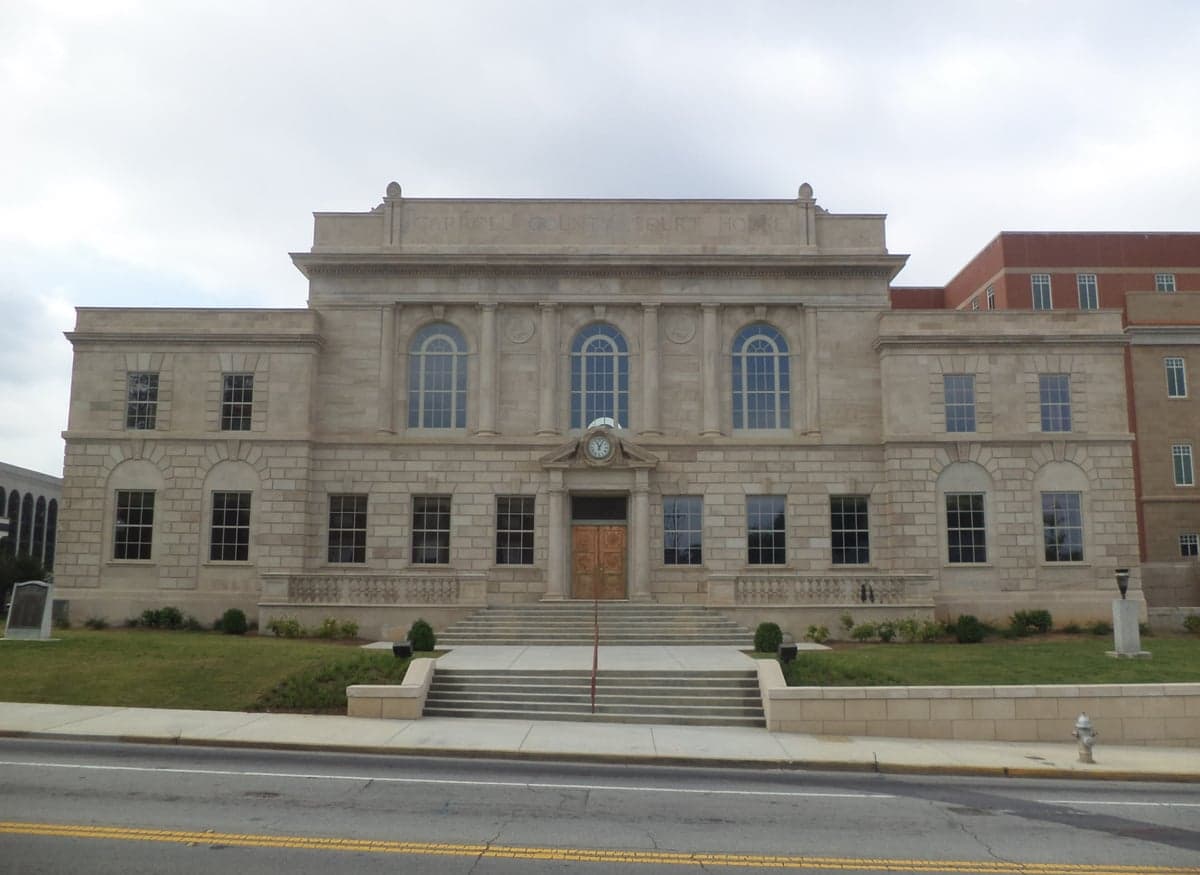
Photo: Wikipedia
Personal Sovereignty in Carroll County
Viable for self-reliance. Generally workable, though some barriers may limit total independence.
What does Personal Sovereignty tell us?
Personal Sovereignty measures your capacity for self-reliance and independence with minimal government friction. Higher scores mean fewer barriers between you and the way you want to live... but it assumes you have the space you need and good neighbors.
What does this tell us?
Personal Sovereignty measures your capacity for self-reliance and independence with minimal government friction. Higher scores mean fewer barriers between you and the way you want to live... but it assumes you have the space you need and good neighbors.
State Policy
Energy independence: Importer (26% of energy produced in-state)
Personal Liberty
Homesteading

Personal Liberty Analysis
Carroll County, Georgia, offers a notably high degree of personal sovereignty relative to metro Atlanta, with a governance culture that leans toward minimal interference in daily life, property use, and self-defense choices. The county seat of Carrollton, along with smaller towns like Villa Rica, Bowdon, and Mount Zion, each present distinct regulatory environments, but the overall county posture is one of light-touch governance, particularly when compared to jurisdictions inside the I-285 perimeter. For individuals and families prioritizing autonomy—whether in tax burden, firearm rights, or the freedom to live off-grid—Carroll County ranks among the more liberty-friendly options within commuting distance of Atlanta.
Tax burden and regulatory posture: how Carroll County compares to metro Atlanta
Carroll County’s tax structure is a clear draw for those seeking to keep more of their earnings. The county’s millage rate for unincorporated areas hovers around 10.5 mills, significantly lower than Fulton County’s 10.8–12.0 mills and well below DeKalb’s 14.0+ mills. Property taxes on a $300,000 home in unincorporated Carroll County run roughly $3,150 annually, compared to $4,200+ in much of metro Atlanta. The county also benefits from Georgia’s statewide flat income tax of 5.49% (as of 2026), which is lower than the progressive rates in neighboring states like Alabama or Tennessee’s lack of income tax but still competitive regionally. Sales tax in Carroll County is 7%, with a 1% local option for schools, which is standard for the region. Regulatory posture is generally permissive: there are no county-wide zoning overlays that restrict small-scale agriculture or home-based businesses in unincorporated areas, though incorporated towns like Villa Rica and Carrollton enforce their own municipal codes. For example, Villa Rica requires a business license for home-based operations, while unincorporated areas allow most low-impact enterprises without a permit. The county’s approach to building permits is straightforward—no impact fees for new construction in unincorporated zones—and environmental regulations are limited to state-level stream buffer rules, not county-imposed setbacks. This creates a notably lighter regulatory burden than in Gwinnett or Cobb counties, where stormwater management and tree preservation ordinances add cost and delay.
Self-defense and gun law specifics: what the Second Amendment looks like in Carroll County
Georgia is a constitutional carry state, and Carroll County’s sheriff’s office has a reputation for being pro-Second Amendment in both policy and practice. No permit is required to carry a concealed firearm in Georgia as of 2022, and Carroll County does not impose any local restrictions beyond state law. The sheriff’s office issues Georgia Weapons Carry Licenses (WCL) for reciprocity with other states, with a typical turnaround of 30–60 days. Carrollton, as a city, does not have any additional firearm ordinances—no bans on open carry, no magazine capacity limits, and no waiting periods. The county’s gun culture is robust: there are multiple indoor and outdoor shooting ranges, including the Carroll County Gun Club near Bowdon and River Bend Gun Club in nearby Whitesburg (just over the county line). Stand-your-ground laws apply statewide, and Carroll County courts have historically upheld self-defense claims in home-defense cases. For those who prioritize firearm access, the county is a safe harbor compared to states with magazine bans or red-flag laws—Georgia has no such statutes. The only notable nuance is that Mount Zion’s town council considered a noise ordinance in 2023 that could affect outdoor ranges, but it did not pass. Overall, Carroll County offers a permissive environment for gun owners, with no local barriers to purchase, carry, or storage.
Self-reliance and homesteading viability: lot sizes, zoning, and off-grid feasibility
For those seeking to live off-grid or pursue a homesteading lifestyle, Carroll County is one of the more viable options within an hour of Atlanta. Unincorporated areas have no minimum lot size for single-family homes, though septic system requirements (set by the county health department) typically demand at least 1–2 acres for a conventional septic drain field. In practice, this means 2-acre parcels are the sweet spot for off-grid setups with a well and septic. Towns like Bowdon and Mount Zion have more relaxed municipal codes than Carrollton: Bowdon allows backyard chickens without a permit, and Mount Zion has no zoning ordinance at all—just building codes. Off-grid solar is fully legal in unincorporated areas, with no county permit required for rooftop panels, though grid-tied systems must follow state electrical codes. Rainwater collection is unrestricted, and composting toilets are permitted if they meet Georgia’s plumbing code. The county does not ban livestock in unincorporated zones—horses, goats, and cattle are common on parcels of 5+ acres. Villa Rica, by contrast, restricts livestock to parcels of 3+ acres and requires a permit for beekeeping, so homesteaders should target unincorporated areas or Bowdon for maximum flexibility. The county’s agricultural exemption for property taxes is available for parcels of 10+ acres used for bona fide farming, which can cut tax bills by 50% or more. For those who want to build a tiny house or a yurt, Carroll County’s building code follows the state’s minimum standards, but no county ordinance prohibits alternative dwellings as long as they meet structural and septic requirements. This makes the county a strong contender for self-reliant living, especially compared to metro Atlanta counties that mandate minimum square footage or prohibit off-grid utilities.
Personal liberties: parental rights, medical autonomy, speech, and property
Carroll County’s governance reflects a broader Georgia trend of deference to parental authority and limited government intervention in private medical decisions. Parental rights in education are protected under Georgia’s Parents’ Bill of Rights (2022), which requires school districts to notify parents of curriculum changes and allows them to opt children out of sex education or controversial materials. The Carroll County School District has implemented this policy without controversy, and there have been no local disputes over library books or classroom content as of 2026. Medical autonomy is similarly broad: Georgia has no vaccine mandate for adults, and the state’s 2023 law prohibits local governments from requiring masks or vaccines for public services. Carroll County’s board of commissioners has not passed any health-related ordinances beyond state requirements. For those concerned about medical freedom, the county has a growing network of direct-primary-care clinics and a few functional medicine practitioners in Carrollton. Free speech is robust—the county has no local ordinances restricting political signage, leafleting, or public assembly, though Carrollton’s city code requires a permit for parades or large gatherings on public streets. Property rights are strongly protected: Carroll County does not use eminent domain for economic development (unlike some metro Atlanta counties that have condemned land for private projects), and the county’s zoning board has a reputation for approving variances for fences, sheds, and home businesses. The only notable restriction is that Villa Rica enforces a 35-foot height limit on residential structures, which could affect those wanting a tall barn or silo. Overall, the county’s approach to personal liberties is consistent with a small-government philosophy, with few local intrusions beyond what state law requires.
In the broader context of Georgia and the Southeast, Carroll County offers a balanced sovereignty profile: lighter than the regulatory-heavy Atlanta core, but not as permissive as rural counties in south Georgia or Alabama. For a single individual or family who values tax efficiency, gun rights, and the ability to live self-sufficiently, the county is a strong choice—especially in unincorporated areas or towns like Bowdon and Mount Zion, where municipal oversight is minimal. The trade-off is that Carrollton and Villa Rica have more amenities but also more rules, so the key is choosing the right jurisdiction within the county. Compared to similar exurban counties like Paulding or Coweta, Carroll County’s tax burden is slightly lower and its zoning is more homestead-friendly, making it a top contender for those who want proximity to Atlanta without sacrificing personal autonomy.

* Values derived from national, state, county, city and local statistics and may differ in a specific area. Last updated: 2026-10-23T22:04:32.000Z
Narrative content on this page is AI-generated and may contain mistakes. Verify any details that matter before acting on them.
ReloMaps may earn a commission from affiliate links at no extra cost to you.

