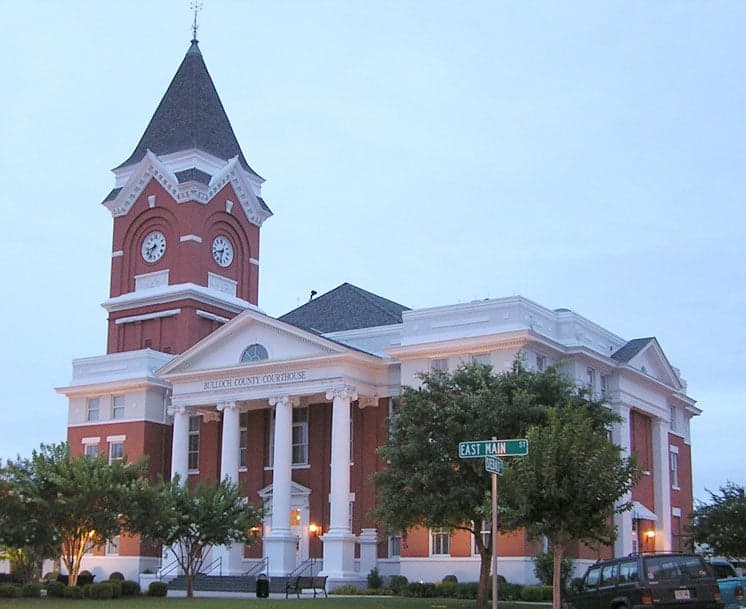
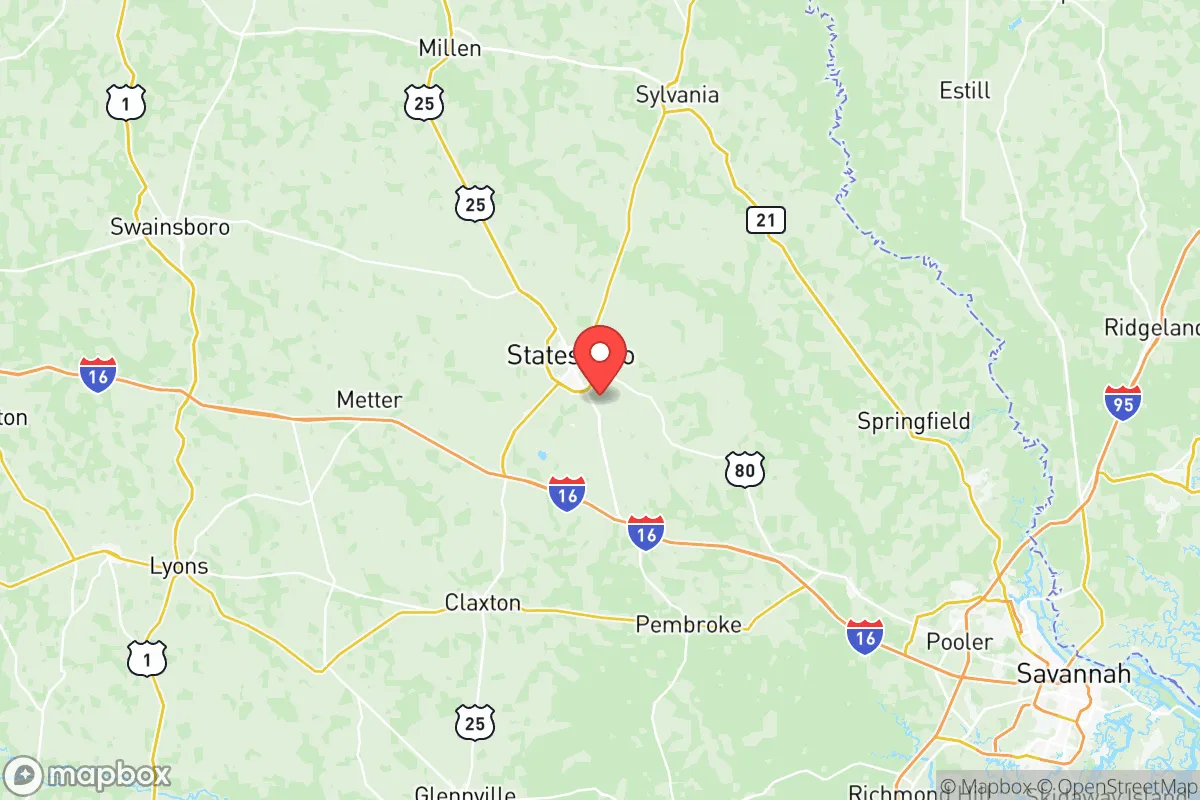
Photo: Wikipedia
Political ClimatePolitical Climate in Bulloch County
Showing district-level results — no local-only data available.
Local Political AnalysisPolitical Analysis of Bulloch County
Bulloch County, Georgia, has long been a reliably Republican stronghold, with a Cook Partisan Voting Index (PVI) of R+7. This means the county consistently votes about seven percentage points more Republican than the national average. However, the political reality on the ground is more nuanced than a single number suggests, with the city of Statesboro acting as a notable blue-leaning island within a deeply red rural landscape. The county's trajectory is slowly shifting, driven by the growing influence of Georgia Southern University, but it remains a place where conservative values dominate local governance and social norms.
How it compares
Bulloch County's R+7 PVI places it squarely in the "solidly Republican" category, but it's not as deep red as many of its neighboring rural counties in southeast Georgia. For context, counties like Candler or Evans to the west are even more conservative. The real contrast, however, is internal. Statesboro, home to Georgia Southern University and roughly 70% of the county's population, is the clear blue dot. Precincts around campus and in the historic downtown area often vote Democratic, sometimes by double-digit margins. In contrast, the smaller towns like Brooklet, Register, and Portal are overwhelmingly Republican, with precincts frequently delivering 75-80% of their votes for GOP candidates. The county's overall R+7 rating is a direct result of this urban-rural split: the high turnout in Statesboro's liberal precincts is consistently outweighed by the even higher Republican margins in the surrounding rural areas. Compared to Georgia as a whole, which has become a competitive swing state (leaning Democratic in recent presidential elections), Bulloch County is a clear outlier, holding onto a political identity that the state's fast-growing metro areas are leaving behind.
What this means for residents
For conservative residents, Bulloch County feels like a natural fit. Local elected officials, from the county commission to the school board, are almost entirely Republican. Gun rights are broadly supported, taxes are kept relatively low, and social issues are generally approached from a traditionalist perspective. You'll find plenty of churches, a strong 4-H presence, and a general sense that the community's values are reflected in its leadership. For liberal residents, the experience is more of a balancing act. While you can find like-minded people, especially in Statesboro's academic and arts communities, you'll likely feel like a political minority in most county-wide conversations. The local Democratic Party is active but struggles to field competitive candidates for county-level offices. National issues like abortion and gun control are debated with less intensity here than in metro Atlanta, as local politics tends to focus on more tangible concerns like road improvements, school funding, and economic development. The university acts as a buffer, creating a more tolerant social environment in Statesboro than in the outlying towns, but the county's overall political climate remains firmly conservative.
Culturally, this political divide manifests in clear ways. The biggest policy distinction is probably the county's approach to growth and development. The rural areas strongly favor slow growth and preserving the agricultural character, while Statesboro's leadership is more pro-development, especially around the university and the new interstate exchanges. This tension plays out in zoning debates and school board elections, where the urban and rural visions for the county's future often clash. Another key distinction is the role of Georgia Southern. The university is the county's largest employer and a major economic engine, but its liberal-leaning faculty and student body are sometimes viewed with suspicion by more conservative residents. This creates a unique dynamic where the county's economic health depends on an institution that many of its voters are culturally at odds with. Looking ahead, as Statesboro continues to grow and attract new residents from more diverse backgrounds, the county's R+7 rating may slowly drift toward the center, but for the foreseeable future, Bulloch County will remain a place where conservative politics are the norm, and the liberal minority navigates a community that is politically comfortable but not always ideologically aligned with them.

State Political ClimatePolitical Climate in Georgia
State Political AnalysisPolitical Environment in the State
Georgia has transformed from a reliably Republican stronghold into the nation’s most competitive swing state over the past two decades, a shift driven by explosive growth in the Atlanta metro and a diversifying electorate. The state’s current political reality is a razor-thin partisan balance: Joe Biden won Georgia by just 0.23% in 2020, and the 2024 presidential race was decided by roughly 2 points, with both parties treating it as a must-win battleground. For a relocator, this means you are moving into a state where your vote genuinely counts, but where the political culture is deeply split between a rapidly growing, multiracial urban coalition and a deeply conservative rural and exurban base.
Urban vs. rural divide
The political map of Georgia is a classic story of metro dominance versus rural resistance. The Atlanta metropolitan area, home to roughly 60% of the state’s population, is the engine of Democratic performance. Core counties like Fulton (Atlanta), DeKalb (Decatur), and Clayton are among the most reliably Democratic jurisdictions in the South, delivering margins of 70-85% for Democratic candidates. The real story of Georgia’s shift, however, is the suburban ring: Cobb County (Marietta), Gwinnett (Lawrenceville), and Henry County (McDonough) have flipped from Republican to Democratic or competitive status over the last three cycles, driven by an influx of college-educated professionals and a growing Asian-American and Hispanic electorate. Outside the I-285 perimeter, the state is deeply Republican. Rural south Georgia — places like Tifton, Valdosta, and Waycross — vote 65-75% Republican, as do the exurban and small-town counties north of Atlanta, such as Pickens and Gilmer. The notable exception is the Augusta area (Richmond County), which leans Democratic, and the Columbus metro (Muscogee County), which is a competitive swing area. Savannah (Chatham County) has also trended blue in recent cycles, but the surrounding coastal counties remain red. The divide is not just geographic but cultural: the Atlanta region’s economy, demographics, and social values increasingly resemble a Northeastern or West Coast metro, while the rest of the state holds to traditional Southern conservatism.
Policy environment
Georgia’s state-level policy environment is firmly controlled by a Republican legislature and governor, producing a low-tax, limited-government framework that appeals to conservative relocators. The state has a flat income tax rate of 5.49%, which is scheduled to drop to 4.99% by 2029 under legislation passed in 2022. There is no state-level estate or inheritance tax. Property taxes are levied at the county level and are generally moderate, though they can be high in top-tier school districts like those in Cobb and Gwinnett counties. The regulatory environment is business-friendly, with Georgia ranking consistently in the top 10 for ease of doing business. Education policy has been a flashpoint: the state has a robust school choice program, including the Georgia Promise Scholarship Act (2024), which provides $6,500 vouchers for students in low-performing schools, and a thriving charter school sector. At the same time, the state has seen heated battles over curriculum content and library books, with the Republican-led legislature passing measures to increase parental oversight of school materials. Healthcare policy is a mixed bag: Georgia did not expand Medicaid under the Affordable Care Act, leaving a coverage gap for low-income adults, but the state has pursued a limited "Georgia Pathways" waiver with work requirements. Election laws have been a national focus: the Election Integrity Act of 2021 (SB 202) added a photo ID requirement for absentee voting, limited drop boxes, and restricted third-party ballot collection, changes that have been praised by conservatives for security and criticized by Democrats as restrictive.
Recent policy direction
The last three years have seen Georgia’s Republican majority push a broad conservative agenda across multiple fronts. On gun rights, Georgia is a permitless carry state as of 2022 (HB 218), allowing any legal gun owner to carry a concealed firearm without a license. On parental and education rights, the state passed the "Parents’ Bill of Rights" (SB 449) in 2022, codifying parental authority over medical decisions and school records, and has restricted instruction on gender identity and sexual orientation in elementary schools. On speech and privacy, Georgia has not enacted a broad state-level privacy law like California or Virginia, but it has passed restrictions on social media platforms’ ability to moderate content (HB 509, 2024), aligning with conservative free-speech concerns. Medical and bodily autonomy is a sharp dividing line: Georgia’s 2019 "Heartbeat Bill" (HB 481) bans abortion after detection of a fetal heartbeat, roughly six weeks, with limited exceptions for rape, incest, and maternal health. This law was blocked by courts for two years but reinstated after the Dobbs decision in 2022. Property rights are generally strong, with no statewide rent control and relatively permissive zoning in most counties, though the Atlanta metro has seen increasing local land-use regulation. On voting and ballot access, the trend has been toward tightening: in addition to SB 202, the state has purged voter rolls regularly and shortened the runoff election window from nine weeks to four, a change that affected the 2022 Senate runoff. For a relocator weighing personal liberties, Georgia offers broad gun rights and low taxes but imposes significant restrictions on abortion access and has a more regulated voting process than many other states.
Civil unrest & political movements
Georgia has been a focal point for national political movements on both sides. The 2020 election aftermath saw massive protests in Atlanta over racial justice and police reform, as well as a sustained "Stop the Steal" movement that included a controversial ballot audit in Cobb County and ongoing litigation over election procedures. The state has seen organized activist infrastructure on both sides: the Georgia Democratic Party has built a formidable ground game through groups like Fair Fight Action (founded by Stacey Abrams), while conservative groups like the Georgia Republican Assembly and various election integrity organizations remain highly active. Immigration politics are less visible than in border states, but Georgia has passed strict enforcement measures, including a 2011 law (HB 87) that allowed police to check immigration status and penalized those who harbored undocumented immigrants. There are no sanctuary cities in Georgia; state law explicitly prohibits them. Secession or nullification rhetoric is minimal and fringe. The most visible flashpoint for a new resident would be the constant political advertising: Georgia’s swing-state status means it is saturated with campaign ads, mailers, and canvassers during every election cycle, a level of political intensity that can be jarring for someone moving from a less competitive state.
Projection
Over the next five to ten years, Georgia is likely to remain a competitive swing state, but the trajectory favors a slow, incremental shift toward the Democratic column if current demographic trends hold. The Atlanta metro continues to grow by roughly 70,000-80,000 people per year, with a disproportionate share of new residents being young, college-educated, and racially diverse — all groups that lean Democratic. The suburbs of Cobb, Gwinnett, and Henry counties are unlikely to revert to their Republican past. However, the Republican Party is also gaining ground in exurban and rural areas, and the state’s growing Hispanic population is not uniformly Democratic; many Cuban-American and Venezuelan-American communities in metro Atlanta lean Republican. The wild card is migration from other states: Georgia is a top destination for domestic movers, and the political lean of these newcomers is mixed. If the state continues to attract conservative retirees from Florida and the Midwest, the partisan balance could remain very close. A relocator moving to Georgia in 2026 should expect to live in a state where control of the legislature and governor’s mansion will be hotly contested every cycle, and where policy outcomes will swing sharply depending on which party holds power.
For a new resident, the bottom line is that Georgia offers a low-tax, business-friendly environment with strong gun rights and school choice, but also a deeply polarized political culture where your daily experience will vary dramatically depending on whether you settle inside the Atlanta metro or in a rural county. If you are conservative, you will find a state government that largely reflects your values, but you will be living in a state that is increasingly competitive and where your vote matters more than in a deep-red state. If you are liberal, you will find vibrant urban communities and a growing political coalition, but you will face a state government that is actively restricting abortion access, tightening voting laws, and limiting certain classroom discussions. The practical takeaway: choose your county carefully, as local governance and community culture vary more in Georgia than in many states, and be prepared for a high level of political engagement and advertising year-round.
* Values derived from national, state, county, city and local statistics and may differ in a specific area. Last updated: 2026-06-17T10:01:58.000Z
Narrative content on this page is AI-generated and may contain mistakes. Verify any details that matter before acting on them.
ReloMaps may earn a commission from affiliate links at no extra cost to you.

