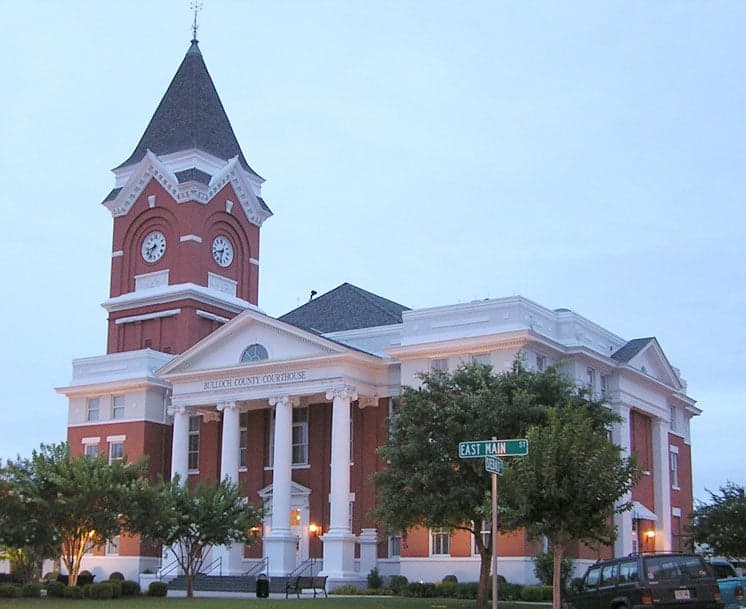
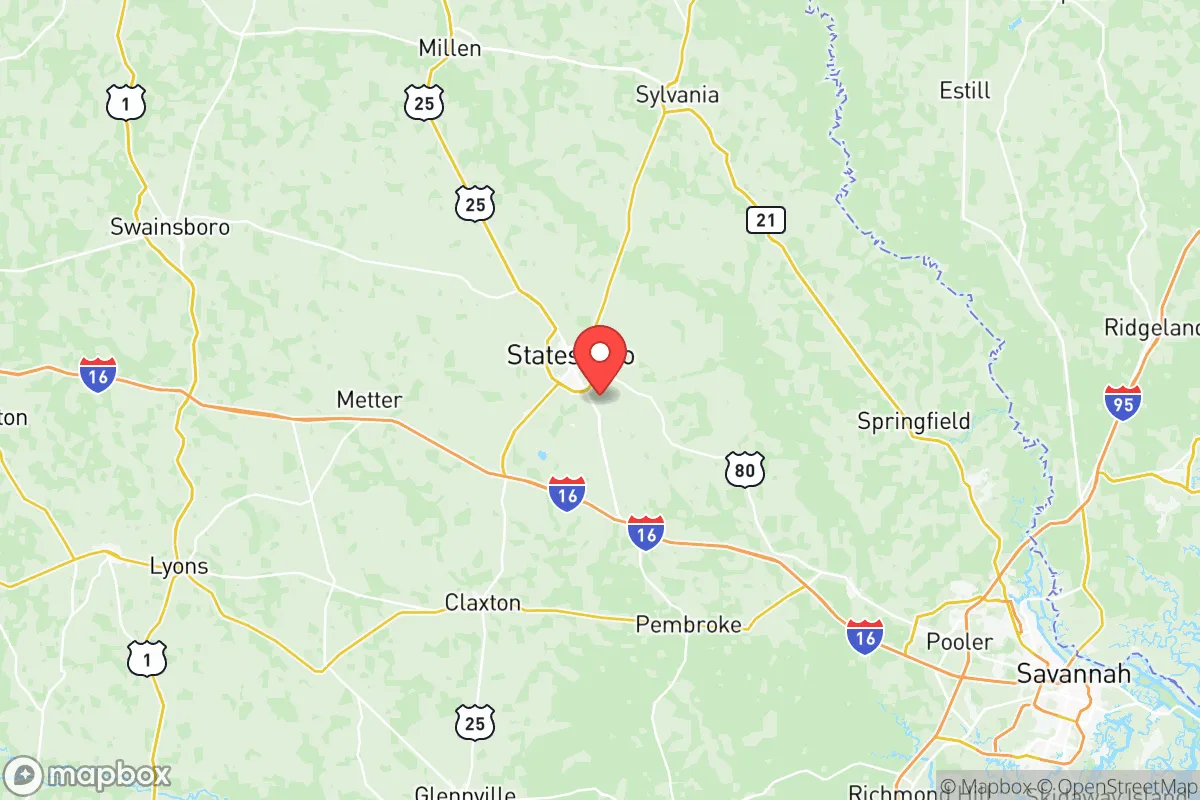
Photo: Wikipedia
Quality of Life in Bulloch County
A livable area that tracks near national norms for affordability, walkability, and neighborhood health.
What does Quality of Life tell us?
Quality of Life measures an area by evaluating factors like cost of living, nearby amenities, country club access, airport proximity, socioeconomic signals and neighborhood character. For large states, this is a general average — quality of life can vary dramatically between metro areas, suburbs, and rural communities within the same state.
What does this tell us?
Quality of Life measures an area by evaluating factors like cost of living, nearby amenities, country club access, airport proximity, socioeconomic signals and neighborhood character. For large states, this is a general average — quality of life can vary dramatically between metro areas, suburbs, and rural communities within the same state.
Cost of Living
23% below national average
104%
The Real Cost of Living in Bulloch County for 2026
| Tier | Individual | Family (4) |
|---|---|---|
| Survival | $15k | $29k |
| Comfortable | $37k | $55k |
| Luxury | $103k+ | $159k+ |
| Elite (Top 5%) | $132k+ | $204k+ |
Quality-of-Life Analysis
Bulloch County, Georgia, offers a broad quality-of-life spectrum that spans the college-town energy of Statesboro, the quiet routine of smaller communities like Brooklet and Register, and the open farmland of unincorporated areas. The county’s overall cost of living index sits at 77 (well below the U.S. average of 100), with a median home value of $191,600 and median rent of $968, making it one of the more affordable counties in the Savannah-Hinesville-Statesboro Combined Statistical Area. This range attracts a mix of Georgia Southern University students and faculty, young families seeking affordable starter homes, and retirees looking for low-cost rural acreage within an hour of the coast.
Largest town(s) & population centers
Statesboro is the county seat and dominant population center, home to roughly 35,000 residents and the 26,000-student campus of Georgia Southern University. Daily life here revolves around the university calendar: the downtown district along East Main Street fills with students during the academic year, while summer months are quieter. The city offers the county’s widest range of amenities, including East Georgia Regional Medical Center, a Walmart Supercenter, and a growing collection of chain and local restaurants along Veterans Memorial Parkway. The average commute in Bulloch County is about 24 minutes, and for Statesboro residents, most jobs, shopping, and healthcare are within a 10- to 15-minute drive. Housing here spans the county’s price range: older bungalows near campus sell in the $150,000s, while new subdivisions on the south side (such as those off Brannen Street) push toward $300,000. Renters dominate the student-heavy neighborhoods, with the countywide median rent of $968 reflecting a mix of off-campus apartments and single-family rentals.
Smaller towns & rural pockets
Brooklet, about 10 miles north of Statesboro, is a growing bedroom community with a small historic downtown and a population just over 2,000. It offers a slower pace while still providing easy access to Statesboro’s jobs and shopping. Register, farther north near the Jenkins County line, is a tiny unincorporated community with fewer than 200 residents, no stoplights, and a landscape of pecan orchards and pine plantations. Portal, east of Statesboro along U.S. 80, is another small town (roughly 650 residents) that serves as a gateway to the Ogeechee River and the George L. Smith State Park area. These smaller communities lack the retail and healthcare infrastructure of Statesboro; residents typically commute 20 to 30 minutes for groceries, medical appointments, and most employment. Housing in these pockets is markedly cheaper: a three-bedroom home on an acre in Brooklet can be found in the $160,000–$200,000 range, while rural land in Register or Portal often sells for under $5,000 per acre.
Cost & lifestyle range
The cost-of-living spread across Bulloch County is driven primarily by housing type and location. At the low end, rural properties in the northern and eastern parts of the county (around Register and the Ogeechee River corridor) offer the cheapest land and lowest property taxes, but require the longest drives for basic services. At the high end, newer subdivisions in southern Statesboro (such as the Brannen Park area) and custom homes on large lots near Brooklet represent the county’s most expensive real estate, with some properties exceeding $400,000. The median home value of $191,600 is attainable for a household earning roughly $50,000 per year, well within reach for dual-income families or mid-career professionals. Renters face a tight market near campus, where two-bedroom apartments often lease for $1,100–$1,300, but the countywide median of $968 reflects more affordable options in outlying areas. Amenities follow a similar gradient: Statesboro has the only full-service hospital, the only movie theater, and the only major grocery chains (Publix, Walmart, Aldi), while smaller towns rely on local convenience stores and Dollar General outlets.
Bulloch County works best for people who want a low cost of living and don’t mind driving 20 to 30 minutes for certain services. Families and professionals who need daily access to a university town’s amenities will gravitate toward Statesboro or the Brooklet corridor. Retirees, remote workers, and those seeking a quiet rural lifestyle on a tight budget will find the most value in the county’s northern and eastern rural pockets, where land is cheap and neighbors are few. The county’s 24-minute average commute is a realistic reflection of life here: most residents trade a short drive for significantly lower housing costs than the national average.

Crime in Bulloch County
Generally safer than 56% of comparable U.S. locations.
Violent CrimeViolent Crime Analysis
Property CrimeProperty Crime Analysis
Crime Analysis
Bulloch County, Georgia, presents a mixed safety profile that requires careful consideration for potential residents. The county's violent crime rate of 262 incidents per 100,000 residents is notably lower than the national average, while its property crime rate of 1,236.6 per 100,000 sits slightly above the national benchmark. This data, drawn from recent FBI Uniform Crime Reporting statistics, paints a picture of a community where violent confrontations are less common than in many parts of the country, but property-related offenses like theft and burglary remain a persistent concern for residents in the county's primary population centers, including Statesboro, Brooklet, and Portal.
Crime in context
When compared to Georgia's statewide violent crime rate of approximately 380 per 100,000, Bulloch County's 262 per 100,000 is a meaningful improvement, placing the county in a safer tier than many of the state's more urbanized areas. The property crime rate of 1,236.6 per 100,000, however, runs close to the national average of roughly 1,200 per 100,000 and is elevated relative to some of Georgia's more rural counties. A significant driver of this property crime figure is the city of Statesboro, home to Georgia Southern University. Like many college towns, Statesboro experiences seasonal spikes in theft, vehicle break-ins, and bicycle theft, particularly during the academic year and major events like the Georgia Southern football season. The Bulloch County Sheriff's Office and the Statesboro Police Department have both implemented targeted patrols and community awareness campaigns to address these trends, but the transient student population and high-density housing near campus create conditions that are inherently challenging to police effectively.
What residents experience
For families and long-term residents, the day-to-day reality of safety in Bulloch County varies significantly by location and time of day. The unincorporated areas of the county, including communities like Register and Nevils, generally report very low crime volumes, with most incidents being domestic in nature or isolated property crimes. In contrast, the more densely developed commercial corridors of Statesboro, particularly along US Highway 301 and Veterans Memorial Parkway, see a higher concentration of retail theft, vehicle break-ins, and occasional aggravated assaults. The presence of a large state university also means that the local judicial system, including the Ogeechee Judicial Circuit which covers Bulloch County, handles a high volume of lower-level offenses such as underage possession, DUIs, and disorderly conduct. Residents should be aware that the district attorney's office in this circuit, like many in Georgia's more progressive-leaning judicial districts, has at times emphasized diversion programs and alternative sentencing for non-violent offenders. While these programs aim to reduce recidivism, critics argue they can result in lighter consequences for repeat property offenders, potentially contributing to the county's elevated property crime rate.
Neighborhood-level variation is pronounced in Bulloch County. The safest residential areas are typically found in the southern and western portions of the county, away from the Statesboro city limits, where subdivisions and rural homesteads benefit from lower population density and active neighborhood watch programs. Areas near the Georgia Southern campus, particularly the neighborhoods immediately surrounding the university's core, experience the highest rates of reported theft and burglary. The city of Brooklet, located just north of Statesboro, offers a quieter, small-town environment with crime rates well below the county average. For those considering a move to the area, focusing on properties in these outlying communities or in established Statesboro neighborhoods like the Brannen Park area can provide a significantly different safety experience than living in the immediate orbit of the university. Prospective residents are strongly advised to review the most recent crime mapping data from the Bulloch County Sheriff's Office and to speak with local real estate agents about specific subdivisions before making a decision.
* Values derived from national, state, county, city and local statistics and may differ in a specific area. Last updated: 2026-06-17T10:01:58.000Z
Narrative content on this page is AI-generated and may contain mistakes. Verify any details that matter before acting on them.
ReloMaps may earn a commission from affiliate links at no extra cost to you.

