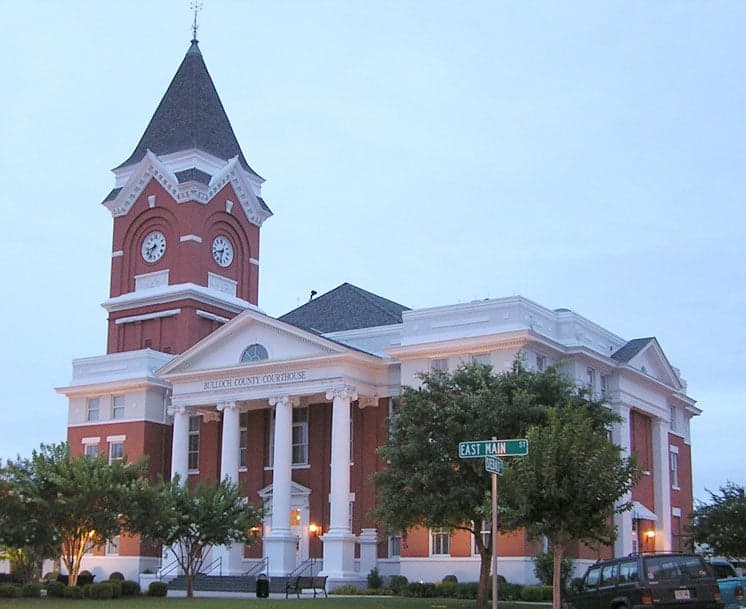
Photo: Wikipedia
Strategic Assessment of Bulloch County
Workable tactical position. Some exposure to population density or targets, but generally defensible in a crisis.
What does the Strategic Assessment tell us?
Our Strategic Assessment grades tactical survivability of an area. Major population centers, military targets, fallout zones, natural disasters, and border exposure all drive risk — lower exposure means a more defensible position in a crisis.
This is heavily inspired by Joel Skousen's Strategic Relocation book. Highly recommended you checkout the book ($)What does this tell us?
Our Strategic Assessment grades tactical survivability of an area. Major population centers, military targets, fallout zones, natural disasters, and border exposure all drive risk — lower exposure means a more defensible position in a crisis.
This is heavily inspired by Joel Skousen's Strategic Relocation book. Highly recommended you checkout the book ($)Strategic Pillars

Key Distances
Strategic Assessment Analysis
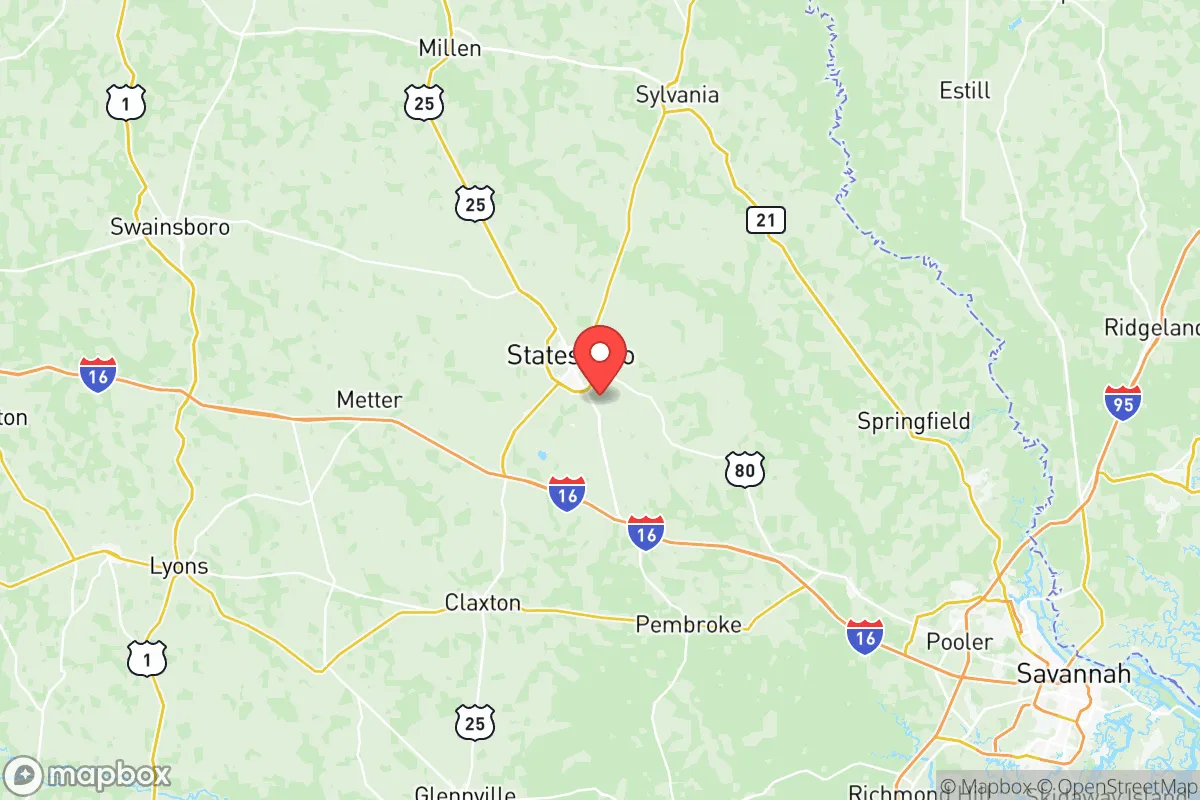
Bulloch County, Georgia, anchored by the city of Statesboro, offers a strategic relocation option for those prioritizing disaster readiness and self-sufficiency, balancing rural resilience with access to regional infrastructure. Its position roughly 50 miles inland from the Atlantic coast and 60 miles northwest of Savannah places it outside the immediate blast and fallout zones of major coastal targets, while its location along Interstate 16 provides a viable evacuation corridor away from population-dense areas like Atlanta or the Savannah River nuclear facilities. The county’s economy, rooted in agriculture and Georgia Southern University, provides a stable, non-industrial base that reduces its attractiveness as a target, making it a defensible choice for families and individuals seeking a lower-risk environment.
Geographic position and natural advantages for disaster preparedness
Bulloch County sits on the Georgia Coastal Plain, a region characterized by flat to gently rolling terrain that offers practical advantages for self-sufficient living. The area’s elevation averages around 200 feet above sea level, providing natural drainage that reduces flood risk compared to coastal zones, though low-lying areas near the Ogeechee River and its tributaries—such as the Canoochee River—can experience localized flooding during heavy rains. The county’s location places it over 100 miles from the nearest nuclear power plant (Plant Vogtle near Augusta) and roughly 80 miles from the Savannah River Site, a major nuclear materials processing facility, significantly reducing fallout exposure risk in a major event. The climate is humid subtropical, with hot summers and mild winters, supporting year-round gardening and livestock management—key for food self-sufficiency. The region’s natural resources include abundant surface water from the Ogeechee River and numerous creeks, as well as access to the Floridan Aquifer, one of the most productive groundwater sources in the Southeast, which underpins local well water reliability.
Risks, exposures, and proximity to fallout-relevant landmarks
While Bulloch County avoids the highest-risk zones, it is not without exposures. The primary man-made risk comes from its proximity to the Port of Savannah, a critical national logistics hub located about 60 miles southeast, which could be a target in a conflict scenario. However, prevailing winds in the region typically blow from the west and southwest, meaning fallout from a Savannah strike would likely move eastward over the Atlantic, not toward Bulloch County. The county is also roughly 90 miles from the Houston County refinery corridor near Warner Robins, which includes the Robins Air Force Base—a major military installation that could be a secondary target. Statesboro itself hosts no high-value industrial or military assets, reducing its direct targeting risk. Natural hazards include the threat of hurricanes, which can bring damaging winds and flooding from the coast, though the inland location significantly weakens storm intensity by the time they arrive. Tornadoes are a moderate risk, with the county averaging 1-2 tornado warnings per year, typically EF-0 to EF-1 strength. The area’s flat terrain offers limited natural defensibility, but the low population density (roughly 80,000 residents county-wide) and spread-out rural settlements provide a degree of security through obscurity.
Practical resilience for a relocator: food, water, energy, and defensibility
For a relocator focused on self-sufficiency, Bulloch County presents strong fundamentals. Agriculture dominates the local economy, with major crops including cotton, peanuts, corn, and soybeans, as well as extensive poultry operations—Tyson Foods and Pilgrim’s Pride both have processing plants in the area, providing local food processing infrastructure. The county’s agricultural extension service through the University of Georgia offers resources for small-scale farming and livestock management. Water access is excellent: the Floridan Aquifer provides clean, abundant groundwater at depths of 100-300 feet, and many rural properties already have private wells. The Ogeechee River and its tributaries offer surface water for irrigation or emergency use, though treatment would be necessary. Energy resilience is moderate: Georgia Power serves the area with a grid that has seen improvements after recent storms, but rural areas can experience extended outages. Solar potential is good, with the region averaging 5.5 peak sun hours per day, making off-grid solar systems viable. Wood is abundant for heating, with pine forests covering much of the county. Defensibility is limited by the flat terrain, but the county’s rural character—with many properties set back from main roads and surrounded by farmland or forest—offers natural privacy and buffer zones. The local law enforcement presence is adequate, with the Bulloch County Sheriff’s Office and Statesboro Police Department covering the main population centers, but response times in remote areas can exceed 20 minutes.
The overall strategic picture for Bulloch County is one of balanced resilience: it avoids the highest-risk zones while offering practical resources for self-sufficient living. Its location between Savannah and Macon provides access to regional medical facilities (including East Georgia Regional Medical Center in Statesboro) and supply chains without the vulnerability of being in a major metro area. The county’s agricultural base, abundant water, and moderate climate make it a strong candidate for families or individuals seeking a lower-risk environment that still supports a modern lifestyle. For those willing to invest in well water, solar power, and food production systems, Bulloch County offers a defensible, resource-rich base that can weather both natural disasters and broader geopolitical disruptions without the isolation of more remote locations.

* Values derived from national, state, county, city and local statistics and may differ in a specific area. Last updated: 2026-06-17T10:01:58.000Z
Narrative content on this page is AI-generated and may contain mistakes. Verify any details that matter before acting on them.
ReloMaps may earn a commission from affiliate links at no extra cost to you.

