Photo: Wikipedia
Demographics of Bulloch County
Affluence Level in Bulloch County
A below-average socioeconomic profile. Incomes, home values, and educational attainment trail the U.S., with higher poverty and unemployment.
People of Bulloch County
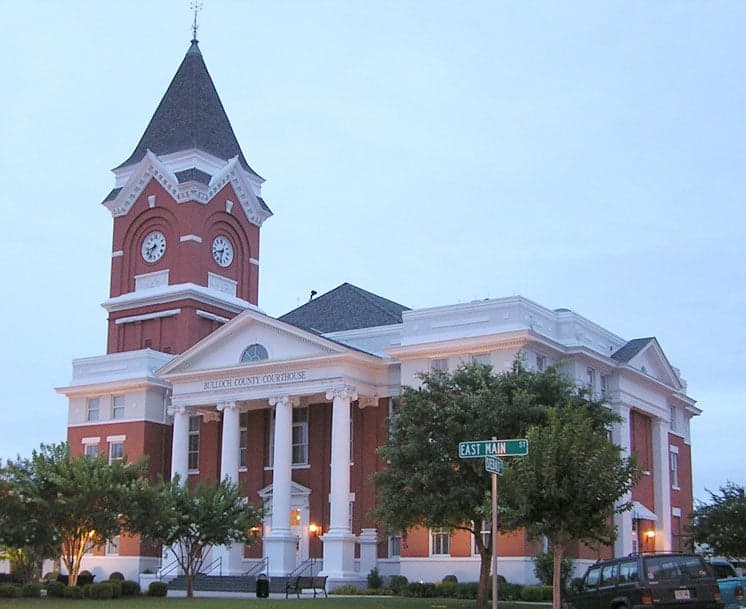
Today, Bulloch County is home to 81,372 residents, a population shaped by deep Southern roots and the steady influence of Georgia Southern University in Statesboro. The county is predominantly native-born, with only 2.0% foreign-born, and its racial makeup reflects a historic Black-white divide now moderated by a small but growing Hispanic community (5.0%) and tiny Asian (0.9%) and Indian (0.5%) populations. The people here carry a distinct identity: a mix of old agricultural families, university faculty and students, and a rising professional class drawn to the Savannah-adjacent corridor. With 30.8% holding a college degree—driven largely by the university—Bulloch County is more educated than many rural Georgia counties, yet it retains a conservative, family-oriented character that appeals to those seeking affordable land and a slower pace.
Settlement & growth (pre-1960)
Before European settlement, the area now known as Bulloch County was part of the ancestral homeland of the Creek (Muscogee) people, who lived in scattered villages along the Ogeechee and Canoochee rivers. The Creeks were forcibly removed through treaties and land cessions in the early 1800s, culminating in their expulsion during the 1830s Trail of Tears. The county itself was created in 1796 from parts of Bryan and Screven counties, named after Georgia politician Archibald Bulloch, and the first white settlers were primarily Scots-Irish and English yeoman farmers pushing inland from the coast.
These early settlers took up small cotton and subsistence farms, and the county's first real town, Statesboro, was established in 1803 as the seat of government. For much of the 19th century, Bulloch County remained a sparsely populated, rural area dominated by cotton agriculture and a slave-based economy. By 1860, enslaved African Americans made up roughly 40% of the county's population, a proportion that would persist in modified form through the Jim Crow era. After the Civil War, many freedmen remained in the area as sharecroppers and tenant farmers, concentrating in rural communities like Brooklet, Portal, and Register, where their descendants still live today.
The arrival of the railroad in the 1880s transformed Bulloch County. The Savannah and Statesboro Railway connected the county to coastal markets, and Statesboro grew into a regional trading hub for cotton, timber, and turpentine. This period also saw the founding of Georgia Southern University in 1906 as a teacher-training school, which would eventually become the county's largest employer and demographic engine. The early 20th century brought no major immigrant waves—Bulloch County was overwhelmingly native-born white and Black—but the boll weevil infestation and the Great Depression pushed many Black residents north during the Great Migration, a trend that continued through the 1950s. By 1960, the county's population stood at roughly 24,000, still heavily agricultural and deeply segregated.
Modern era (post-1965)
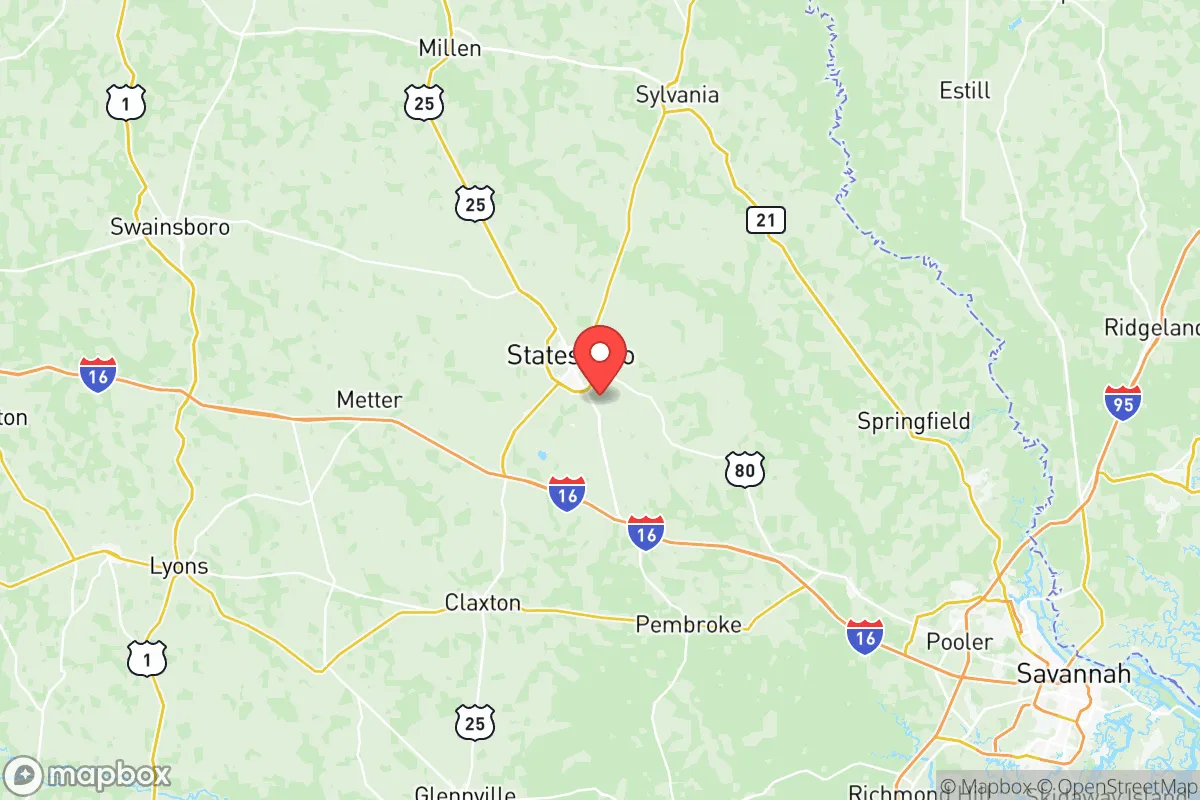
The post-1965 era in Bulloch County is defined less by international immigration and more by domestic migration and suburbanization. The 1965 Hart-Cellar Act had minimal direct impact here—the foreign-born share remains just 2.0%—but the county's growth since the 1970s has been driven by the expansion of Georgia Southern University and the spillover of population from Savannah, located roughly 50 miles southeast. Statesboro has absorbed most of this growth, evolving from a sleepy college town into a small city of nearly 35,000, with new subdivisions spreading along U.S. Highway 301 and Georgia Highway 67.
The Black population, which had declined during the Great Migration, stabilized and then grew slightly as African American families returned to the region for lower costs and family ties. Today, Black residents make up 28.2% of the county, concentrated in Statesboro's older neighborhoods and in rural communities like Nevils and Stilson. The Hispanic population, though still small at 5.0%, has grown noticeably since 2000, driven by labor demand in construction, poultry processing, and agriculture. Most Hispanic residents are Mexican or Central American, and they have settled primarily in Statesboro and in the farming areas around Denmark and Hopeulikit, where they work in the region's poultry plants and blueberry fields.
Asian and Indian communities remain tiny—0.9% and 0.5% respectively—and are almost entirely tied to Georgia Southern University. Faculty, graduate students, and medical professionals from East and Southeast Asia (primarily Chinese, Korean, and Vietnamese) and from the Indian subcontinent live in Statesboro, often in neighborhoods near campus like the Fairwood area. There is no distinct ethnic enclave; these populations are dispersed and highly educated. The white population, at 61.8%, remains the majority, but its share has declined slightly as the county diversifies. Many white residents are native-born Georgians, often from multi-generational Bulloch County families, though a growing number are retirees and remote workers moving from Atlanta and the Northeast for lower housing costs.
The future
Bulloch County is slowly becoming more diverse, but the pace is gradual. The Hispanic share is projected to rise to 7-8% by 2035, driven by continued labor demand in agriculture and construction, while the Black share is expected to hold steady or increase slightly as African American families continue to return from Northern cities. The Asian and Indian populations will likely grow modestly as Georgia Southern expands its international recruitment, but they will remain small and concentrated in Statesboro. The white population, while still the majority, will continue its slow relative decline as the county's overall growth comes from minority groups and from domestic in-migration of younger, more diverse families.
Geographically, most future growth will concentrate in Statesboro and along the Highway 67 corridor toward Savannah, where new subdivisions and apartment complexes are already under construction. Rural areas like Adabelle and Leefield will likely see little change, remaining small, tight-knit communities of longtime residents. The county's cultural identity is evolving from a purely rural, agricultural society into a hybrid of college town and exurban bedroom community, with a growing emphasis on healthcare, education, and logistics jobs. Political leanings are likely to remain conservative, though the university's presence may introduce a small liberal counterweight over time.
For someone moving in now, Bulloch County offers a stable, affordable, and family-friendly environment with a strong sense of place. The population is still overwhelmingly native-born and rooted in Southern traditions, but the slow diversification and the university's influence are creating a more varied social landscape. Newcomers will find a community that values faith, family, and hard work, with the convenience of Savannah's amenities an hour away and the quiet of rural Georgia at their doorstep.

* Values derived from national, state, county, city and local statistics and may differ in a specific area. Last updated: 2026-06-17T10:01:58.000Z
Narrative content on this page is AI-generated and may contain mistakes. Verify any details that matter before acting on them.
ReloMaps may earn a commission from affiliate links at no extra cost to you.

