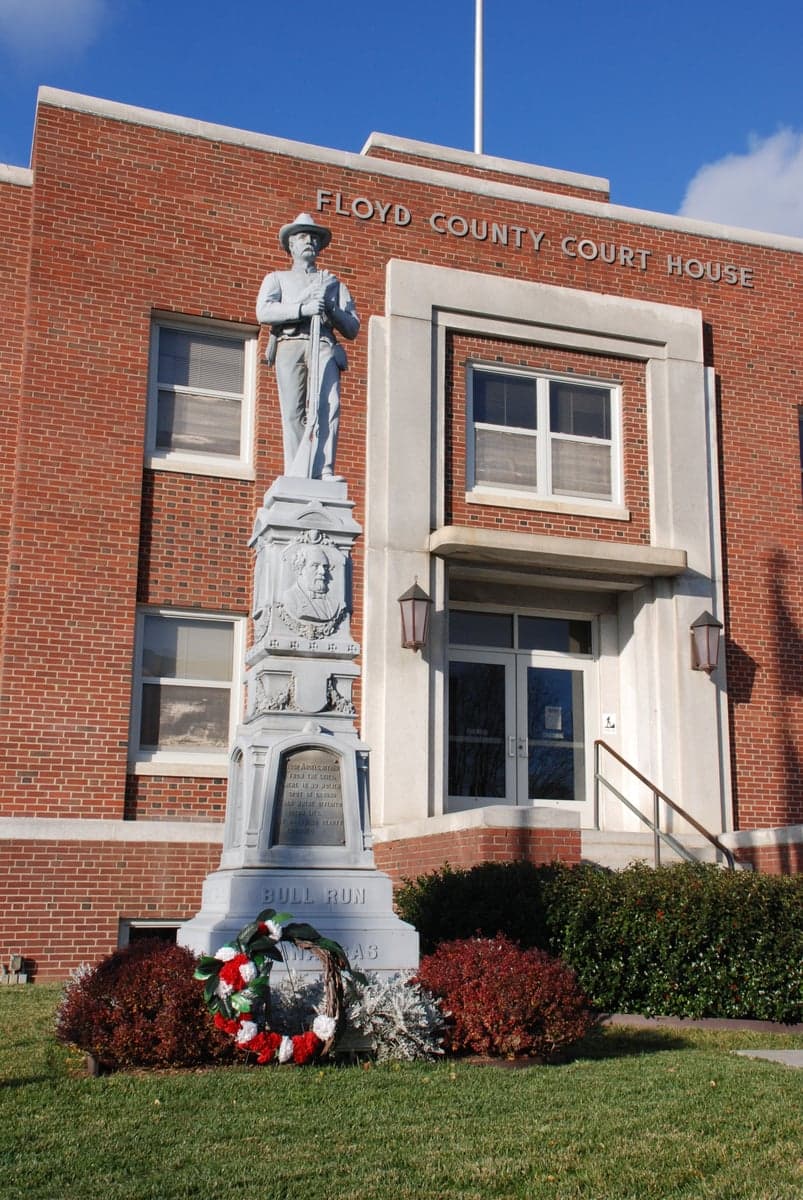
Photo: Wikipedia
Political ClimatePolitical Climate in Floyd, VA
District shown is the primary district for this city’s centroid. Cities may span multiple districts.
Local Political AnalysisPolitical Analysis of Floyd, VA
Floyd, Virginia, is one of the most politically distinctive places in the commonwealth—a deep-red rural county with a Cook PVI of R+22, yet one that has developed a quirky, countercultural streak that makes it far more complex than a simple partisan label. The county has voted reliably Republican for decades, but the presence of the Floyd Country Store, the annual FloydFest music festival, and a steady influx of artists and retirees from Northern Virginia and the Piedmont have created a unique blend of old-time Appalachian conservatism and progressive hippie energy. That tension is the defining feature of local politics, and it shows no signs of resolving anytime soon.
How it compares
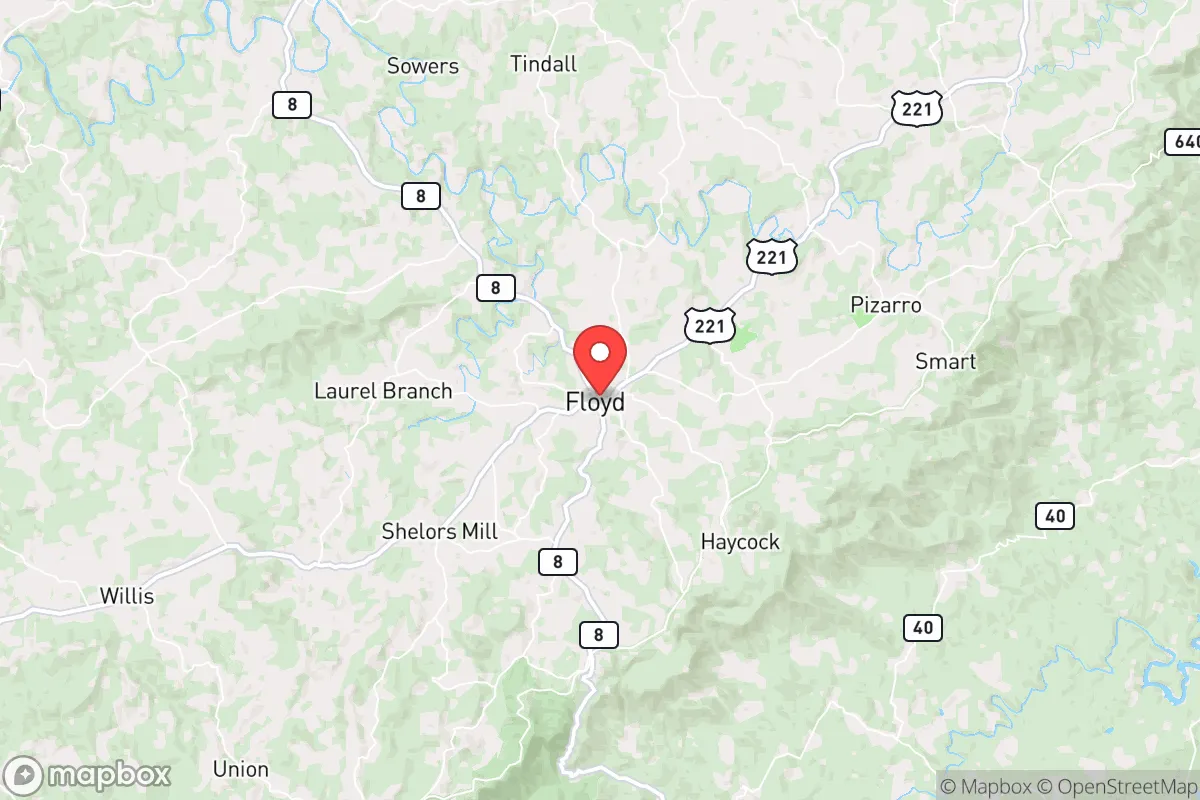
The contrast between Floyd and the rest of Virginia is stark. The state as a whole carries a Cook PVI of D+4, powered by the urban crescent stretching from Northern Virginia through Richmond to Hampton Roads. Floyd sits in the Blue Ridge Highlands, roughly 45 minutes from Roanoke and about an hour from Blacksburg, home to Virginia Tech. While Blacksburg and Roanoke lean Democratic, Floyd County itself remains solidly Republican—Trump won the county by roughly 30 points in 2020, and local races for sheriff, commonwealth's attorney, and board of supervisors are typically decided in GOP primaries. The political geography is a classic rural-versus-urban split: the farther you get from the college towns and the interstate corridors, the redder the map becomes.
What this means for residents
For conservative residents, Floyd's lean means local government is generally aligned with their values—taxes are kept low, gun rights are respected, and the county has resisted the kind of zoning and land-use regulations that are common in Northern Virginia. The board of supervisors and school board are dominated by Republicans, and the county has voted against Democratic statewide candidates by wide margins in every recent cycle. For liberal residents, the reality is more nuanced. They are a visible minority, especially in the town of Floyd itself, where progressive candidates can win local races and the arts community thrives. But they have learned to work within the system—showing up at county meetings, building coalitions with conservative neighbors on issues like land preservation and opposition to large-scale development, and accepting that statewide Democratic candidates will not carry the county. The practical effect is a politics of pragmatism: both sides know they need to talk to each other to get anything done.
Culturally, Floyd is a case study in how a deep-red area can still harbor a vibrant progressive subculture. The town of Floyd (population around 450) is a weekend destination for music lovers, with the Floyd Country Store's Friday Night Jamboree drawing crowds that are as likely to include a Berkeley transplant as a fifth-generation farmer. The county has a strong local food movement, a thriving craft beverage scene, and a reputation for welcoming outsiders—even as it votes overwhelmingly for Republican candidates. That duality is the source of both the area's charm and its occasional friction. Newcomers sometimes arrive expecting a liberal enclave and are surprised by the political reality; longtime residents sometimes worry that the influx of outsiders will eventually shift the county's politics. So far, it hasn't—the R+22 PVI has held steady through multiple cycles—but the cultural transformation is real, and it is the reason Floyd is often described as "the Berkeley of the Blue Ridge."

State Political ClimatePolitical Climate in Virginia
State Political AnalysisPolitical Environment in the State
Virginia has shifted from a reliably red state to a solidly Democratic one over the past two decades, now carrying a Cook PVI of D+4. The transformation is driven almost entirely by explosive growth in the Washington, D.C. suburbs—Fairfax, Loudoun, and Prince William counties—which now dwarf the rest of the state in raw votes. A state that voted for George W. Bush in 2004 by 8 points voted for Joe Biden in 2020 by 10, and the trajectory shows no sign of reversing.
Urban vs. rural divide
The political map of Virginia is a tale of two commonwealths. The urban crescent—Northern Virginia, Richmond, and Hampton Roads—is overwhelmingly Democratic. Fairfax County alone casts more votes than the entire western half of the state, and Loudoun County, once a rural exurb, is now one of the most Democratic large counties in the nation. Richmond's rapid gentrification and the growth of Virginia Beach's younger, more diverse population have cemented Democratic control of the major metros.
Meanwhile, the rural south and west remain deeply Republican. Places like Roanoke, Lynchburg, and the Shenandoah Valley towns of Harrisonburg and Staunton anchor a conservative coalition that has been losing ground numerically for two decades. The 2021 gubernatorial race showed the divide clearly: Republican Glenn Youngkin won 90 of 95 counties but lost the statewide popular vote to Democrat Terry McAuliffe by 2 points, carried entirely by the urban crescent. The 2023 legislative elections confirmed the pattern—Democrats won the House of Delegates and Senate by sweeping the suburbs, while Republicans were left with a geographically vast but numerically shrinking rural base.
Policy environment
Virginia's policy environment is a study in contrasts. The state has a right-to-work law, a 6% corporate income tax, and a flat 5.75% individual income tax rate—all relatively business-friendly. Property taxes are set locally and are moderate by national standards. But the regulatory posture has shifted left in recent years, particularly on energy and labor. Virginia joined the Regional Greenhouse Gas Initiative (RGGI) in 2020, then Youngkin pulled the state out in 2023, only for a court to rule he lacked the authority—a back-and-forth that illustrates the policy whiplash.
Education policy is the most contested arena. Youngkin's 2021 campaign centered on parental rights, and he signed executive orders banning mask mandates and critical race theory in schools. The state's public schools remain highly rated, particularly in Northern Virginia, but the curriculum battles have energized both bases. Election laws are moderate: Virginia has no voter ID requirement, offers same-day registration, and has no-excuse absentee voting. Gun laws have tightened under Democratic control—the 2020 General Assembly passed universal background checks, a red flag law, and a one-handgun-per-month limit.
Recent policy direction
The last five years have seen Virginia swing hard on several fronts. On guns, the 2020 package was the most significant expansion of firearm regulation in state history, and Youngkin's 2022 veto of a bill to ban assault weapons shows the issue remains live. On abortion, Virginia is the last Southern state without a near-total ban—Democrats blocked Youngkin's proposed 15-week limit in 2023, and the issue is expected to dominate the 2025 gubernatorial race. On parental rights, Youngkin signed a model policy requiring schools to notify parents of curriculum changes and allowing them to opt children out of certain materials.
On taxes, Youngkin signed a $4 billion tax cut package in 2022, including the first income tax rate reduction in decades. On energy, the state is committed to a 100% carbon-free grid by 2050 under the Virginia Clean Economy Act, though Youngkin's RGGI exit attempt signals ongoing friction. On voting, the state has expanded access—automatic voter registration, early voting centers, and no-excuse absentee—making it one of the easier states to cast a ballot in the South.
Civil unrest & political movements
Virginia has been a flashpoint for national political movements. The 2017 Unite the Right rally in Charlottesville, which turned deadly, remains a defining moment—it galvanized both white nationalist organizing and a massive counter-mobilization, and the city's removal of Confederate statues became a template for the national reckoning. Richmond's Monument Avenue saw similar removals during the 2020 George Floyd protests, which were large and occasionally violent.
Immigration politics are quieter but present. Northern Virginia's sanctuary policies—Fairfax and Arlington counties limit cooperation with ICE—are a point of contention with rural Republicans. The 2023 fight over a proposed data center moratorium in Prince William County showed how growth and environmental concerns are reshaping even the Democratic coalition. Election integrity controversies have been muted compared to other states, though Youngkin's 2021 victory and the subsequent Democratic sweep in 2023 have both sides claiming the system works when they win.
Projection
Over the next decade, Virginia's Democratic lean will likely deepen. The D.C. suburbs continue to add tens of thousands of residents annually, and the in-migration is overwhelmingly college-educated and left-leaning. The 2025 gubernatorial race will be a test—Youngkin's popularity suggests Republicans can still compete with the right candidate, but the structural math is against them. The rural exodus is accelerating: counties like Buchanan and Wise in the far southwest are losing population every year, shrinking the Republican base further.
By 2030, expect Virginia to look more like Maryland—a solidly blue state with a Republican minority concentrated in the west and south. The policy implications are significant: gun restrictions will likely tighten, abortion access will remain protected, and the state's energy transition will accelerate. For a conservative relocator, the state will feel increasingly like a blue enclave outside the rural pockets. For a liberal relocator, it will feel like a safe harbor in the South.
For anyone moving to Virginia, the practical takeaway is this: your experience will depend almost entirely on where you land. Northern Virginia and Richmond offer a blue, cosmopolitan environment with high costs and excellent schools. The Shenandoah Valley and Southside offer a red, rural lifestyle with lower costs and a slower pace. The state government will likely remain Democratic for the foreseeable future, so conservative residents should expect continued liberal policy on guns, abortion, and education—but the state's business climate and tax structure remain comparatively friendly. Choose your county carefully; in Virginia, the locality matters more than the state.
* Values derived from national, state, county, city and local statistics and may differ in a specific area. Last updated: 2026-10-13T18:25:56.000Z
Narrative content on this page is AI-generated and may contain mistakes. Verify any details that matter before acting on them.
ReloMaps may earn a commission from affiliate links at no extra cost to you.

