Photo: Wikipedia
Demographics of Floyd, VA
Affluence Level in Floyd, VA
A middle-class area roughly in line with national averages across income, home values, education, and employment.
People of Floyd, VA
Floyd, Virginia, is a small Blue Ridge Mountain town of roughly 510 residents that remains overwhelmingly white (88.4%) and almost entirely American-born, with zero foreign-born residents recorded in the latest data. The town’s identity is a blend of old Appalachian farming stock, a notable Hispanic minority of 8.2%, and a significant college-educated cohort of 36.8% that reflects its reputation as an arts and music hub. Despite its tiny size, Floyd is a cultural crossroads where traditional mountain life meets a creative-class influx, making it demographically distinct from the surrounding county.
How the city was settled and grew
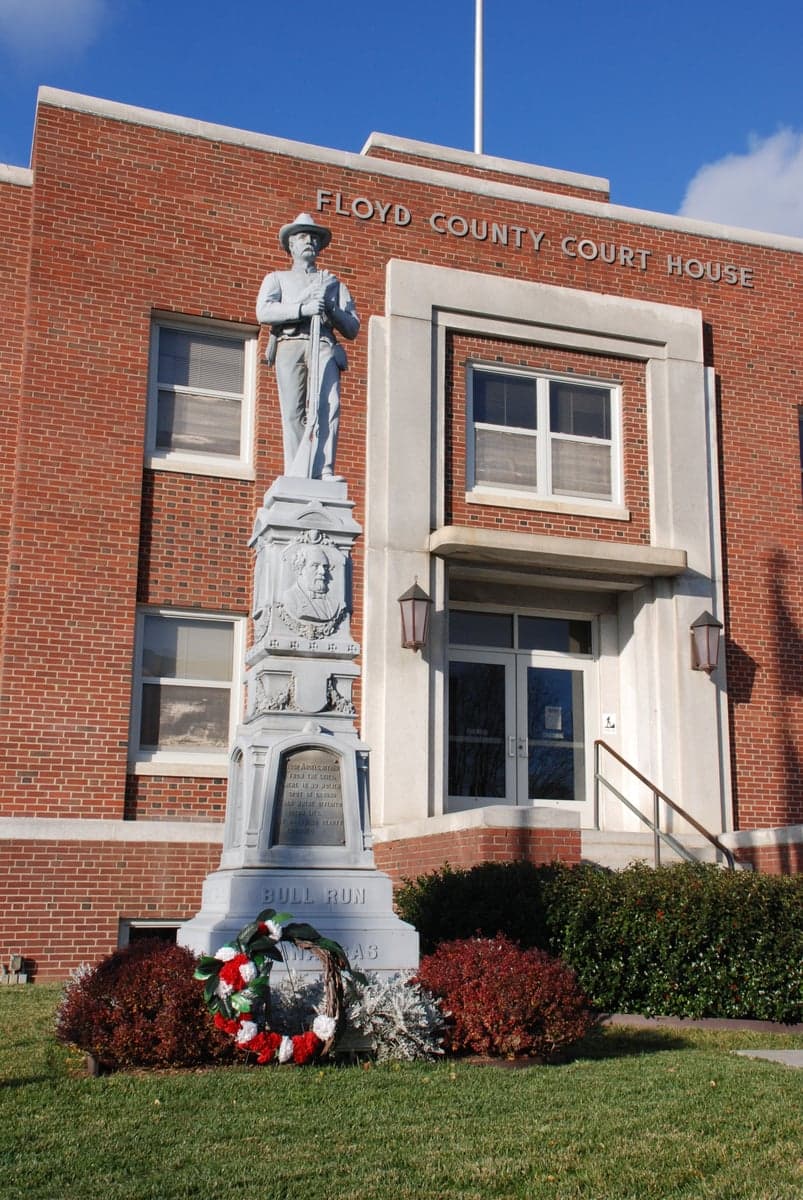
Floyd was established in 1831 as the county seat of the newly formed Floyd County, carved out of neighboring Montgomery County. The original settlers were predominantly Scots-Irish and English yeoman farmers who moved south and west along the Great Wagon Road in the late 18th and early 19th centuries, drawn by cheap land grants in the Blue Ridge foothills. These families—names like Weddle, Conner, and Slusher still appear on local roads—built the town’s earliest homes around the courthouse square, an area now known as Downtown Floyd, which remains the historic and commercial core. The arrival of the railroad in the early 1900s bypassed Floyd proper, which slowed industrial growth but preserved the town’s agrarian character; the surrounding Little River District and Alum Ridge areas became the heart of the apple and livestock economy that sustained the population through the mid-20th century. Unlike many Virginia towns, Floyd never experienced a major immigrant wave in this era—its growth came almost entirely from natural increase and modest in-migration from nearby rural counties.
Modern era (post-1965)
The post-1965 period brought a quiet but significant transformation. The 1970s counterculture movement drew a wave of back-to-the-land migrants—artisans, musicians, and homesteaders—who settled in the Check and Willis areas just outside town, establishing the craft and music scene that now anchors Floyd’s identity. This influx was overwhelmingly white and college-educated, and it accelerated after the 1990s as the Floyd Country Store on Locust Street became a regional draw for Americana music, attracting retirees and remote workers. The Hispanic population, now 8.2%, began arriving in the 1990s and 2000s, primarily as agricultural laborers in the county’s apple orchards and poultry operations; these families have concentrated in the Simpsons and Burks Fork areas, working in the packing sheds and farms that ring the town. The Black population, at 2.0%, is a small but long-standing presence, descended from families who worked the region’s tobacco and timber industries in the early 1900s, though their numbers have declined as younger generations moved to larger cities. The Asian and Indian populations are effectively zero, and the foreign-born share is 0.0%, making Floyd one of the least internationally diverse towns in Virginia.
The future
Floyd’s population is aging and slowly diversifying, though the pace is glacial. The 36.8% college-educated share is nearly double the county average, and that educated cohort is driving a steady influx of remote workers and retirees drawn to the music scene and mountain scenery—a trend that is likely to continue as broadband access improves. The Hispanic share, currently 8.2%, is the fastest-growing segment, driven by second-generation families moving from farm labor into construction, hospitality, and small business; these families are dispersing beyond the agricultural areas into Downtown Floyd and the Meadow area, where a small but visible Latino business presence has emerged. The white population, while still dominant, is aging, and the town’s under-18 cohort is more diverse than its over-65 cohort, suggesting a slow but real shift. Over the next 10-20 years, expect Floyd to remain overwhelmingly white and American-born, but with a growing Hispanic minority, a stable Black community, and a continued influx of educated newcomers who will likely reinforce the town’s arts-and-crafts identity rather than dilute it.
For someone moving to Floyd now, the town offers a rare combination: a deeply rooted Appalachian culture with a progressive artistic overlay, a population that is still 88% white but gradually becoming more Hispanic, and a social fabric where the courthouse square and the music venue matter more than any demographic divide. The practical reality is that Floyd is a small, safe, and increasingly well-educated community where newcomers—especially those with remote income—will find a welcoming but close-knit environment, and where the demographic future is one of slow, manageable change rather than rapid transformation.

* Values derived from national, state, county, city and local statistics and may differ in a specific area. Last updated: 2026-10-13T18:25:56.000Z
Narrative content on this page is AI-generated and may contain mistakes. Verify any details that matter before acting on them.
ReloMaps may earn a commission from affiliate links at no extra cost to you.

