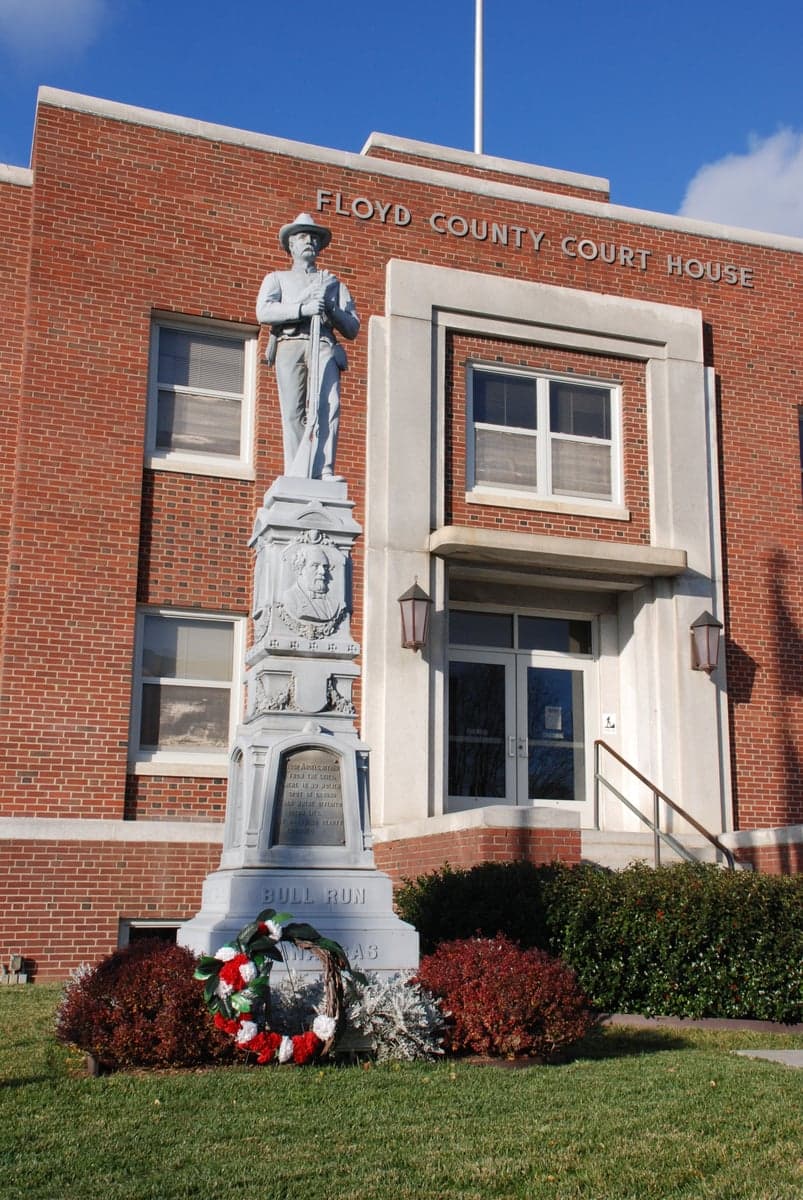
Photo: Wikipedia
Personal Sovereignty in Floyd, VA
Viable for self-reliance. Generally workable, though some barriers may limit total independence.
What does Personal Sovereignty tell us?
Personal Sovereignty measures your capacity for self-reliance and independence with minimal government friction. Higher scores mean fewer barriers between you and the way you want to live... but it assumes you have the space you need and good neighbors.
What does this tell us?
Personal Sovereignty measures your capacity for self-reliance and independence with minimal government friction. Higher scores mean fewer barriers between you and the way you want to live... but it assumes you have the space you need and good neighbors.
State Policy
Energy independence: Importer (20% of energy produced in-state)
Personal Liberty
Homesteading

Personal Liberty Analysis
Floyd, Virginia, offers one of the stronger personal sovereignty environments in the mid-Atlantic, combining a light-touch county regulatory culture with Virginia’s generally permissive self-defense statutes and a deep local tradition of self-reliance. For a relocation reader weighing autonomy, the key takeaway is that Floyd County’s rural character translates into fewer layers of local oversight than you would find in Northern Virginia or even the New River Valley metros, while the state’s uniform legal framework still sets the outer boundaries. The practical result is a place where individual initiative — whether in housing, energy, or livelihood — faces fewer bureaucratic hurdles than in most of the eastern U.S.
Tax burden and regulatory posture in Floyd County
Virginia’s tax structure is moderate overall, but Floyd County’s local choices push the effective burden toward the lighter end. The county’s real property tax rate sits around $0.50 per $100 of assessed value, which is notably below the state average and roughly half of what you would pay in nearby Roanoke City. There is no county-level personal property tax on household goods, and the state’s income tax is a flat 5.75% with no local add-on, keeping the combined marginal rate predictable. Sales tax in Floyd is 5.3% — the state minimum plus a regional 1% — which is lower than the 6% or more charged in most Virginia localities.
Regulatory posture is where Floyd distinguishes itself. The county has no zoning ordinance covering most unincorporated land, meaning a property owner can generally use their land for residential, agricultural, or light commercial purposes without seeking a special-use permit. Building permits are required for new structures, but the county’s inspection office operates with a small staff and a practical, non-adversarial reputation. There is no county-wide noise ordinance, no business license fee for home-based enterprises, and no local minimum wage, leaving the state’s $12.00/hour floor as the only constraint. For someone wanting to run a workshop, a farm stand, or a trade business from their property, the administrative overhead is minimal.
Self-defense and gun law specifics in Virginia
Virginia is a shall-issue state for concealed carry, and Floyd County’s circuit court issues permits routinely to applicants who pass the background check and complete the required training. No permit is needed to open carry a handgun in Virginia, and the state recognizes permits from all other states via reciprocity agreements, which matters for residents who travel. The state’s Castle Doctrine is strong: there is no duty to retreat in one’s dwelling, and Virginia law presumes that a person who uses defensive force against an unlawful intruder in their home or vehicle acted with reasonable fear of death or great bodily harm.
Floyd County’s sheriff’s office is publicly supportive of the Second Amendment, and the county has formally declared itself a Second Amendment sanctuary — a resolution that signals local enforcement priorities rather than changing law. Magazine capacity is unrestricted, and there is no state-level assault weapons ban, no waiting period for long guns, and no registration requirement. The main state-level constraints are the universal background check for private handgun transfers (effective 2020) and a one-handgun-per-month purchase limit. For a relocation reader, the practical takeaway is that Floyd offers a permissive firearms environment with predictable, non-discretionary permitting.
Homesteading and off-grid viability: lot sizes, zoning, and feasibility
Floyd County’s rural land market makes genuine self-reliance financially achievable. Unimproved parcels of 5 to 20 acres commonly list between $3,000 and $6,000 per acre, and the county’s lack of zoning means there is no minimum lot size for agricultural use — a 2-acre parcel can support a house, a barn, and a market garden without special approvals. The county does enforce the state’s building code, but it has no local requirement for engineered septic systems on standard soils; a conventional gravity-fed drainfield approved by the health department is the norm.
Off-grid living is feasible but requires planning around two constraints. First, the county requires a certificate of occupancy before a dwelling can be inhabited, which means the structure must pass basic electrical and structural inspection — a fully unpermitted cabin will not get that certificate. Second, Virginia’s Uniform Statewide Building Code applies, so a straw-bale or earth-sheltered home will need an engineer’s stamp. That said, solar panels, rainwater collection, and composting toilets are all legal without special permits, and the county does not require connection to any utility grid. Many residents heat with wood, and the county’s agricultural zoning (or lack thereof) allows keeping livestock, including poultry, goats, and cattle, on modest acreage.
Personal liberties: parental rights, medical autonomy, speech, and property
Virginia’s legal framework gives Floyd residents a solid baseline for personal autonomy, with some notable caveats. On parental rights, the state requires parental consent for a minor’s medical treatment, and Virginia law explicitly affirms that parents have a fundamental right to direct their child’s upbringing, education, and care. Homeschooling is straightforward: parents file a simple notice of intent with the local school division and provide evidence of progress annually; Floyd County Public Schools processes these filings without the friction reported in some urban districts. The county has no local mask mandates, vaccine requirements, or school health mandates beyond the state’s standard immunization schedule, which includes a philosophical exemption option.
Medical autonomy is more mixed. Virginia does not have a state-level right-to-try law for experimental treatments beyond the federal statute, and the state’s Board of Medicine maintains conventional licensing requirements that limit access to alternative practitioners. However, there is no state income tax on retirement income, which indirectly supports the self-directed lifestyle many sovereignty-minded retirees seek. On speech, Floyd is a normal First Amendment jurisdiction — no local ordinances restrict signage, public assembly, or expressive activity beyond standard time-place-manner rules. Property rights are the strongest pillar: the lack of zoning, combined with Virginia’s right-to-farm law that protects agricultural operations from nuisance suits, means a landowner has substantial control over their property’s use.
Overall sovereignty relative to other regions
Compared to the broader U.S. landscape, Floyd ranks in the top tier for personal sovereignty among eastern localities — comparable to rural counties in West Virginia or upstate New York’s “North Country,” but with better climate and lower land prices than either. It is not a libertarian enclave like Grafton, New Hampshire, or a low-tax state like Texas; Virginia’s income tax and universal background check are real constraints. But the combination of no county zoning, a shall-issue carry regime, a right-to-farm statute, and a county government that defaults to “yes” on land use creates a practical autonomy that most of the Northeast and West Coast simply cannot match. For a family or individual who wants to live largely self-directed — growing food, carrying a firearm, schooling at home, and building a life without asking permission — Floyd County delivers that at a price point that remains accessible.

* Values derived from national, state, county, city and local statistics and may differ in a specific area. Last updated: 2026-10-13T18:25:56.000Z
Narrative content on this page is AI-generated and may contain mistakes. Verify any details that matter before acting on them.
ReloMaps may earn a commission from affiliate links at no extra cost to you.

