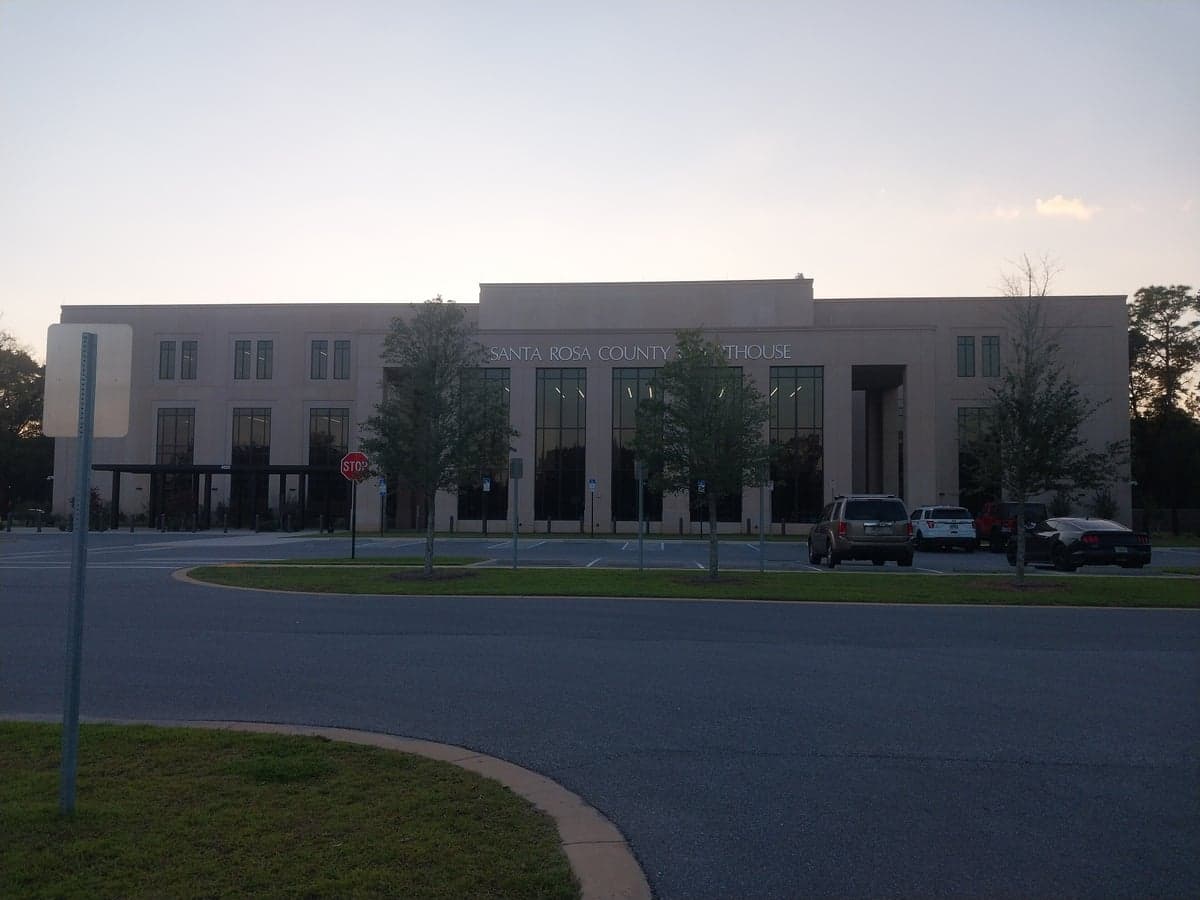
Photo: Wikipedia
Political ClimatePolitical Climate in Santa Rosa County
Showing county-level results — no local-only data available.
Lean and PVI are calculated from this county’s 2020 and 2024 presidential results, Cook-style.
Political rankings in Florida
- Most Conservative Cities in Florida
- Most Liberal Cities in Florida
- Best Liberal-Leaning Towns in the South
- Safest Liberal-Leaning Towns in the South
- Safest Conservative-Leaning Towns in the South
- Safest Liberal-Leaning Towns on the East Coast
- Safest Conservative-Leaning Towns on the East Coast
- Affordable Small Towns for Conservatives
- Most Conservative Counties in Florida
- Most Liberal Counties in Florida
Local Political AnalysisPolitical Analysis of Santa Rosa County
Santa Rosa County is one of the most reliably Republican areas in the Florida Panhandle, with a Cook Partisan Voting Index (PVI) of R+26, meaning it votes about 26 points more Republican than the national average. The county has been trending redder over the past decade, driven by an influx of conservative-leaning retirees and families from higher-tax states, as well as the out-migration of younger, more moderate residents to nearby Escambia County or Pensacola. While the surrounding state of Florida as a whole is a competitive swing state with a slight Republican lean (R+3), Santa Rosa County is a deep-red stronghold where Democratic candidates rarely crack 35% of the vote in presidential elections.
How it compares to Florida as a whole
The political gap between Santa Rosa County and the rest of Florida is stark. While Florida’s statewide races are often decided by single-digit margins, Santa Rosa County consistently delivers Republican victories by 20 to 30 points. For example, in the 2024 presidential election, Donald Trump carried the county with roughly 72% of the vote, compared to about 56% statewide. This divergence is partly because Santa Rosa lacks the large urban centers (like Miami, Orlando, or Tampa) that drive Democratic turnout in Florida. Instead, the county is dominated by exurban and rural communities such as Milton, Pace, Gulf Breeze, and Navarre, where conservative values and gun rights are deeply embedded. The only precincts that occasionally lean blue are in the more affluent, waterfront parts of Gulf Breeze and a small pocket near the University of West Florida border in Pace, but even those are still reliably Republican by national standards.
What this means for residents
For conservative residents, the political climate is highly comfortable. Local government, school boards, and law enforcement are overwhelmingly Republican, and policies around taxes, development, and Second Amendment rights tend to be permissive. There are no major cultural friction points for conservatives, and the county’s rapid growth (population up about 15% since 2020) has been managed with a pro-business, low-regulation approach. For liberal or moderate residents, the reality is more isolating. Democratic candidates rarely campaign in the county, and progressive viewpoints are often marginalized in local media and civic discourse. That said, the county’s growing diversity—especially in Navarre and Gulf Breeze—has created small but vocal pockets of progressive activism, particularly around environmental issues like the protection of the Blackwater River and opposition to overdevelopment. Still, these groups face an uphill battle in a county where voter registration is roughly 60% Republican, 25% Democratic, and 15% independent.
One cultural distinction worth noting is the county’s strong military influence. Santa Rosa County is home to parts of Whiting Field Naval Air Station and is a bedroom community for personnel stationed at nearby NAS Pensacola and Eglin Air Force Base. This military presence reinforces the area’s conservative lean, but it also fosters a sense of community service and patriotism that transcends party lines. Residents, regardless of political affiliation, tend to rally around veterans’ causes and local disaster response efforts. Looking ahead, the county’s political trajectory seems locked in for the near term, though continued in-migration from blue states could slowly moderate the edge over the next decade—but don’t expect Santa Rosa to become a swing county anytime soon.

State Political ClimatePolitical Climate in Florida
State Political AnalysisPolitical Environment in the State
Florida has transformed from a quintessential swing state into a solidly Republican-leaning powerhouse over the past decade, with a registered Republican voter advantage of over 800,000 as of 2026. The state’s political trajectory has been a sharp rightward shift since 2020, driven by a massive influx of conservative-leaning domestic migrants from the Northeast and Midwest, combined with a state GOP that has consolidated power under Governor Ron DeSantis. While Democrats still hold sway in dense urban cores and some suburban pockets, the statewide lean is now unmistakably red, with Republicans controlling the governorship, both chambers of the legislature, and both U.S. Senate seats.
Urban vs. rural divide
The political map of Florida is a textbook study in geographic polarization. The Democratic strongholds are concentrated in the urban corridors of Miami-Dade County (though it has shifted right significantly since 2020), Orlando (Orange County), and Tampa (Hillsborough County). These areas deliver massive raw vote margins for Democrats, but they are increasingly surrounded by deep-red suburbs and exurbs. The Republican base is anchored in the sprawling I-4 corridor suburbs like Lakeland and The Villages, the entire Panhandle from Pensacola to Tallahassee’s outskirts, and the fast-growing Gulf Coast cities like Naples and Sarasota. The most dramatic shift has been in Miami-Dade, where Cuban-American and Venezuelan-American voters have swung hard toward the GOP, flipping the county from a 29-point Democratic margin in 2016 to a near-tie in 2024. Meanwhile, Duval County (Jacksonville) has trended red, while Pinellas County (St. Petersburg) remains a competitive bellwether.
Policy environment
Florida’s policy environment is defined by a low-tax, low-regulation posture that appeals directly to conservative relocators. The state has no personal income tax, a corporate income tax rate of 5.5%, and a 6% state sales tax (local options can push it to 8.5%). Property taxes are levied at the county level, with a $50,000 homestead exemption that keeps effective rates moderate. The regulatory climate is business-friendly, with streamlined permitting and a right-to-work law that limits union power. Education policy has been a flashpoint: the state pioneered school choice with the Tax Credit Scholarship program and expanded universal school vouchers in 2023, making Florida a national leader in educational freedom. Healthcare policy is market-oriented, with no state-level individual mandate and a limited Medicaid expansion (only covering pregnant women and children up to 200% of the federal poverty level). Election laws have been tightened since 2020, with stricter voter ID requirements, limits on drop boxes, and a ban on ballot harvesting. The state also has a "stand your ground" self-defense law and a constitutional carry law (permitless carry) passed in 2023.
Recent policy direction
The last three years have seen a cascade of legislation that has cemented Florida as a laboratory for conservative governance. The Parental Rights in Education Act (HB 1557, 2022), dubbed "Don't Say Gay" by critics, restricts classroom instruction on sexual orientation and gender identity through third grade. The Stop WOKE Act (HB 7, 2022) limits workplace and educational training on race and identity. On gun rights, the constitutional carry law (SB 150, 2023) allows permitless concealed carry for anyone 21 or older. On immigration, the state passed SB 1718 (2023), which mandates E-Verify for employers with 25+ workers, bans local sanctuary policies, and requires hospitals to ask about immigration status. On medical freedom, Florida banned COVID-19 vaccine mandates for private employers and schools in 2021, and in 2023 prohibited mRNA vaccine mandates entirely. On property rights, the state has preempted local rent control ordinances and limited local government authority over short-term rentals (like Airbnb). On voting, SB 90 (2021) restricted drop boxes, limited third-party ballot collection, and required signature matching. On abortion, the state passed a six-week abortion ban (HB 5, 2023), which took effect in 2024 after the Florida Supreme Court upheld the 15-week ban. On privacy, the state has no comprehensive data privacy law, but it does have a biometric privacy law (similar to Illinois' BIPA) and a ban on social media censorship of political speech (SB 7072, 2021).
Civil unrest & political movements
Florida has seen its share of political flashpoints, but the intensity has cooled since the peak of the COVID-19 era. The Black Lives Matter protests in 2020 were large and sometimes violent in Miami, Orlando, and Tampa, but no sustained movement has emerged. The Stop the Steal movement had a significant presence, with rallies at the state capitol and in The Villages, but no major election-related violence occurred. Immigration politics are a constant undercurrent, especially in South Florida, where the Miami-Dade County Commission passed a symbolic resolution in 2023 declaring the county a "non-sanctuary" jurisdiction. The state has seen organized protests against the Parental Rights in Education Act and the abortion ban, with large rallies at the capitol and in downtown Miami. The Florida Democratic Party has struggled to maintain relevance, with internal divisions between moderates and progressives. The most visible political movement is the DeSantis-aligned conservative coalition, which has successfully pushed through the legislative agenda described above. A new resident would notice the ubiquity of political signage, especially in suburban and rural areas, and the active presence of local Republican clubs and conservative activist groups.
Projection
Over the next 5-10 years, Florida is likely to become even more Republican, but the margin of dominance may narrow as the state's population continues to diversify. The in-migration from blue states is overwhelmingly conservative-leaning, but it is also bringing younger, more diverse families who may not align perfectly with the current GOP platform. The I-4 corridor will remain the key battleground, with suburbs like Winter Garden and Lake Nona (Orlando area) trending purple. The Miami-Dade shift is likely to continue, but the county may stabilize as a competitive toss-up rather than a Republican lock. The state's aging population (The Villages, Naples, Sarasota) will remain deeply conservative, while younger voters in Tampa and Orlando may push back on some social policies. The biggest wildcard is climate change: rising sea levels and hurricane intensity could reshape migration patterns and insurance costs, potentially slowing growth in coastal areas. A new resident moving in now should expect a state that is politically stable and conservative, with a government that is actively shaping national policy debates, but also one where local politics vary dramatically from county to county.
For a new resident, the bottom line is that Florida offers a low-tax, business-friendly environment with a government that is actively pursuing a conservative social and economic agenda. If you align with that agenda, you will find a state that is welcoming and aligned with your values. If you lean left, you will find vibrant urban communities in Miami, Orlando, and Tampa where you can live comfortably, but you will have little influence on state-level policy. The practical takeaway is that Florida is not a swing state anymore—it is a red state with blue cities, and the trajectory is toward more red. Choose your county carefully, because the political culture of Miami Beach is a world away from Pensacola, and your day-to-day experience will be shaped more by local government than by Tallahassee.
* Values derived from national, state, county, city and local statistics and may differ in a specific area. Last updated: 2026-11-17T22:31:04.000Z
Narrative content on this page is AI-generated and may contain mistakes. Verify any details that matter before acting on them.
ReloMaps may earn a commission from affiliate links at no extra cost to you.

