Photo: Wikipedia
Demographics of Santa Rosa County
Affluence Level in Santa Rosa County
A middle-class area roughly in line with national averages across income, home values, education, and employment.
People of Santa Rosa County
Santa Rosa County, Florida, is home to 193,719 residents, a population that is 79.1% White, 6.6% Hispanic, 5.5% Black, and 1.9% East/Southeast Asian, with a notably low foreign-born share of just 1.6%. The county’s character is defined by its blend of rural Panhandle tradition and rapidly expanding military-adjacent suburbs, anchored by the cities of Milton and Gulf Breeze. Its people are predominantly native-born, politically conservative, and increasingly drawn from other parts of Florida and the U.S. South, creating a community that values space, affordability, and proximity to both Eglin Air Force Base and the Gulf Coast beaches.
Settlement & growth (pre-1960)
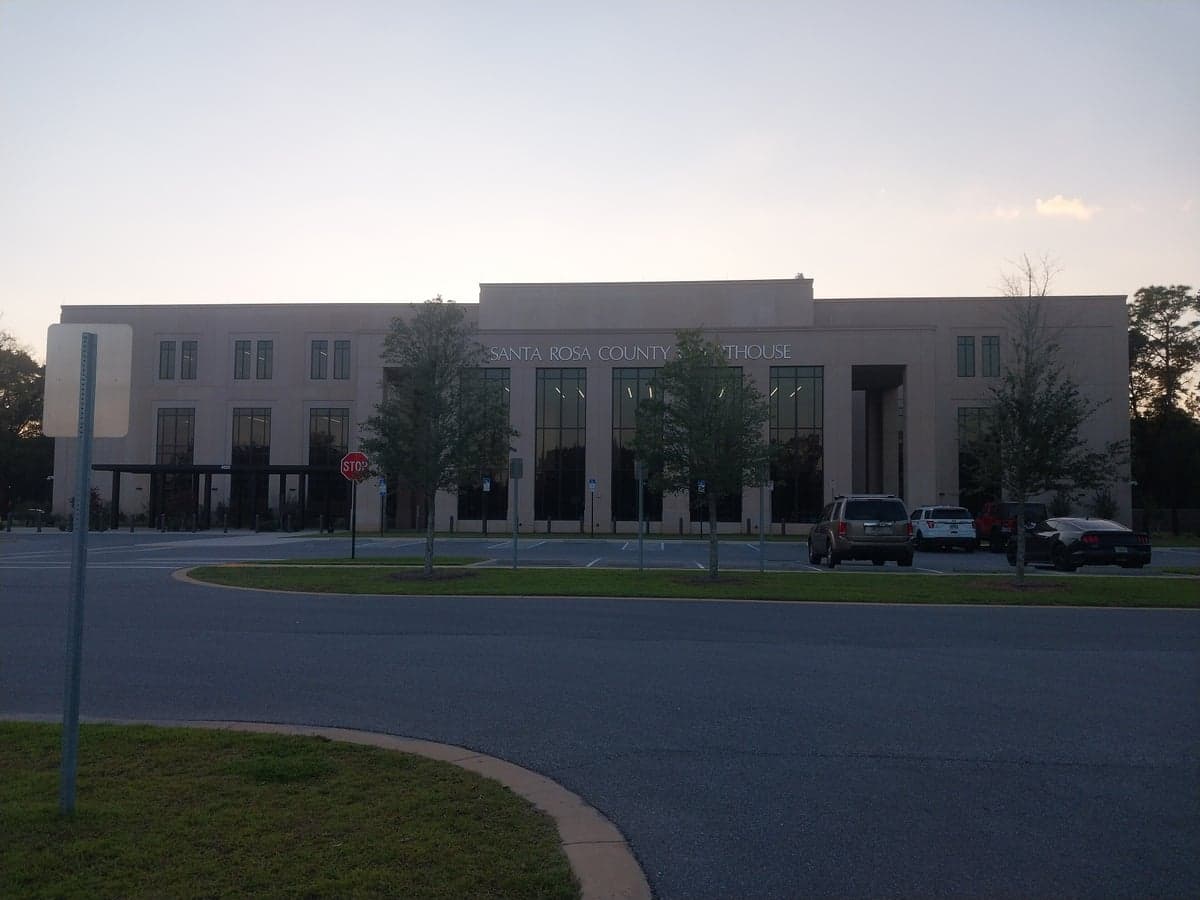
Long before European arrival, the area now known as Santa Rosa County was inhabited by the Pensacola people, a Muskogean-speaking tribe whose villages lined the bays and rivers. Spanish explorers under Tristán de Luna attempted a short-lived colony at Pensacola Bay in 1559, but sustained European settlement did not take hold until the British period (1763–1781), when a small number of Anglo traders and farmers moved into the Blackwater River valley. After Florida became a U.S. territory in 1821, the U.S. Army established a fort at the confluence of the Blackwater and Escambia rivers, which became the nucleus of Milton, the county seat since 1842.
The first major American wave arrived in the 1830s and 1840s: yeoman farmers from Georgia, Alabama, and the Carolinas, drawn by cheap land under the Armed Occupation Act of 1842. These settlers were overwhelmingly Scots-Irish and English, and they established small cotton and timber plantations along the Blackwater and Yellow rivers. The county’s economy revolved around the Blackwater River’s lumber mills, which shipped yellow pine to Pensacola and beyond. Milton became a mill town, and the nearby communities of Bagdad and Munson grew as logging and turpentine camps. A small number of enslaved Black laborers were brought in to work the timber and naval stores industries; after Emancipation, many remained as sharecroppers and mill workers, forming the foundation of Santa Rosa’s Black community, which today still clusters in Milton and the East Milton area.
Through the late 19th and early 20th centuries, the population grew slowly but steadily, remaining overwhelmingly native-born White and rural. The arrival of the Louisville and Nashville Railroad in the 1880s connected Milton and Jay to national markets, but the county saw little of the immigrant waves that transformed other parts of Florida. No significant German, Italian, or Eastern European enclaves formed; the foreign-born share in 1920 was below 1%. The Great Depression hit the timber industry hard, and many families left for jobs in Pensacola or Mobile. World War II brought the first major outside influence: the establishment of Eglin Field (now Eglin Air Force Base) just west of the county line in Okaloosa County. Military personnel began to settle in southern Santa Rosa, particularly in the Gulf Breeze area, which was little more than a fishing village before the war.
Modern era (post-1965)
The 1965 Hart-Cellar Act had minimal direct effect on Santa Rosa County, as the region never attracted large numbers of post-1965 immigrants. The foreign-born share remains just 1.6% today, far below the national average. Instead, the county’s modern demographic story is one of domestic migration: the Sun Belt boom, military expansion, and suburban spillover from Pensacola and Eglin Air Force Base.
The construction of the Pensacola Bay Bridge in 1960 and the Garcon Point Bridge in 1999 transformed Gulf Breeze from a quiet beach town into a fast-growing bedroom community for Pensacola and the military bases. Gulf Breeze today is the county’s most affluent and educated enclave, with a population that is heavily White (over 90%) and professional, including many retired military officers and healthcare workers. The Navarre area, along the coast, experienced similar growth from the 1980s onward, attracting families and retirees seeking beach access without the density of Destin or Panama City Beach. Navarre’s population is also predominantly White but has a slightly higher Hispanic share (around 8%), driven by service-industry workers in tourism and construction.
Inland, Milton has grown more slowly and retains a more working-class, rural character. The city’s Black population (about 12%) is the largest in the county, a legacy of the post-Emancipation mill-worker community. The Pace area, between Milton and the Escambia County line, has become the county’s fastest-growing suburban corridor, absorbing families priced out of Pensacola and Gulf Breeze. Pace is overwhelmingly White and family-oriented, with new subdivisions and strip malls replacing pine forests. The northern part of the county, around Jay and Berrydale, remains sparsely populated and agricultural, with a strong rural conservative identity and very little ethnic diversity.
Hispanic growth has been modest but steady, rising from about 3% in 2000 to 6.6% today. This population is primarily Mexican and Central American, working in construction, landscaping, and agriculture, and is dispersed across the county rather than concentrated in a single enclave. The East/Southeast Asian population (1.9%) is largely Filipino, connected to the military presence at Eglin and Whiting Field, and clusters in Gulf Breeze and Navarre. The Indian-subcontinent population (0.2%) is very small, mostly professionals in healthcare and engineering. The Black population has remained stable at around 5.5%, with no significant in-migration from other regions.
The future
Santa Rosa County is projected to continue growing at a steady pace, driven by domestic migration from higher-cost states and the ongoing expansion of Eglin Air Force Base and Whiting Field. The population is likely to become slightly more diverse, but the foreign-born share will remain low, and the county will stay overwhelmingly White and native-born. The Hispanic share may reach 10–12% by 2040, but this growth will be dispersed rather than concentrated in ethnic neighborhoods. The Pace and Navarre areas will absorb most new development, while Milton may see modest infill and revitalization. The cultural identity of the county is likely to remain conservative, family-oriented, and military-friendly, with a growing tension between coastal suburbanites and inland rural residents over land use and growth management.
For someone moving in now, Santa Rosa County offers a stable, low-diversity, and politically conservative environment with strong schools in the southern part of the county and affordable land in the north. The population is growing but not transforming; the character of the county in 2040 will look much like it does today, only with more subdivisions and a slightly larger Hispanic presence. New arrivals should expect a community that values tradition, self-reliance, and proximity to nature, and that remains one of the least foreign-born counties in Florida.

* Values derived from national, state, county, city and local statistics and may differ in a specific area. Last updated: 2026-11-17T22:31:04.000Z
Narrative content on this page is AI-generated and may contain mistakes. Verify any details that matter before acting on them.
ReloMaps may earn a commission from affiliate links at no extra cost to you.

