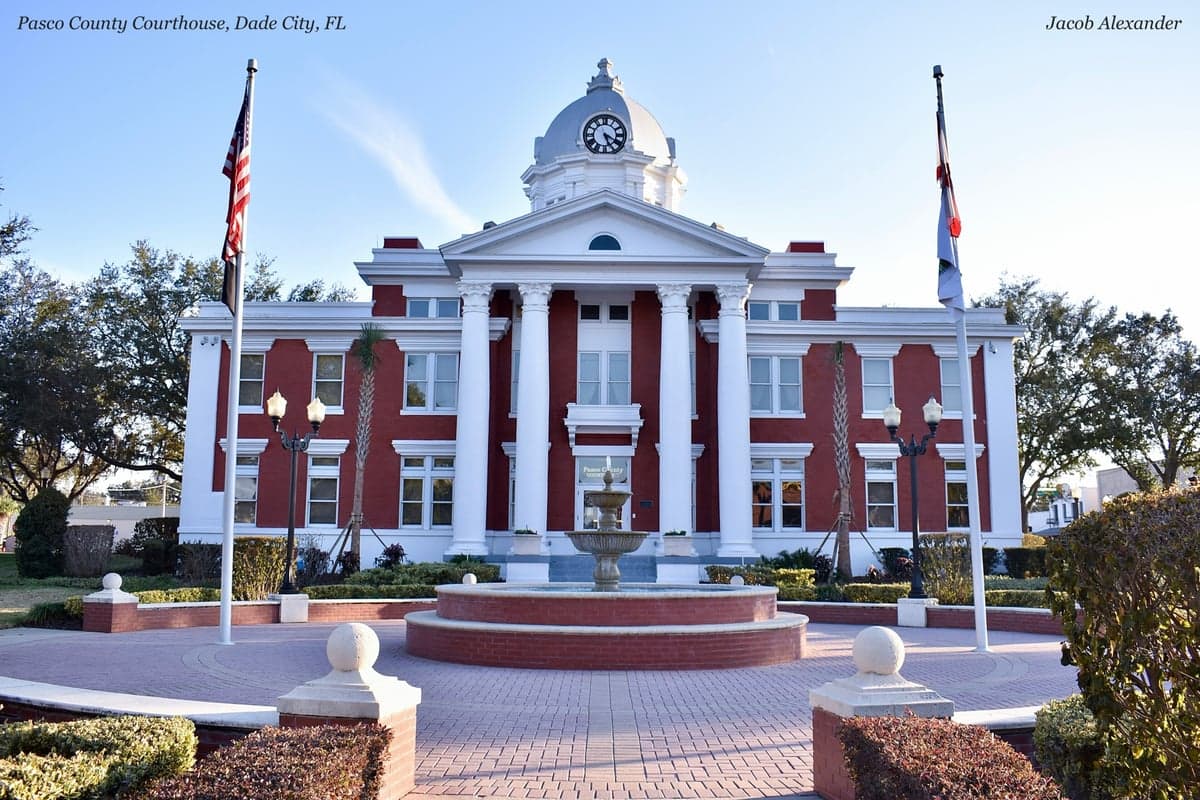
Photo: Wikipedia
Political ClimatePolitical Climate in Pasco County
Showing county-level results — no local-only data available.
Lean and PVI are calculated from this county’s 2020 and 2024 presidential results, Cook-style.
Political rankings in Florida
- Most Conservative Cities in Florida
- Most Liberal Cities in Florida
- Best Liberal-Leaning Towns in the South
- Safest Liberal-Leaning Towns in the South
- Safest Conservative-Leaning Towns in the South
- Safest Liberal-Leaning Towns on the East Coast
- Safest Conservative-Leaning Towns on the East Coast
- Affordable Small Towns for Conservatives
- Most Conservative Counties in Florida
- Most Liberal Counties in Florida
Local Political AnalysisPolitical Analysis of Pasco County
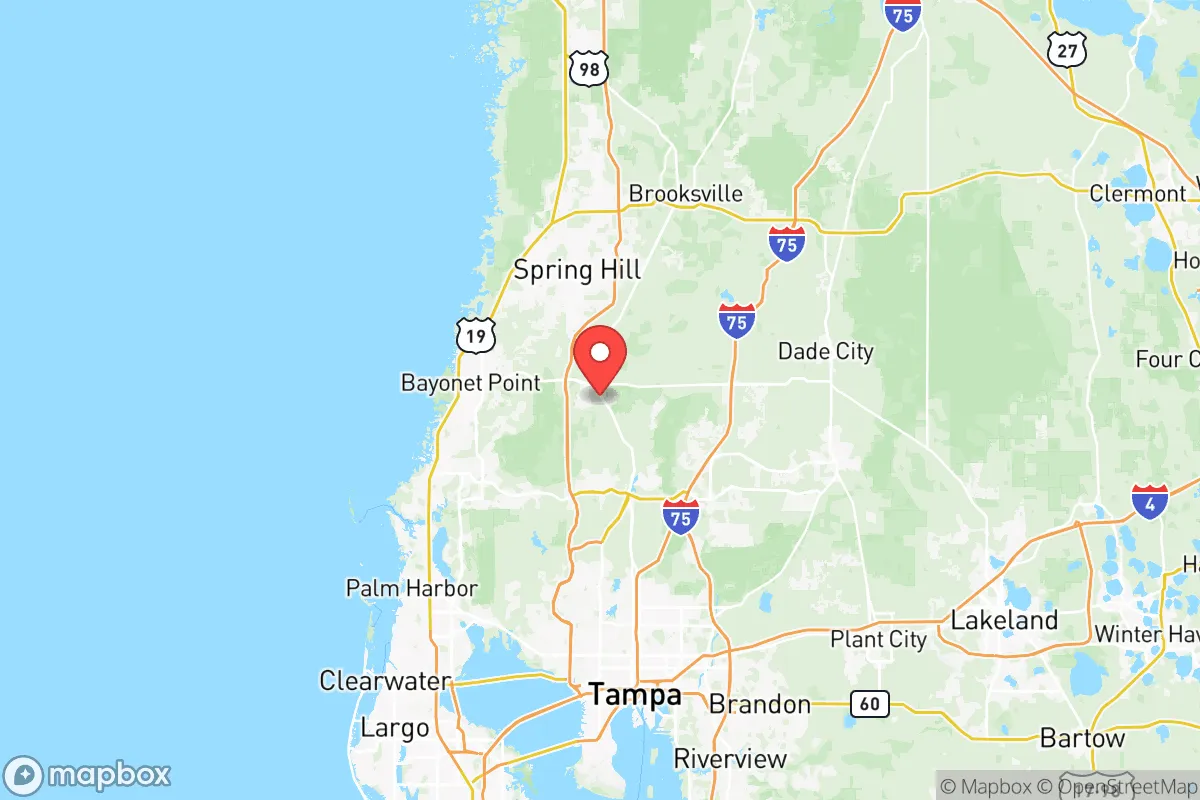
Pasco County has shifted decisively to the right over the past decade, carrying a Cook Partisan Voting Index of R+17 that makes it one of the more reliably Republican counties in the Tampa Bay region. That R+17 rating means the county votes about 17 points more Republican than the national average in presidential elections, a margin that has widened noticeably since 2016 as new development has brought in conservative-leaning retirees and families from the Midwest and Northeast. The county's trajectory is toward deeper red territory, though the political geography is far from uniform — you can drive from a deep-blue precinct in central New Port Richey to a rock-ribbed Republican stronghold in Wesley Chapel in under 30 minutes.
How it compares to Florida as a whole
Florida's statewide Cook PVI is not publicly calculated in the same way, but the state has voted Republican in five of the last six presidential elections and is generally considered a lean-red state with a PVI around R+3 to R+5. Pasco County's R+17 is dramatically more Republican than the state average, placing it in the same conservative tier as counties like Lake (R+18) and Marion (R+16), rather than the swing counties like Pinellas (R+2) or Hillsborough (D+2) that border it. The practical effect is that Pasco reliably delivers 55-60% of its vote to Republican candidates in statewide races, making it a critical part of the GOP's "I-4 Corridor" firewall. Within the county, the political variation is stark: the coastal communities of Hudson and New Port Richey still have pockets of Democratic-leaning precincts, particularly around the older mobile home parks and waterfront neighborhoods, while the inland suburbs of Wesley Chapel, Land O' Lakes, and Trinity vote Republican by margins closer to 65-70%. The swing precincts are concentrated in central Pasco around the Zephyrhills and Dade City areas, where a mix of longtime rural residents and newer exurban commuters create more competitive races at the local level.
What this means for residents
For conservative residents, Pasco's political climate means their values are broadly reflected in county government, school board policy, and local law enforcement priorities. The county commission has been Republican-controlled for decades, and issues like low property taxes, limited zoning regulations, and Second Amendment protections are generally non-controversial. For liberal residents, the reality is more nuanced: while they are a clear minority countywide, they hold significant influence in specific municipal elections — the city councils of New Port Richey and Dade City have seen progressive candidates win seats in recent cycles — and the proximity to Democratic-leaning Pinellas and Hillsborough counties means access to like-minded communities is a short drive away. The practical tradeoff is that liberal residents may find their views on social issues or environmental policy out of step with county-level decisions, but they benefit from the same low cost of living and relatively light regulatory environment that attracts conservatives.
Culturally, Pasco County has a distinct identity that sets it apart from the rest of Florida. It lacks the tourist-driven economy of Orlando or the beach-tourism focus of Pinellas, instead feeling like a working-class and middle-class exurb where the dominant industries are healthcare, construction, and logistics. The county's rapid growth — it was one of the fastest-growing counties in the U.S. through the 2010s and 2020s — has created a tension between longtime residents who remember when Dade City was a sleepy farming town and newcomers who expect suburban amenities. That growth has also pushed the county's politics further right, as the new arrivals tend to be more conservative than the retirees they replaced. The result is a place where the political conversation is dominated by growth management, school capacity, and infrastructure funding, with the underlying assumption that the county will remain Republican-leaning for the foreseeable future.

State Political ClimatePolitical Climate in Florida
State Political AnalysisPolitical Environment in the State
Florida has transformed from a quintessential swing state into a solidly Republican-leaning powerhouse over the past decade, with the GOP now holding a supermajority in the state legislature and a 1-million-voter registration advantage as of 2026. The shift is driven by a massive influx of conservative-leaning migrants from the Northeast and Midwest, particularly into fast-growing metros like Naples, Ocala, and the Panhandle, while the state's once-dominant Democratic strongholds in Miami-Dade and Palm Beach counties have shifted rightward by double digits since 2020. The result is a state where Republicans have won every statewide race since 2012, and where the political center of gravity has moved decisively toward the I-4 corridor and the Gulf Coast.
Urban vs. rural divide
The political map of Florida is starkly divided between its dense urban cores and its sprawling suburban and rural expanses. Miami-Dade County, once a Democratic fortress, has flipped dramatically — voting for Donald Trump by 11 points in 2024 after supporting Hillary Clinton by 30 points in 2016, a shift driven largely by Cuban-American and Venezuelan voters who prioritize anti-socialist messaging and economic freedom. Broward and Palm Beach counties remain Democratic, but their margins have shrunk as conservative retirees and families move into suburbs like West Palm Beach and Boca Raton. The Tampa Bay area is a microcosm of the state: Hillsborough County (Tampa) is a true swing county, while Pinellas County (St. Petersburg) has trended red since 2020. The Panhandle, from Pensacola to Tallahassee, is deeply Republican, with rural counties like Liberty and Calhoun routinely voting 80%+ GOP. The I-4 corridor (Orlando to Tampa) remains the key battleground, but even Orange County (Orlando) has seen its Democratic margin shrink as conservative-leaning Puerto Rican and Central Florida transplants arrive.
Policy environment
Florida's policy environment is defined by a low-tax, low-regulation posture that appeals strongly to conservative relocators. There is no state income tax, a major draw for high-earners and retirees, and property taxes are capped by the Save Our Homes amendment, which limits annual increases to 3% for homesteaded properties. The state has a constitutional right-to-work law, meaning union membership cannot be a condition of employment, and it is a stand-your-ground state with a permitless carry law (effective July 2023) that allows concealed carry without a license. Education policy has shifted sharply rightward: the Parental Rights in Education Act (HB 1557, 2022) restricts classroom instruction on sexual orientation and gender identity in early grades, and the state has expanded school choice through universal education savings accounts (HB 1, 2023), making Florida a national leader in school vouchers. Healthcare policy is mixed — the state did not expand Medicaid under the ACA, but it has robust telehealth laws and a competitive insurance market. Election laws have tightened: the 2023 SB 7050 restricted ballot drop boxes and third-party voter registration, and the state conducts aggressive voter roll maintenance, removing inactive and non-citizen registrants.
Recent policy direction
The last three years have seen Florida enact a sweeping conservative agenda under Governor Ron DeSantis and the GOP supermajority. On gun rights, the 2023 permitless carry law (HB 543) eliminated the requirement for a concealed weapons license, though a three-day waiting period for handgun purchases remains. On education and parental rights, the Stop WOKE Act (HB 7, 2022) restricted workplace and classroom instruction on race and gender, while the Don't Say Gay law (HB 1557) was expanded in 2023 to cover all grades. On medical and bodily autonomy, Florida banned abortions after six weeks (HB 5, 2023), with exceptions for rape, incest, and the life of the mother, and the state has restricted gender-affirming care for minors (SB 254, 2023). On property rights, the state has preempted local rent control ordinances and limited local government authority over short-term rentals (SB 280, 2023). On voting and ballot access, the 2023 election integrity law (SB 7050) banned ballot drop boxes on private property and required stricter ID for mail-in ballots. On privacy and surveillance, Florida has banned TikTok on government devices and restricted Chinese land ownership near military bases (SB 264, 2023). The overall direction is toward maximizing individual liberty in economic and self-defense matters while restricting government power on social and medical issues.
Civil unrest & political movements
Florida has seen relatively low levels of sustained civil unrest compared to states like Oregon or Minnesota, but there have been notable flashpoints. The 2020 George Floyd protests in Miami, Tampa, and Jacksonville saw some property damage and curfews, but the state's strong police presence and early curfew enforcement kept things from escalating. The Parkland school shooting in 2018 sparked the March for Our Lives movement, which organized massive student-led protests in Tallahassee and Washington, D.C., and led to the passage of the Marjory Stoneman Douglas High School Public Safety Act, which raised the gun purchase age to 21 and created a "red flag" law — a rare instance of gun control in a conservative state. Immigration politics are a constant flashpoint: Governor DeSantis has bused migrants to Martha's Vineyard and Sacramento, and the state passed the SB 1718 law in 2023, which requires hospitals to ask about immigration status and makes it a felony to transport undocumented immigrants into the state. There is no sanctuary city movement of note; in fact, the state has preempted local "sanctuary" policies. Election integrity controversies have been minimal compared to 2020 battleground states, though the state's aggressive voter roll purges have drawn lawsuits from voting rights groups. The Florida Democratic Party has struggled to maintain relevance, with internal divisions between moderates and progressives and a shrinking donor base.
Projection
Over the next 5-10 years, Florida is likely to become more Republican and more culturally conservative, driven by continued in-migration from blue states and the naturalization of conservative-leaning Hispanic voters. The I-4 corridor will remain competitive, but the GOP's registration advantage is expected to grow as retirees and remote workers from New York, California, and Illinois continue to settle in Naples, Sarasota, and the Villages. The Miami-Dade shift is likely permanent, as younger Cuban-American and Venezuelan voters are more conservative than their parents' generation. The Panhandle will remain deeply red, while Alachua County (Gainesville) and Leon County (Tallahassee) will remain Democratic islands due to their university populations. The biggest wildcard is climate change: rising sea levels and hurricane risk could slow growth in coastal areas like Miami Beach and the Florida Keys, while inland metros like Ocala, Lakeland, and Gainesville could see accelerated growth. The state's housing affordability crisis — driven by insurance costs and limited supply — could also dampen in-migration if it continues unchecked. Expect the GOP to continue pushing on school choice, tax cuts, and deregulation, while Democrats will focus on abortion rights, climate resilience, and expanding Medicaid — but with limited legislative power.
For a new resident, the bottom line is this: Florida offers a low-tax, high-freedom environment for those who align with its conservative tilt, but it is not a libertarian paradise — the state is aggressive on immigration enforcement, abortion restrictions, and education content. If you are a conservative or libertarian-leaning individual or family, you will find a welcoming policy environment and a growing community of like-minded transplants. If you are a liberal, you will find vibrant urban pockets in Miami, Orlando, and St. Petersburg, but you will face a state government that is actively hostile to many of your policy preferences. Either way, the state's no-income-tax, right-to-work, and stand-your-ground framework is unlikely to change, and the political trajectory is clearly toward deeper red. Plan accordingly.
* Values derived from national, state, county, city and local statistics and may differ in a specific area. Last updated: 2026-10-25T03:17:51.000Z
Narrative content on this page is AI-generated and may contain mistakes. Verify any details that matter before acting on them.
ReloMaps may earn a commission from affiliate links at no extra cost to you.

