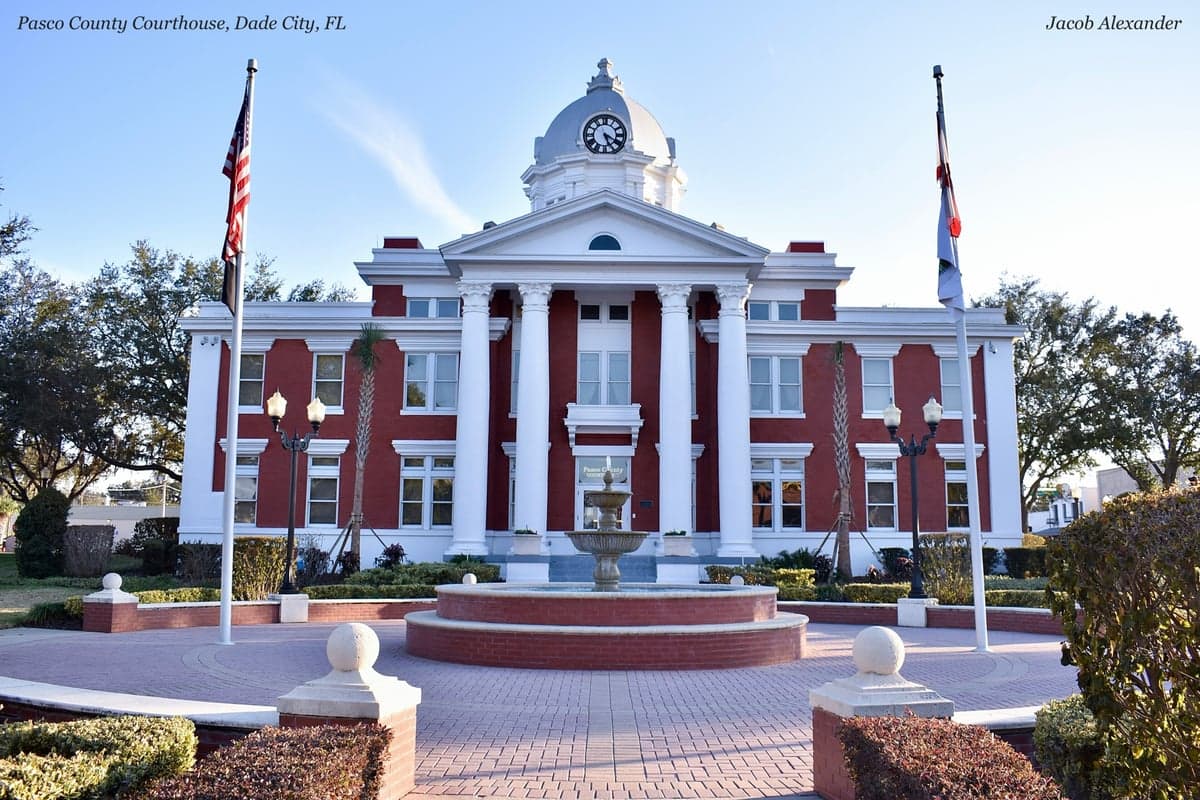
Photo: Wikipedia
Personal Sovereignty in Pasco County
Viable for self-reliance. Generally workable, though some barriers may limit total independence.
What does Personal Sovereignty tell us?
Personal Sovereignty measures your capacity for self-reliance and independence with minimal government friction. Higher scores mean fewer barriers between you and the way you want to live... but it assumes you have the space you need and good neighbors.
What does this tell us?
Personal Sovereignty measures your capacity for self-reliance and independence with minimal government friction. Higher scores mean fewer barriers between you and the way you want to live... but it assumes you have the space you need and good neighbors.
State Policy
Energy independence: Importer (12% of energy produced in-state)
Personal Liberty
Homesteading

Personal Liberty Analysis
Pasco County, Florida, offers a notably high degree of personal sovereignty relative to many other parts of the state and the nation, driven by a combination of low state taxes, permissive self-defense laws, and a regulatory environment that generally favors individual choice over government mandate. While not a libertarian enclave, the county’s governance leans heavily toward personal responsibility and minimal interference in daily life, particularly when compared to the more heavily regulated urban centers of the Northeast or West Coast. This autonomy is not uniform across the county, however, with distinct differences in lifestyle and regulatory posture between the coastal communities, the suburban corridor, and the rural eastern reaches.
Tax burden and regulatory posture in Pasco County
Florida’s lack of a state income tax is the foundational pillar of personal financial sovereignty in Pasco County. Residents keep 100% of their earned wages, which directly supports self-reliance by reducing the need for government services. The county’s property tax rates are moderate, with a combined millage rate typically ranging from 18 to 22 mills depending on the specific municipality and fire district. For a median-priced home around $350,000, this translates to an annual property tax bill of roughly $3,500 to $4,200, which is competitive with other fast-growing Sun Belt counties. The regulatory posture in Pasco is generally light-touch. Building permits are required, but the county’s development services department is known for a streamlined, business-friendly approach, particularly in unincorporated areas. In contrast, the city of New Port Richey has a more traditional municipal code with stricter zoning and rental regulations, while Dade City and San Antonio maintain a more rural, less bureaucratic character. There is no county-level business tax or occupational license fee for most small businesses, further reducing the friction of starting a venture. The absence of a state estate tax and the homestead exemption (up to $50,000 off assessed value) also bolster long-term wealth retention for families.
Self-defense and gun law specifics in Pasco County
Pasco County is a strong Second Amendment jurisdiction, operating fully under Florida’s permissive state preemption laws. The county itself has no local firearm ordinances that exceed state law, meaning no additional waiting periods, magazine capacity limits, or registration requirements beyond what the state mandates. Florida is a “shall issue” state for concealed carry, and as of July 2023, permitless carry (constitutional carry) is legal for residents who are 21 or older and legally allowed to possess a firearm. This means a law-abiding individual can carry a concealed firearm without a permit in Pasco County, though a permit is still recommended for reciprocity when traveling out of state. The sheriff’s office, led by Sheriff Chris Nocco, is publicly and operationally supportive of gun rights. The county has a robust network of gun ranges, including the Wyoming Antelope Club in New Port Richey and the Hernando Sportsman’s Club just north of the county line. Stand-your-ground and castle-doctrine laws apply fully, providing strong legal protection for the use of deadly force in self-defense within one’s home, vehicle, or workplace. The culture of firearm ownership is visible and normalized, particularly in the eastern and central parts of the county around Wesley Chapel and Land O’ Lakes, where gun stores and training facilities are common.
Self-reliance and homesteading viability in Pasco County
The viability of a self-reliant, homesteading lifestyle varies dramatically across Pasco County’s geography. The eastern half of the county, encompassing areas like Dade City, San Antonio, and Lacoochee, offers the most realistic opportunity for off-grid and semi-rural living. Here, zoning allows for agricultural uses, and lot sizes of 1 to 10 acres are common and affordable, with raw land prices ranging from $15,000 to $40,000 per acre. The county’s land development code permits accessory dwelling units, barns, and workshops on agricultural parcels without excessive red tape. Raising chickens, goats, and even small livestock is generally permitted on parcels of one acre or more in unincorporated areas, though a permit is required for larger operations. Rainwater collection is legal and encouraged, and many rural properties rely on well water and septic systems, which are regulated but not prohibitively expensive. Solar panel installation is straightforward, with no county-level restrictions on residential solar, though net metering is governed by the local utility, Duke Energy. In contrast, the western coastal communities like Hudson and Port Richey are more densely developed, with smaller lots (typically under a quarter-acre) and homeowners’ associations that often restrict livestock, gardening, and external modifications. The suburban corridor along the I-75 and SR-54 corridors, including Wesley Chapel and Trinity, is dominated by planned communities with strict CC&Rs that heavily limit self-reliant activities. For a family seeking true homesteading autonomy, the eastern rural tracts near Dade City and San Antonio are the clear choice.
Personal liberties in Pasco County
Pasco County’s approach to personal liberties reflects a broader Florida trend toward individual autonomy in several key areas. Parental rights are strongly protected; the county school district, Pasco County Schools, has adopted policies that emphasize parental notification and consent for health services and curriculum opt-outs, aligning with the state’s Parental Bill of Rights. Medical autonomy is generally respected, with no county-level vaccine mandates or business closures during the 2020-2021 period, a stance that was publicly supported by the county commission. The county does not have any local mask or vaccine mandates in effect as of 2026. Freedom of speech and assembly are robustly protected, with the county maintaining a neutral stance on political expression in public spaces. Property rights are a central tenet of local governance; the county has a strong property rights ordinance that requires a supermajority vote of the commission to approve any regulation that diminishes property value, and eminent domain is rarely used for private development. The absence of a county-level rental registry or rent control ordinance further underscores the light regulatory touch. However, it is worth noting that the county does enforce building codes and environmental regulations, particularly in coastal and wetland areas, which can limit certain property modifications. Overall, the legal environment in Pasco County is designed to maximize individual choice while maintaining basic public safety and environmental standards.
Compared to other fast-growing regions in the Southeast, Pasco County stands out for its combination of low taxes, strong self-defense protections, and genuine opportunities for rural self-reliance, particularly in its eastern half. While the suburban and coastal areas impose more restrictions through HOAs and denser zoning, the county as a whole offers a level of personal sovereignty that is difficult to find in similarly populated areas of the Northeast, Midwest, or West Coast. For a single individual or family prioritizing autonomy, Pasco County provides a legal and cultural environment where personal responsibility is the default, and government interference in daily life is minimal.

* Values derived from national, state, county, city and local statistics and may differ in a specific area. Last updated: 2026-10-25T03:17:51.000Z
Narrative content on this page is AI-generated and may contain mistakes. Verify any details that matter before acting on them.
ReloMaps may earn a commission from affiliate links at no extra cost to you.

