Photo: Wikipedia
Political ClimatePolitical Climate in Martin County
Showing district-level results — no local-only data available.
Local Political AnalysisPolitical Analysis of Martin County
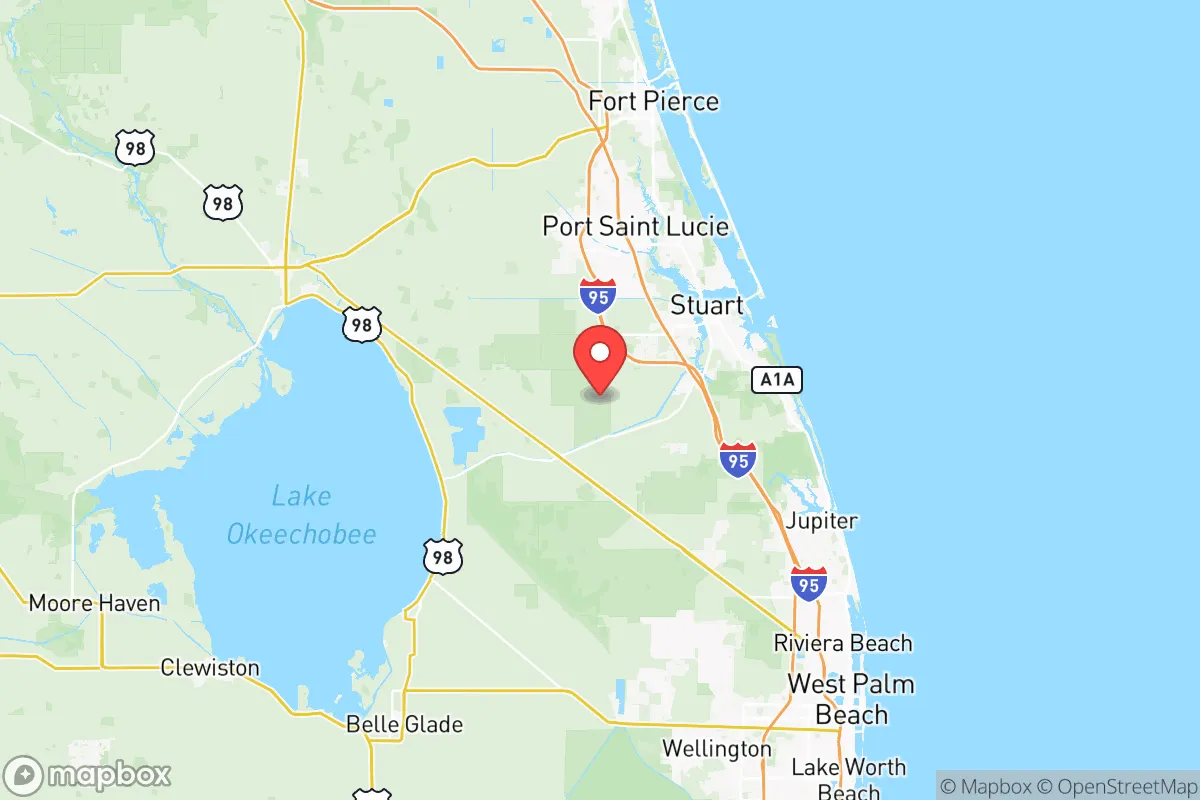
Martin County leans solidly Republican, with a Cook Partisan Voting Index (PVI) of R+7, making it two points more conservative than Florida as a whole (R+5). That gap has widened slightly in recent cycles, as the county's retiree-heavy, slower-growth communities have held steady while the state's fast-growing metros have pulled it toward the center. The county hasn't voted for a Democratic presidential candidate since 1996, and in 2024, Donald Trump carried it by roughly 18 points—consistent with the R+7 baseline. But the political map isn't uniform: the coastal enclave of Sewall's Point and parts of Stuart near the waterfront show more competitive precincts, often splitting tickets in local races, while inland communities like Indiantown and Hobe Sound north of Jonathan Dickinson State Park vote heavily Republican. The swing precincts tend to cluster around the Palm City area, where newer transplants from the Northeast and Midwest bring more moderate suburban views, especially on environmental issues like the Indian River Lagoon restoration.
How it compares
Compared to Florida's statewide R+5, Martin County's R+7 reflects a more entrenched conservative base, but it's not an outlier on the Treasure Coast. Neighboring St. Lucie County is a true swing county (R+1), while Indian River County to the north is R+9. So Martin sits in the middle of the regional spectrum—more conservative than St. Lucie, less so than Indian River. What sets Martin apart from the state trend is its resistance to the leftward drift seen in places like Orange or Miami-Dade counties. The county's population is older (median age ~49 vs. Florida's ~42), whiter, and more likely to be registered Republican. That demographic stability means the political lean hasn't shifted much since the 2010s, even as Florida's overall PVI tightened from R+3 to R+5. One notable difference: Martin County's local GOP is more establishment-oriented than the firebrand factions in parts of the Panhandle, and local races often turn on growth management and water quality rather than culture-war issues.
What this means for residents
For conservative residents, Martin County offers a reliable political home where their votes consistently carry local, state, and federal elections. The county commission has been Republican-controlled for decades, and school board races rarely see competitive Democratic challengers. That means policy tends to align with conservative priorities—lower taxes, limited zoning changes, and a skeptical approach to state-mandated growth targets. For liberal residents, the reality is more about finding community within a minority. There are active Democratic clubs in Stuart and Jensen Beach, and the county's environmental movement (focused on the St. Lucie River and Lake Okeechobee discharges) draws bipartisan support. But progressive candidates rarely break 45% in countywide races, and social-issue ballot measures (like the 2024 amendment on abortion rights) underperform the statewide average here by 5-7 points. The practical effect is that liberal residents often focus their energy on municipal elections in Stuart or Jensen Beach, where turnout is lower and a few hundred votes can flip a city council seat.
Culturally, Martin County's conservatism is more "country club" than "populist"—think golf course fundraisers and chamber of commerce luncheons rather than rallies. The county's strict growth management ordinances (some of the toughest in Florida) enjoy broad support across party lines, creating a rare policy consensus that frustrates developers regardless of their politics. The Indian River Lagoon crisis has also forged unusual alliances: environmental groups backed by Republican snowbirds and Democratic activists alike pushed for the 2016 half-cent sales tax for water projects, which passed with 62% support. So while the partisan lean is clear, the lived political reality is more nuanced than the R+7 label suggests—especially on local issues that touch everyone's backyard.

State Political ClimatePolitical Climate in Florida
State Political AnalysisPolitical Environment in the State
Florida is a solidly Republican state with a Cook PVI of R+5, but calling it a simple red state misses the real story. Over the past 20 years, it’s shifted from a classic swing state—where elections were decided by a few thousand votes—to a reliably right-leaning powerhouse, driven by a massive influx of conservative-leaning transplants from the Northeast and Midwest, particularly into the I-4 corridor and the Gulf Coast. The dominant coalition is a mix of suburban families, retirees, and working-class voters, with the GOP now holding a voter registration advantage of over 500,000 as of 2024, a dramatic reversal from the 2008 era when Democrats led by nearly 700,000.
Urban vs. rural divide
The political map is starkly divided. The major metros—Miami-Dade, Broward (Fort Lauderdale), and Orange County (Orlando)—are the Democratic strongholds, with Miami-Dade in particular being a fascinating case: it’s still blue-leaning but has been trending right, with Trump improving his margin there by 10 points between 2016 and 2024. Meanwhile, the sprawling suburbs of Tampa, Jacksonville, and Palm Beach County have become the GOP’s engine, with places like St. Johns County (south of Jacksonville) and Collier County (Naples) routinely delivering 65%+ Republican votes. The rural Panhandle—think Panama City, Pensacola, and the Big Bend region—is deep red, often voting 75-80% Republican. The I-4 corridor, stretching from Tampa through Lakeland to Daytona Beach, is the ultimate battleground; it’s where statewide races are won or lost, and it’s now trending redder as conservative-leaning transplants fill new subdivisions in Polk County and Volusia County.
Policy environment
Florida’s policy environment is aggressively conservative on most fronts. There is no state income tax, a major draw for relocators, and property taxes are capped by the Save Our Homes amendment, which limits annual increases to 3% for homesteaded properties. The regulatory posture is business-friendly, with a right-to-work law and minimal union influence. Education policy has been a flashpoint: the state leads the nation in school choice, with over 1.3 million students using vouchers or tax-credit scholarships as of 2025, and it banned Critical Race Theory and DEI initiatives in public schools and universities. Healthcare is a mixed bag—Florida did not expand Medicaid under the ACA, leaving roughly 800,000 uninsured, but it has a robust private market. Election laws have tightened: there are strict voter ID requirements, limits on drop boxes, and a ban on ballot harvesting, all passed in the 2021 SB 90 law. The state also has a “stand your ground” self-defense law and is a castle doctrine state.
Recent policy direction
The last five years have seen a rapid consolidation of conservative priorities. On gun and self-defense law, Florida in 2023 passed a permitless carry law (HB 543), allowing concealed carry without a license, while maintaining a three-day waiting period for handgun purchases. Parental and education rights were reshaped by the 2022 Parental Rights in Education Act (HB 1557), which restricts classroom instruction on sexual orientation and gender identity through third grade, and the 2023 “Don’t Say Gay” expansion (HB 1069) extended that through eighth grade. Speech and privacy saw the 2023 Social Media Use by Minors law (HB 3), which bans children under 14 from having social media accounts and requires parental consent for 14- and 15-year-olds. On medical and bodily autonomy, Florida enacted a 6-week abortion ban in 2023 (HB 5), with exceptions for rape, incest, and the life of the mother, and the state Supreme Court upheld it in 2024. Property rights are strongly protected, with no statewide rent control and a 2023 law (SB 250) preempting local rent stabilization ordinances. Taxation remains low, with a 6% sales tax and periodic “tax holidays” for back-to-school and disaster preparedness. Voting and ballot access has been restricted: the 2023 SB 7050 law increased penalties for third-party voter registration organizations and tightened rules on mail-in ballots, requiring them to be requested every election cycle rather than automatically sent.
Civil unrest & political movements
Florida has seen its share of political flashpoints. The 2020 Black Lives Matter protests were large in Miami, Orlando, and Tampa, but largely peaceful, with some property damage in downtown areas. The state’s response was the 2021 “Combating Public Disorder” law (HB 1), which enhanced penalties for rioting and blocking roads. Immigration politics are front and center: Governor DeSantis signed the 2023 SB 1718, which requires businesses with 25+ employees to use E-Verify, bans local “sanctuary” policies, and makes it a felony to transport undocumented immigrants into the state. This led to a wave of protests from immigrant-rights groups, particularly in Miami and Immokalee. Election integrity remains a hot-button issue: the 2020 recount in Broward and Palm Beach counties fueled GOP skepticism, leading to the creation of a state Office of Election Crimes and Security in 2022, which has prosecuted a handful of cases of double voting. Secession or nullification rhetoric is minimal, though some far-right groups have floated “Florida as a redoubt” ideas. A new resident would notice the prevalence of “Don’t Tread on Me” flags and DeSantis signs in rural areas, contrasted with “We Believe” signs in blue enclaves like St. Petersburg and Gainesville.
Projection
Over the next 5-10 years, Florida is likely to become even more Republican. The in-migration pattern is overwhelmingly conservative: the top states sending new residents are New York, California, and Illinois, and these transplants tend to be older, wealthier, and more right-leaning. The Hispanic vote, particularly among Cuban-Americans in Miami-Dade and Venezuelan-Americans in Kendall and Doral, is shifting right, with Trump winning 45% of the Hispanic vote in Florida in 2024, up from 35% in 2016. The Democratic base is shrinking as younger, liberal-leaning residents are priced out of coastal cities and move to Georgia or the Carolinas. The state’s population is projected to grow by 3 million by 2035, with most growth in red-leaning suburbs like The Villages (the massive retirement community) and Pasco County. However, a wildcard is climate change: rising sea levels and hurricane risk could eventually slow growth in coastal areas, potentially shifting the political center of gravity inland. A relocator moving in now should expect a state that is firmly conservative on taxes, education, and social issues, with a GOP supermajority in the legislature that shows no signs of weakening.
For a new resident, the bottom line is this: if you’re conservative, you’ll find a state that aligns with your values on taxes, guns, education, and regulation, with a government that is actively pushing those priorities. If you’re liberal, you’ll find a state where your vote is less impactful, but where you can still live comfortably in blue enclaves like Miami Beach, Orlando, or Tallahassee—just expect to pay a premium for that lifestyle and to see policies you disagree with at the state level. The political climate is stable, predictable, and trending further right, so choose your neighborhood accordingly.
* Values derived from national, state, county, city and local statistics and may differ in a specific area. Last updated: 2026-06-27T18:04:38.000Z
Narrative content on this page is AI-generated and may contain mistakes. Verify any details that matter before acting on them.
ReloMaps may earn a commission from affiliate links at no extra cost to you.

