Photo: Wikipedia
Strategic Assessment of Martin County
Meaningful friction. Expect exposure to either population pressure, blast zones, or natural disaster risk. Consider buying a retreat property.
What does the Strategic Assessment tell us?
Our Strategic Assessment grades tactical survivability of an area. Major population centers, military targets, fallout zones, natural disasters, and border exposure all drive risk — lower exposure means a more defensible position in a crisis.
This is heavily inspired by Joel Skousen's Strategic Relocation book. Highly recommended you checkout the book ($)What does this tell us?
Our Strategic Assessment grades tactical survivability of an area. Major population centers, military targets, fallout zones, natural disasters, and border exposure all drive risk — lower exposure means a more defensible position in a crisis.
This is heavily inspired by Joel Skousen's Strategic Relocation book. Highly recommended you checkout the book ($)Strategic Pillars

Key Distances
Strategic Assessment Analysis
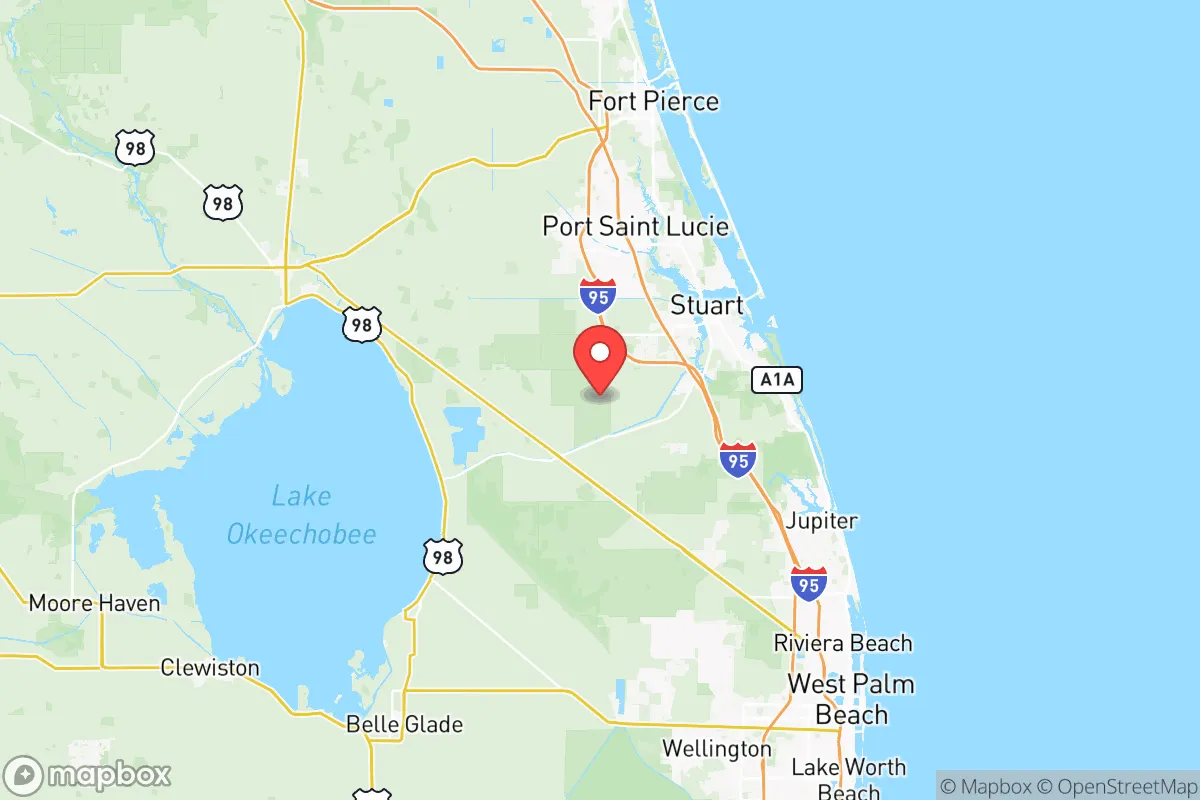
Martin County, Florida, offers a compelling strategic profile for relocation-minded readers who prioritize resilience, combining a semi-rural buffer from major metropolitan chaos with direct access to critical infrastructure and natural resources. Located along Florida’s Atlantic coast roughly halfway between Jacksonville and Miami, the county provides a geographic sweet spot: close enough to major employment and supply hubs like Palm Beach County and the Treasure Coast, yet far enough from the densest population centers to offer meaningful defensibility and self-sufficiency options. For a single individual or family thinking seriously about disaster readiness, Martin County’s mix of coastal access, inland agricultural land, and a relatively low population density (roughly 160,000 residents across 556 square miles) creates a foundation worth examining in detail.
Geographic position and natural advantages for long-term stability
Martin County’s location along the St. Lucie River and the Indian River Lagoon provides a natural buffer and multiple water-based escape or supply routes, a factor often overlooked in standard relocation checklists. The county sits on a coastal ridge that rises to about 50 feet above sea level in western areas near Indiantown, offering terrain that is less flood-prone than the immediate coastline. The presence of the Atlantic Intracoastal Waterway running through the county means residents have access to barge-capable inland waterways for moving supplies or evacuation if road networks are compromised. The county’s western boundary, marked by the Kissimmee River and the vast Okeechobee Waterway, connects Martin County to Lake Okeechobee and the interior of the state, providing a strategic depth that purely coastal counties lack. For a relocator, this means multiple axes of movement and supply, not just a single highway-dependent corridor like I-95, which runs through the eastern part of the county and is notoriously vulnerable to hurricane-related gridlock.
Risks, exposures, and proximity to fallout-relevant landmarks
No resilience assessment is honest without weighing the risks, and Martin County has several that demand attention. The most obvious is hurricane exposure: the county sits squarely in the Atlantic hurricane belt, with a direct hit from a Category 3 or higher storm being a statistical certainty over a 30-year horizon. Storm surge along the coast and the St. Lucie River can reach 15-20 feet in a worst-case scenario, meaning properties east of US-1 or along the riverfront carry significant structural risk. However, the county’s building codes are among the strongest in the nation post-Andrew, and newer construction in communities like Palm City and Sewall’s Point is engineered to withstand high winds. On the man-made risk side, Martin County is not near any nuclear power plants—the closest is St. Lucie Nuclear Power Plant in neighboring St. Lucie County, roughly 15 miles north of the Martin County line. That plant is a concrete risk factor: a major incident there could render the northern part of the county uninhabitable for weeks, though prevailing winds typically blow east or north, pushing fallout offshore or away from Martin County’s population center. The county also sits within 100 miles of the Port of Palm Beach and the Port of Fort Pierce, both of which handle fuel and container shipping, making them potential secondary targets or choke points in a broader disruption scenario. For the preparedness-minded reader, the key takeaway is that Martin County is not a fallout-free zone, but its risks are concentrated and manageable with proper planning—unlike, say, living within 20 miles of a major refinery or military base.
Practical resilience for a relocator: food, water, energy, and defensibility
Martin County’s practical resilience profile is stronger than most coastal Florida counties, largely due to its agricultural base and water resources. The western part of the county, around Indiantown, is home to significant citrus groves, sod farms, and cattle ranching operations, meaning local food production is not just a theoretical possibility but an existing industry. For a relocator looking to establish a small homestead or even a suburban garden, the county’s sandy loam soils and long growing season (Zone 10a) allow for year-round vegetable production. Water is a more nuanced picture: the county draws its municipal supply from the Floridan Aquifer, one of the most productive freshwater aquifers in the world, but saltwater intrusion is a growing concern in coastal wells. For a self-sufficient setup, a well drilled west of I-95 to a depth of 200-300 feet is likely to yield potable water for the foreseeable future, though a reverse osmosis system is a prudent backup. Energy infrastructure is relatively robust: Florida Power & Light maintains a modern grid with underground lines in many newer subdivisions, reducing storm-related outages. Solar potential is excellent, with an average of 230 sunny days per year, and the county’s zoning codes are generally favorable for rooftop solar and battery storage. Defensibility is where Martin County shines compared to denser areas. The county’s population is spread across several distinct communities—Stuart (the county seat), Palm City, Indiantown, and the unincorporated areas—meaning no single chokepoint can cut off the entire county. The road network, while reliant on I-95 for north-south travel, includes multiple state roads (SR 76, SR 710, SR 714) that provide alternative routes inland. For a family, the ability to retreat westward toward Lake Okeechobee or north toward the less-dense St. Lucie County offers a layered evacuation strategy that coastal-only counties cannot match.
The overall strategic picture for Martin County is one of balanced risk and reward. It is not a remote bunker location—it has real hurricane exposure, a nuclear plant within fallout range, and the typical vulnerabilities of any coastal Florida county. But for a relocator who wants proximity to jobs, healthcare, and supply chains without living in a dense urban target zone, Martin County offers a rare combination: agricultural self-sufficiency potential, multiple water and road egress routes, a strong building code, and a community that is neither so small that resources are scarce nor so large that it becomes a primary disruption target. The smart move for a resilience-minded family is to locate west of I-95, preferably in the Palm City or Indiantown areas, drill a private well, install solar with battery backup, and build a network of local suppliers and neighbors. Done right, Martin County can function as a long-term base that rides out most disruptions without requiring a full relocation to a remote, jobless hinterland.

* Values derived from national, state, county, city and local statistics and may differ in a specific area. Last updated: 2026-06-27T18:04:38.000Z
Narrative content on this page is AI-generated and may contain mistakes. Verify any details that matter before acting on them.
ReloMaps may earn a commission from affiliate links at no extra cost to you.

