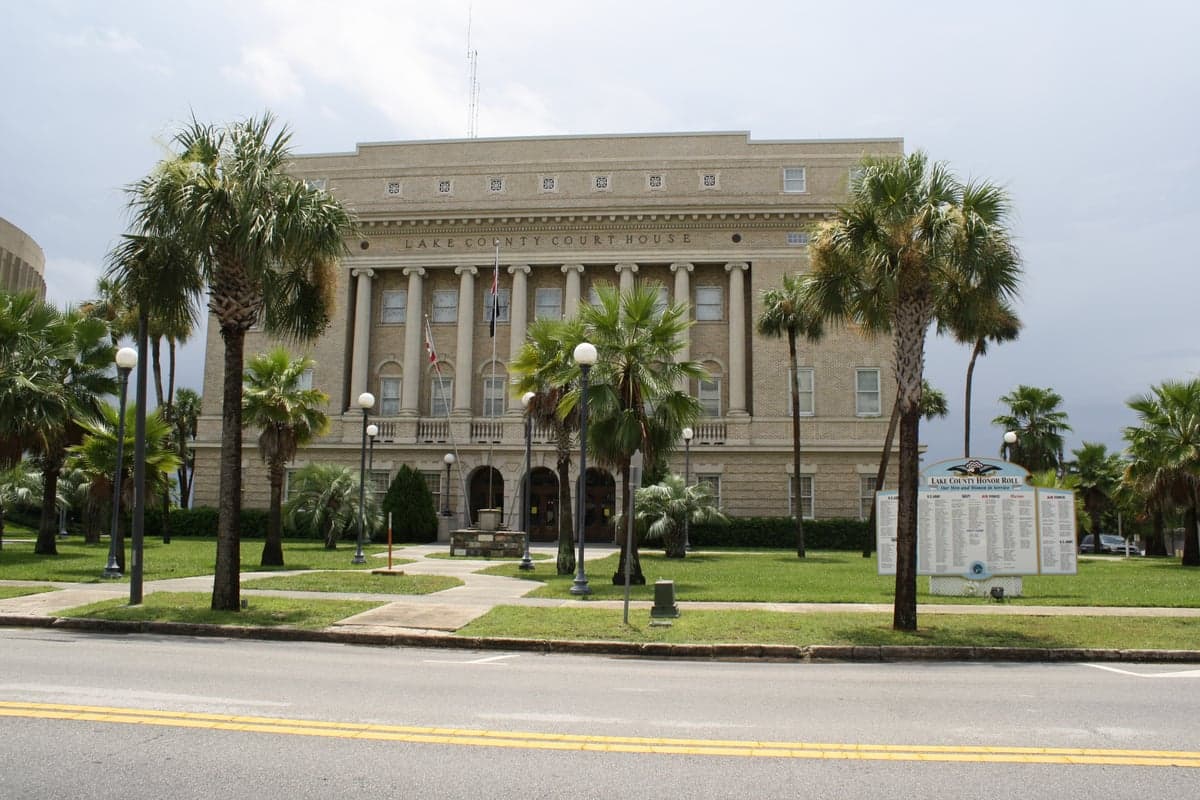
Photo: Wikipedia
Political ClimatePolitical Climate in Lake County
Showing county-level results — no local-only data available.
Lean and PVI are calculated from this county’s 2020 and 2024 presidential results, Cook-style.
Political rankings in Florida
- Most Conservative Cities in Florida
- Most Liberal Cities in Florida
- Best Liberal-Leaning Towns in the South
- Safest Liberal-Leaning Towns in the South
- Safest Conservative-Leaning Towns in the South
- Safest Liberal-Leaning Towns on the East Coast
- Safest Conservative-Leaning Towns on the East Coast
- Affordable Small Towns for Conservatives
- Most Conservative Counties in Florida
- Most Liberal Counties in Florida
Local Political AnalysisPolitical Analysis of Lake County
Lake County, Florida, has shifted from a reliably conservative area to a solidly Republican stronghold, now carrying a Cook Partisan Voting Index (PVI) of R+12. This means the county votes about 12 points more Republican than the national average, a trend that has accelerated over the past decade as new residents from the Midwest and Northeast have moved in. While the county was once a mix of rural Democrats and conservative Republicans, the political center of gravity has moved decisively to the right, with local elections often decided in the Republican primary rather than the general election.
How it compares
Compared to the state of Florida as a whole, Lake County is noticeably more Republican. Florida's overall PVI is R+3, meaning Lake County is about 9 points more conservative than the state average. This gap is visible in presidential elections: in 2020, Donald Trump won Lake County by roughly 20 points, while he won Florida by about 3 points. The county's political geography is not uniform, however. The city of Mount Dora has a visible Democratic presence, with its historic downtown and arts scene attracting a more liberal-leaning population, and it often votes closer to the state average. In contrast, The Villages, the massive retirement community in the southern part of the county, is one of the most reliably Republican voting blocs in the entire state, routinely delivering margins of 70% or more for GOP candidates. Eustis and Tavares lean conservative but have pockets of swing voters, while Clermont, which has seen explosive growth, is more mixed, with newer subdivisions trending slightly more moderate than the county's older communities.
What this means for residents
For conservative residents, Lake County offers a political environment where their views are the clear majority. Local government, from the county commission to the school board, is dominated by Republicans, and policy decisions generally reflect conservative priorities on taxes, development, and education. For liberal residents, the reality is that they are a distinct minority, but not entirely without representation. Mount Dora and parts of Clermont provide social and political spaces where Democratic-leaning residents can find community, and local Democratic clubs remain active, though they have little influence on countywide elections. The practical effect of the R+12 lean is that most residents, regardless of party, experience a county government that is stable and predictable in its conservatism, with low taxes and a pro-growth development approach being the norm.
Culturally, Lake County's political lean is reflected in its policy distinctions. The county has been a leader in the state's fight against COVID-19 mandates, with local officials openly resisting mask and vaccine requirements. Gun rights are strongly supported, with the county declaring itself a "Second Amendment Sanctuary" in 2020. On the other hand, the county's rapid growth has created tension between development-friendly conservatives and those who want to preserve the area's rural character, a debate that often splits the local Republican party. For newcomers, understanding that Lake County is not a purple or swing area is key: it is a deeply red county where the political conversation is shaped by conservative values, and where even moderate Democrats often find themselves out of step with the majority of their neighbors.

State Political ClimatePolitical Climate in Florida
State Political AnalysisPolitical Environment in the State
Florida has transformed from a quintessential swing state into a solidly Republican-leaning powerhouse over the past decade, with registered Republicans now outnumbering Democrats by over 800,000 voters as of 2024. The state’s political center of gravity has shifted decisively rightward, driven by a massive influx of conservative-leaning transplants from the Northeast and Midwest, combined with a growing Hispanic electorate in places like Miami-Dade that has broken sharply toward the GOP. This isn’t your grandfather’s Florida — the 2022 midterms saw Governor Ron DeSantis win a 19-point re-election victory, and Donald Trump carried the state by over 3 points in both 2020 and 2024, a far cry from the 537-vote margin of 2000.
Urban vs. rural divide
The political map of Florida is a study in stark contrasts. The major urban centers — Miami-Dade County, Orlando (Orange County), and Tampa (Hillsborough County) — have historically been Democratic strongholds, but that’s changing fast. Miami-Dade, once a blue bastion, flipped to Trump in 2020 and again in 2024, driven by Cuban-American and Venezuelan voters who respond strongly to anti-socialist messaging. Meanwhile, the sprawling suburbs of Jacksonville (Duval County) and Fort Myers (Lee County) have become reliably red, with Lee County voting +27 points Republican in 2024. The rural Panhandle — places like Panama City and Tallahassee’s surrounding counties — is deeply conservative, often delivering 70-80% GOP margins. The I-4 corridor, stretching from Tampa through Lakeland to Orlando, remains the state’s most competitive battleground, but even there, the trend is redward: Polk County (Lakeland) voted +18 for Trump in 2024, up from +11 in 2020.
Policy environment
Florida’s policy environment is defined by a low-tax, low-regulation posture that appeals strongly to conservative relocators. There is no state income tax, a major draw for high-earners and retirees. Property taxes are capped by the Save Our Homes amendment, which limits annual increases to 3% for homesteaded properties. The regulatory climate is business-friendly, with a right-to-work law and minimal labor union influence. On education, Florida has been a national leader in school choice: the Family Empowerment Scholarship and Florida Tax Credit Scholarship programs allow over 400,000 students to attend private or charter schools. The state’s election laws have tightened significantly since 2020, with stricter voter ID requirements, limits on drop boxes, and a ban on ballot harvesting — changes that have drawn both praise for security and criticism for suppression. Healthcare policy is market-oriented; Florida did not expand Medicaid under the ACA, leaving roughly 800,000 residents in the coverage gap.
Recent policy direction
The last four years have seen an aggressive conservative legislative agenda. On guns and self-defense, Florida enacted permitless carry (HB 543) in 2023, allowing concealed carry without a license, while maintaining a 3-day waiting period for handgun purchases. Parental rights in education were codified via the Parental Rights in Education Act (HB 1557, often called “Don’t Say Gay”), which restricts classroom instruction on sexual orientation and gender identity through third grade. On speech, the state passed the “Stop WOKE Act” (HB 7), limiting how race-related concepts can be taught in schools and workplaces — though parts were blocked by federal courts. Medical and bodily autonomy saw a six-week abortion ban (HB 5) signed in 2023, with no exceptions for rape or incest, though a state constitutional amendment protecting abortion rights will appear on the 2024 ballot. Property rights remain strong, with no state-level rent control allowed and a robust homestead exemption. On privacy, Florida passed a comprehensive data privacy law (SB 262) in 2023, giving residents the right to opt out of data collection. Voting access has been restricted: the 2021 SB 90 law limited drop boxes to early voting sites and required them to be staffed, and felon re-enfranchisement remains contentious after the 2018 Amendment 4 required felons to pay all fines and fees before voting.
Civil unrest & political movements
Florida has seen its share of political flashpoints. The 2020 Black Lives Matter protests were significant in Miami, Tampa, and Orlando, but largely peaceful compared to other states. The state’s immigration politics are front and center: Governor DeSantis made national headlines with the 2022 flights of migrants from Texas to Martha’s Vineyard, and the state passed the tough SB 1718 immigration law in 2023, requiring E-Verify for employers and invalidating out-of-state driver’s licenses for undocumented immigrants. There is no sanctuary city movement of note — in fact, the state has banned sanctuary policies outright. Election integrity remains a hot-button issue; the 2020 recount in Palm Beach County and ongoing litigation over felon voting rights keep the topic alive. Organized activist movements are visible on both sides: the Florida Freedom Alliance and Moms for Liberty are active on the right, while the Florida Rising coalition and Dream Defenders organize on the left. A new resident will notice political bumper stickers and yard signs are common, but open confrontation is rare outside of downtown areas of Miami and Orlando.
Projection
Over the next 5-10 years, Florida’s political trajectory points further right, but with important caveats. The demographic tailwinds are strong: net in-migration of roughly 300,000 people per year, many from high-tax blue states, will continue to boost Republican registration. The Hispanic vote, particularly in Miami-Dade, is likely to stay Republican-leaning as long as socialism remains a potent issue. However, the 2024 abortion amendment could shift the ground — if it passes, it may mobilize Democratic voters and moderate Republicans. The biggest wildcard is climate change: rising sea levels and hurricane intensity could eventually slow migration to coastal areas, potentially dampening the GOP’s growth. For now, expect continued conservative governance on taxes, education, and regulation, with the state remaining a national laboratory for conservative policy. A relocator moving in now should expect to find a state that is increasingly Republican, increasingly diverse, and increasingly assertive in its policy direction.
For a new resident, the bottom line is this: Florida offers a low-tax, business-friendly environment with strong parental rights and school choice, but it comes with a sharply conservative social agenda on abortion, LGBTQ+ issues, and immigration. If you align with that vision, you’ll find a state that is actively building the world you want. If you don’t, you’ll still find a vibrant economy and beautiful weather, but you’ll need to navigate a political landscape that is increasingly hostile to progressive priorities. Either way, Florida is no longer a swing state — it’s a red state with a purpose.
* Values derived from national, state, county, city and local statistics and may differ in a specific area. Last updated: 2026-11-14T03:18:18.000Z
Narrative content on this page is AI-generated and may contain mistakes. Verify any details that matter before acting on them.
ReloMaps may earn a commission from affiliate links at no extra cost to you.

