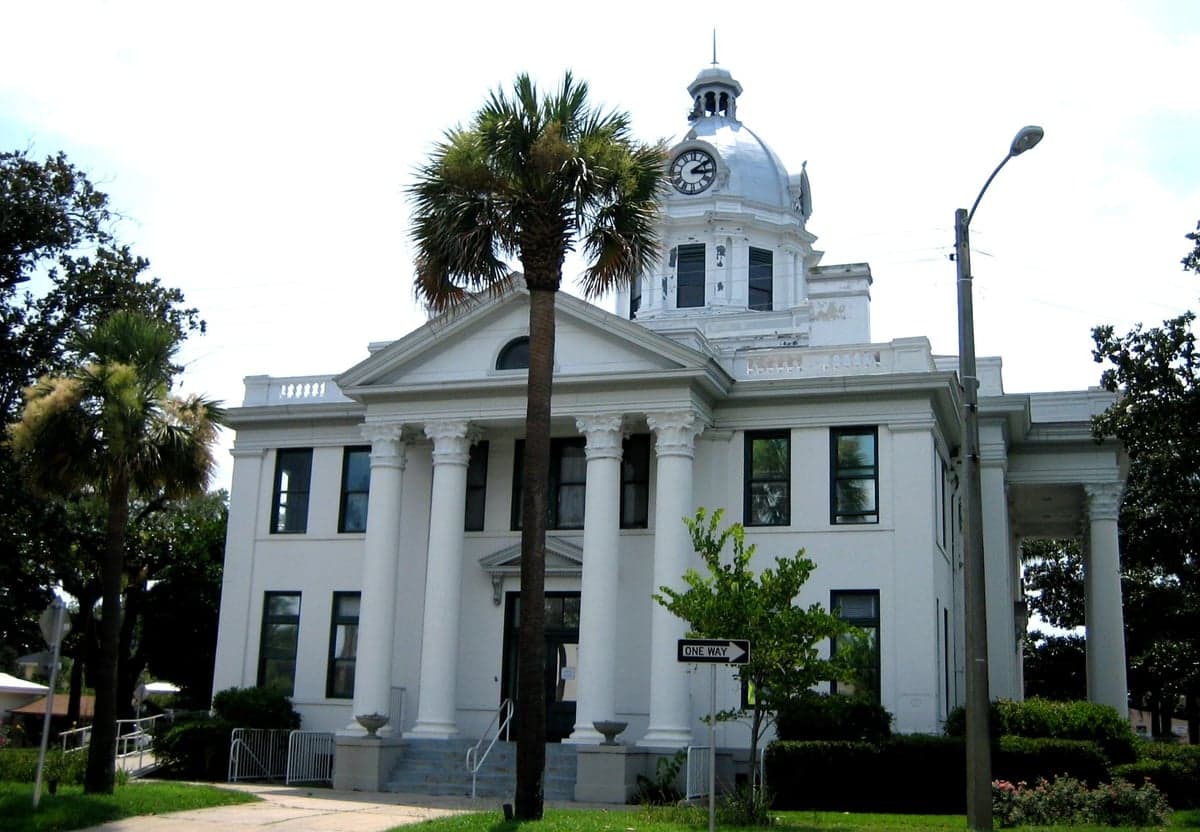
Photo: Wikipedia
Political ClimatePolitical Climate in Jefferson County
Showing county-level results — no local-only data available.
Lean and PVI are calculated from this county’s 2020 and 2024 presidential results, Cook-style.
Political rankings in Florida
- Most Conservative Cities in Florida
- Most Liberal Cities in Florida
- Best Liberal-Leaning Towns in the South
- Safest Liberal-Leaning Towns in the South
- Safest Conservative-Leaning Towns in the South
- Safest Liberal-Leaning Towns on the East Coast
- Safest Conservative-Leaning Towns on the East Coast
- Affordable Small Towns for Conservatives
- Most Conservative Counties in Florida
- Most Liberal Counties in Florida
Local Political AnalysisPolitical Analysis of Jefferson County
Jefferson County, Florida, is a reliably Republican area with a Cook PVI of R+7, meaning it votes about seven points more conservative than the nation as a whole. However, this rural county in the Big Bend region isn't a monolith; its politics are shaped by a distinct split between the more conservative, rural northern and central parts and the slightly more moderate precincts around the county seat, Monticello, and the southern edge near the state capital. While the county has trended redder in recent presidential cycles, local elections often hinge on personality and specific issues rather than straight party lines, giving it a more nuanced feel than the raw PVI suggests.
How it compares
Compared to Florida as a whole, Jefferson County is notably more conservative than the state's average, which has shifted from a traditional swing state to a lean-Republican posture in recent years. The county's R+7 rating places it to the right of many suburban and urban areas, but it's not as deeply red as the Florida Panhandle's core. The real contrast is internal: the town of Monticello, with its historic square and government-adjacent population, often shows the most competitive precincts, occasionally voting for a Democrat in a local race. In contrast, unincorporated areas like Wacissa and Lamont are deeply Republican, with turnout driven by agricultural and hunting interests. The precinct around Ashville Highway is a classic swing area, where a well-funded local candidate can flip it, but a national Republican wave will carry it easily. This patchwork means the county's overall red lean masks a real, if shrinking, Democratic minority concentrated in Monticello and among some long-time African American communities.
What this means for residents
For a conservative resident, Jefferson County offers a comfortable political environment where Republican candidates are the default in most races, and local government tends to favor limited regulation and low taxes. You'll find that the county commission and school board are reliably conservative, and social issues like gun rights and property rights are generally protected. For a liberal resident, the reality is more about finding your niche. You'll likely feel out of step in the wider county, but Monticello provides a small, like-minded community, especially among those involved in the arts, local government, or the nearby university scene in Tallahassee. The key is that local politics here are often less about national culture wars and more about practical matters: road maintenance, fire service funding, and the fate of the local hospital. This can make day-to-day life less polarized than the R+7 label suggests, though national election years can feel tense.
Culturally, Jefferson County distinguishes itself from much of Florida by its deep-rooted, small-town Southern identity. There's a strong sense of local history, with the Monticello Opera House and the county's many historic plantations shaping the landscape. Policy-wise, the county has been a battleground over growth management, with some residents pushing for more development to boost the tax base and others fiercely defending the rural, agricultural character. The county's proximity to Tallahassee also means it's a bedroom community for state workers, which injects a more moderate, professional-class influence into local politics. Looking ahead, the trajectory is likely to remain Republican, but the margin could narrow if more Tallahassee commuters move in, or widen if the area attracts more retirees seeking a conservative, rural haven. For now, it's a place where the national political winds blow hard, but local relationships and practical concerns still hold real sway.

State Political ClimatePolitical Climate in Florida
State Political AnalysisPolitical Environment in the State
Florida has transformed from a quintessential swing state into a solidly Republican-leaning powerhouse over the past decade, with Republicans now holding a supermajority in the state legislature and a 1-million-voter registration advantage as of 2026. The shift is driven by a massive influx of conservative-leaning transplants from the Northeast and Midwest, coupled with a rightward lurch among Hispanic voters, particularly in Miami-Dade County. While Democrats still hold sway in dense urban cores like Orlando and Tallahassee, the state’s overall trajectory has been a steady march rightward since the 2018 gubernatorial race, accelerating through the COVID-era culture wars.
Urban vs. rural divide
The political map of Florida is a study in stark contrasts. The reliably blue strongholds are the urban cores of Miami-Dade County, Orlando (Orange County), and Tallahassee (Leon County), where dense, diverse populations and union-heavy public sectors drive Democratic margins. However, the most dramatic story is Miami-Dade itself: once a Democratic bastion, it flipped to Trump in 2020 and has only grown redder, driven by Cuban-American and Venezuelan voters who view the GOP as more anti-socialist. Meanwhile, the sprawling suburbs of Tampa (Hillsborough County) and Jacksonville (Duval County) have trended right, with once-competitive counties like Pinellas and Seminole now reliably Republican. The rural Panhandle—places like Panama City and Pensacola—votes as deep red as any county in the country, while the I-4 corridor between Tampa and Daytona remains the last true battleground, though it’s now leaning Republican. The Gainesville area (Alachua County) remains a liberal college-town outlier, but it’s increasingly surrounded by red exurbs.
Policy environment
Florida’s policy environment is defined by a low-tax, low-regulation posture that has made it a magnet for businesses and retirees. There is no state income tax, and the corporate tax rate is a flat 5.5%. Property taxes are moderate, though homeowners in fast-growing areas like Naples and Sarasota have seen assessments skyrocket. The state’s education policy has shifted sharply rightward: Governor Ron DeSantis’s “Parental Rights in Education” law (HB 1557, often called “Don’t Say Gay”) restricts classroom instruction on sexual orientation and gender identity through third grade, and a 2023 law (HB 7) bans public schools from teaching critical race theory. School choice is expansive, with universal vouchers available to all students regardless of income. Healthcare policy is market-driven: Florida did not expand Medicaid under the Affordable Care Act, leaving roughly 800,000 low-income residents in a coverage gap. Election laws have been tightened: a 2021 law (SB 90) restricted drop boxes, added voter ID requirements, and limited third-party ballot collection, while a 2023 law (SB 7050) made it harder for felons to restore voting rights after a 2018 ballot initiative. The state also has a “stand your ground” self-defense law and a permitless carry law (HB 543, effective July 2023) that allows concealed carry without a license.
Recent policy direction
The last five years have seen an aggressive consolidation of conservative priorities across nearly every policy domain. On gun and self-defense law, Florida passed permitless carry in 2023, joining 25 other states, and maintains a strong “stand your ground” statute. On parental and education rights, the state has banned DEI programs in public universities (SB 266, 2023) and restricted library books with “age-inappropriate” content. On speech and expression, a 2022 law (HB 7) prohibits workplace training that suggests someone is “inherently racist or oppressive” due to their race, and the state has taken over the New College of Florida in Sarasota, installing a conservative board to reshape the liberal arts curriculum. On privacy and surveillance, Florida has banned TikTok on government devices and passed a law (SB 2580, 2024) requiring age verification for social media use by minors. On medical and bodily autonomy, the state enacted a six-week abortion ban (HB 5, 2023) with no exceptions for rape or incest, and a 2024 law (SB 1640) restricts gender-affirming care for minors, including banning puberty blockers and hormone therapy. On property rights, the state has preempted local rent control ordinances and limited local governments’ ability to regulate short-term rentals like Airbnb. On taxation, the legislature has passed annual tax holidays and a permanent reduction in the commercial rent tax. On voting and ballot access, the state has purged non-citizens from voter rolls and requires a strict photo ID to vote in person.
Civil unrest & political movements
Florida has been a flashpoint for organized activism on both sides. The Black Lives Matter protests in 2020 were large and sometimes violent in Miami, Orlando, and Jacksonville, leading to a heavy police response and subsequent “law and order” legislation. The Moms for Liberty movement, founded in Florida in 2021, has become a national force in school board politics, pushing for book bans and parental oversight. Immigration politics are especially heated: Governor DeSantis has bused migrants from Texas to Martha’s Vineyard and California, and a 2023 law (SB 1718) requires hospitals to ask about immigration status and expands penalties for transporting undocumented immigrants. There is no sanctuary city policy in Florida; state law preempts any local “sanctuary” ordinances. Election integrity remains a live issue: the state’s 2020 election was widely seen as clean, but the 2022 creation of the Office of Election Crimes and Security has led to dozens of prosecutions for alleged voter fraud, mostly targeting felons who voted unknowingly. The secession/nullification rhetoric is minimal compared to Texas, but there is a strong “state sovereignty” streak in the legislature, with bills filed to nullify federal gun laws and environmental regulations.
Projection
Over the next 5-10 years, Florida will likely become even more Republican as the in-migration of conservative retirees and remote workers from blue states continues. The key demographic wildcard is the Hispanic vote: if Miami-Dade’s rightward shift holds and spreads to the growing Puerto Rican and Central American communities in Orlando and Tampa, the state could become as red as Texas. Climate change is the biggest long-term risk—rising sea levels and stronger hurricanes could eventually slow growth in coastal areas like Miami Beach and Fort Lauderdale, but for now, the insurance crisis is manageable. The state’s political leadership will likely remain focused on cultural issues and tax cuts, with less attention to infrastructure and public health. A new resident moving in now should expect a state where the government is actively conservative on social issues, aggressively pro-business, and skeptical of federal authority. The Democratic Party will continue to be a minority force, concentrated in a few urban counties, and the political conversation will be dominated by the GOP’s internal factions—the DeSantis-aligned pragmatists versus the more populist, Trump-aligned wing.
For a new resident, the bottom line is that Florida offers a low-tax, high-freedom environment for those who align with its conservative drift, but it comes with trade-offs: limited public services, a frayed social safety net, and a political culture that can feel like a permanent culture war. If you value low regulation, school choice, and a strong executive, you’ll find a lot to like. If you’re looking for a place where your vote might swing an election, you’re moving to a state where the GOP has a firm grip on power for the foreseeable future. The best advice is to visit the specific area you’re considering—the vibe in St. Augustine is very different from Fort Myers—and understand that the state’s politics are as diverse as its geography, even if the overall direction is clear.
* Values derived from national, state, county, city and local statistics and may differ in a specific area. Last updated: 2026-11-14T05:11:27.000Z
Narrative content on this page is AI-generated and may contain mistakes. Verify any details that matter before acting on them.
ReloMaps may earn a commission from affiliate links at no extra cost to you.

