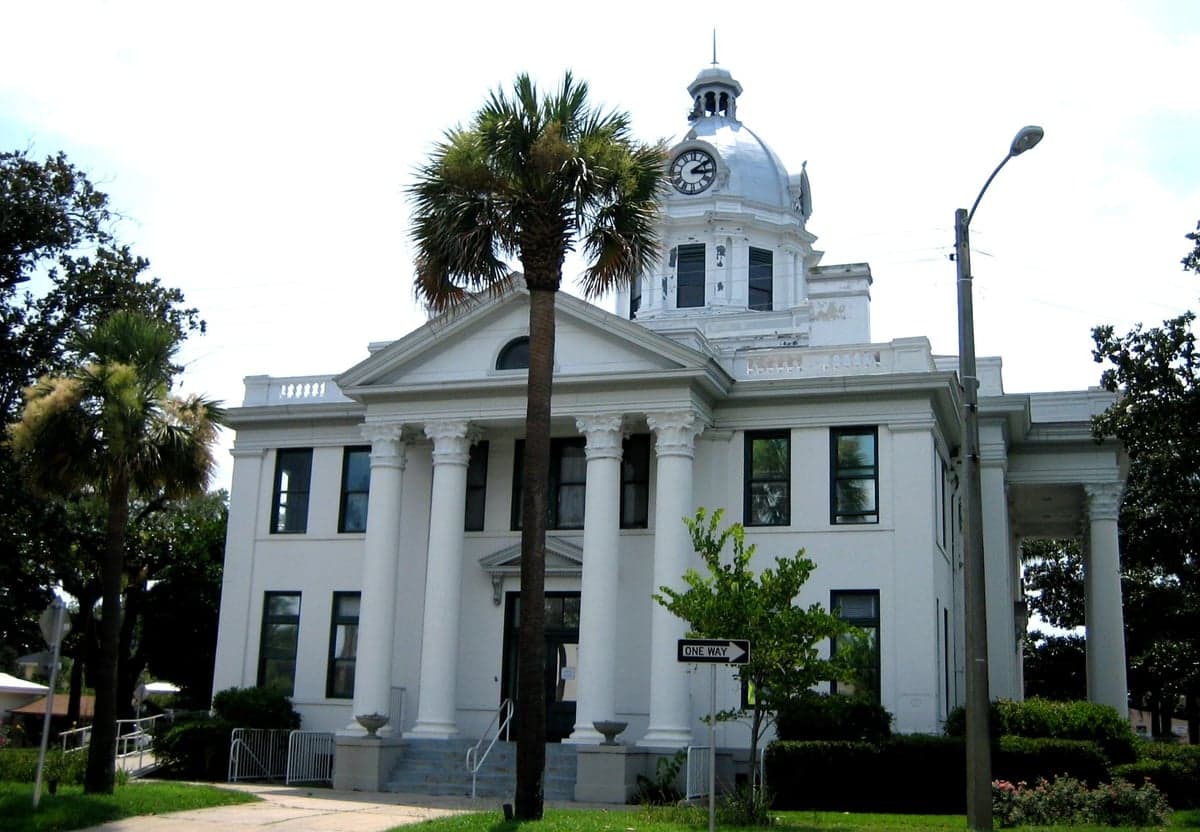
Photo: Wikipedia
Demographics of Jefferson County
Affluence Level in Jefferson County
A below-average socioeconomic profile. Incomes, home values, and educational attainment trail the U.S., with higher poverty and unemployment.
People of Jefferson County
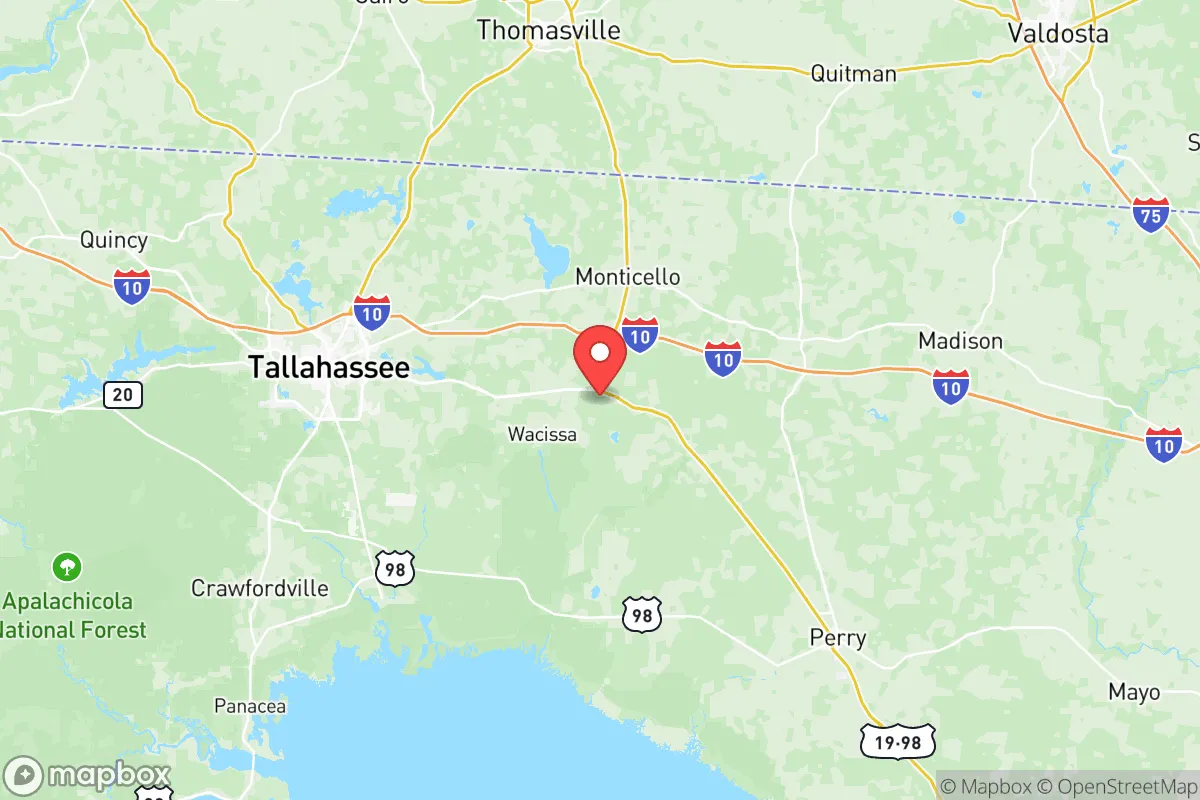
Jefferson County, Florida, is a deeply rural, historically rooted community of 14,713 residents where the population is nearly evenly split between White (60.1%) and Black (30.0%) residents, with a very small Hispanic (4.8%) and East/Southeast Asian (0.7%) presence. The county’s character is defined by its agricultural heritage, its location along the ecotone of the Red Hills and the Gulf Coastal Plain, and a population density of just 18 people per square mile. Distinctive identity markers include a strong sense of place tied to the county seat of Monticello, a legacy of plantation-era history, and a quiet, slow-paced lifestyle that attracts those seeking affordable land and a retreat from urban Florida.
Settlement & growth (pre-1960)
Before European contact, the area now known as Jefferson County was inhabited by the Apalachee people, a Mississippian culture group who lived in fortified towns and practiced maize agriculture. Spanish explorers and missionaries arrived in the 17th century, establishing the mission of San Pedro de los Chines near present-day Wacissa, but the Apalachee population was devastated by disease and slave raids from English colonies to the north. By the early 18th century, the region was largely depopulated, and the Creek and Seminole peoples moved into the area as a buffer zone.
American settlement began in earnest after Florida became a U.S. territory in 1821. The first major wave was planters from Georgia, Virginia, and the Carolinas who arrived in the 1820s and 1830s, drawn by the fertile, red-clay soils of the Red Hills region. They established large cotton plantations, and the county was formally created in 1827. The town of Monticello was laid out in 1828 as the county seat, named after Thomas Jefferson’s estate. These early settlers were predominantly of English and Scots-Irish descent, and they brought with them a slave-based agricultural economy. By 1860, enslaved African Americans made up a majority of the county’s population, working the cotton fields that stretched from Monticello to the hamlet of Drifton.
After the Civil War and emancipation, many freedmen remained in the county as sharecroppers and tenant farmers, establishing small communities such as Ashville and Lamont. The post-Reconstruction era saw the rise of a rigid Jim Crow system, but the Black population remained a substantial share of the county’s total. The arrival of the railroad in the 1880s connected Monticello to regional markets, but the county never experienced the industrial boom that transformed other parts of Florida. Instead, agriculture diversified into tobacco, timber, and later, cattle ranching. A small wave of European immigrants—primarily German and Italian families—settled in the Wacissa area in the early 1900s, drawn by land grants and the promise of small-scale farming, but their numbers were never large enough to form distinct ethnic enclaves. By 1950, Jefferson County’s population stood at roughly 10,000, with a demographic profile that had changed little since the 19th century: a majority White planter class and a large Black agricultural workforce, with virtually no foreign-born residents.
Modern era (post-1965)
The 1965 Hart-Cellar Act, which reshaped U.S. immigration, had almost no direct effect on Jefferson County. The foreign-born population today is just 1.1%, one of the lowest rates in Florida. The county did not attract the post-1965 waves of immigrants from Latin America, Asia, or the Caribbean that transformed nearby urban centers like Tallahassee or Jacksonville. Instead, the county’s demographic story in the modern era is one of domestic out-migration and gradual racial rebalancing.
Beginning in the 1970s, the mechanization of agriculture and the decline of tobacco farming led to a steady loss of jobs, prompting many Black residents to leave for cities in the North and South. The county’s population peaked at around 17,000 in 1960 and then declined, bottoming out at around 12,000 in the 1990s. At the same time, a modest influx of White retirees and second-home buyers from Georgia and the Florida Panhandle began purchasing former plantation properties and lakefront lots around Lake Miccosukee and the Aucilla River corridor. This domestic migration was driven by the search for cheap land, privacy, and a rural lifestyle within commuting distance of Tallahassee (about 30 minutes north). The county’s Black population share, which had been over 50% for much of the 20th century, gradually declined to 30.0% by the 2020 census, while the White share rose to 60.1%.
Suburbanization has been minimal. The county has no incorporated towns other than Monticello, and the unincorporated communities of Wacissa, Drifton, and Lamont remain small crossroads settlements. The Hispanic population, at 4.8%, is a recent and small addition, consisting primarily of Mexican and Central American farmworkers employed in the region’s nurseries and vegetable farms, with a small concentration near Wacissa. The East/Southeast Asian population (0.7%) is almost entirely tied to the University of Florida’s research farms in the area and to a handful of professionals in Monticello. The Indian subcontinent population is effectively zero.
The future
Jefferson County is likely to remain one of Florida’s least diverse and most rural counties for the foreseeable future. The population has stabilized at around 14,700, with modest growth driven by spillover from Tallahassee’s expanding exurbs. New residential development is concentrated along the U.S. 19 corridor south of Monticello and around Lake Miccosukee, where lakefront lots are being subdivided for retirees and remote workers. The county’s cultural identity is evolving from its plantation-era roots toward a more generic rural Southern character, but the racial divide remains pronounced: Monticello’s historic downtown is predominantly White, while the outlying communities of Ashville and Lamont remain predominantly Black.
Demographic projections suggest the county will become slightly more White and older over the next decade, as younger Black residents continue to leave for urban job markets and as White retirees move in. The Hispanic share may grow slowly as agricultural labor demand persists, but it is unlikely to exceed 8-10% by 2040. The county’s college-educated share (18.8%) is well below the state average, and without a major employer or university presence, attracting younger, more diverse residents will remain a challenge.
For someone moving in now, Jefferson County offers a deeply quiet, affordable, and historically layered place—but one where the population is aging, the economy is narrow, and the social fabric remains largely divided along racial lines. It is a place for those who value land, solitude, and tradition over diversity and urban amenities.

* Values derived from national, state, county, city and local statistics and may differ in a specific area. Last updated: 2026-11-14T05:11:27.000Z
Narrative content on this page is AI-generated and may contain mistakes. Verify any details that matter before acting on them.
ReloMaps may earn a commission from affiliate links at no extra cost to you.

