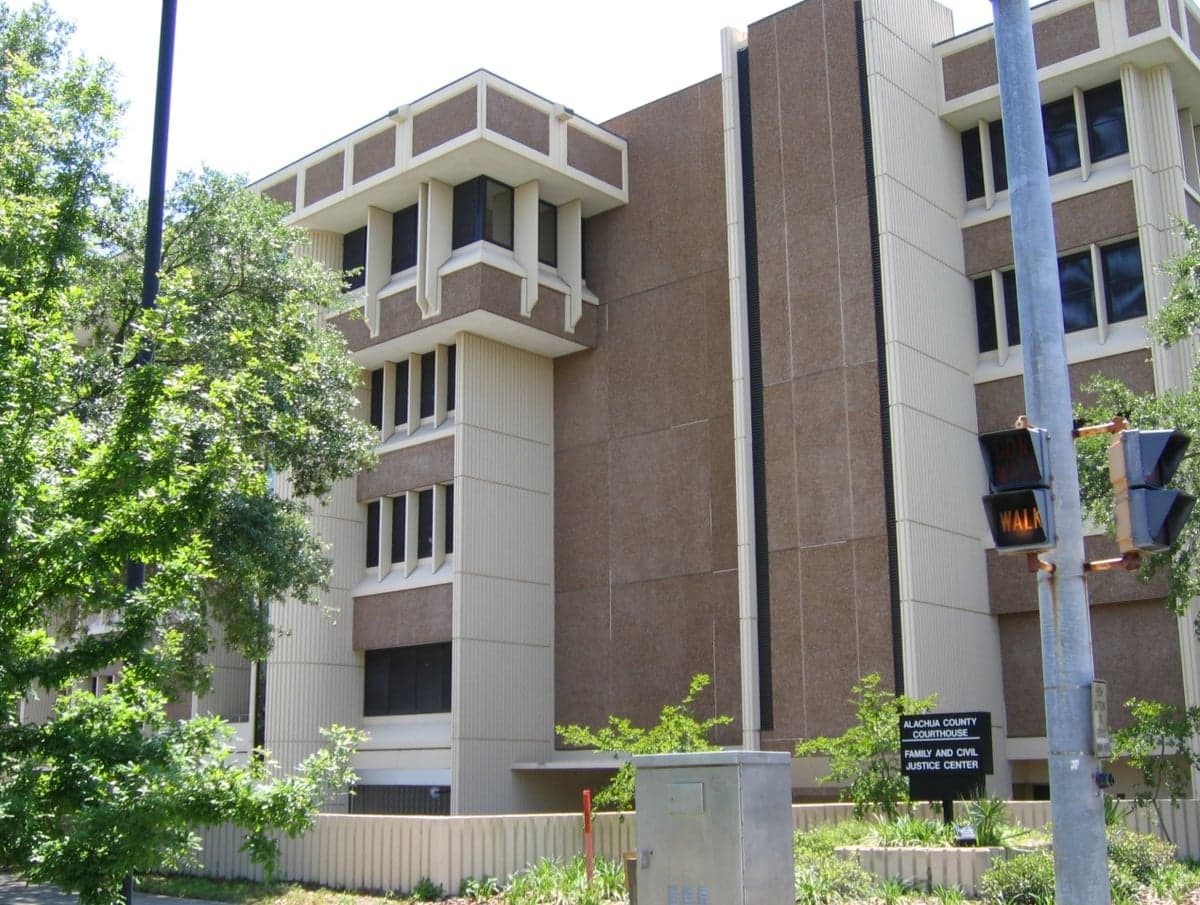
Photo: Wikipedia
Demographics of Alachua County
Affluence Level in Alachua County
A middle-class area roughly in line with national averages across income, home values, education, and employment.
People of Alachua County
Today, Alachua County is home to roughly 281,751 residents, a population shaped by a distinctive blend of a historically Black agricultural and university town core, a large and influential University of Florida community, and a growing, diversifying suburban ring. The county’s identity is defined by the sharp contrast between the college-educated, transient population of Gainesville (47.7% of adults hold a bachelor’s degree or higher) and the deep-rooted, rural communities that predate the university’s rise. With a population that is 58.3% White, 19.0% Black, 12.2% Hispanic, and a small but growing Asian and Indian presence, Alachua County is becoming more diverse, though its foreign-born share remains low at just 5.2%.
Settlement & growth (pre-1960)
Long before European contact, the area now known as Alachua County was the heartland of the Timucua people, particularly the Potano and Utina tribes, who lived in settled villages along the region’s lakes and rivers. Spanish explorers and missionaries arrived in the 16th century, establishing a network of missions that collapsed by the early 1700s due to disease, slave raids, and encroachment from English-allied Creek groups. By the mid-18th century, the region was largely depopulated of its original inhabitants, and the Seminole people, a Creek offshoot, moved into the area, establishing towns like the Alachua Savanna settlement near present-day Micanopy.
American settlement began in earnest after Florida became a U.S. territory in 1821. The first major wave was of Scots-Irish and English planters from Georgia and the Carolinas, who arrived in the 1820s and 1830s to establish cotton plantations. They founded the county’s earliest towns, including Newnansville (the original county seat, now a ghost town) and Micanopy, Florida’s second-oldest inland town. These planters brought enslaved African Americans, who by 1860 made up a majority of the county’s population. After the Civil War, many freedmen remained in the area, establishing independent farming communities such as Archer and the historic Pleasant Street neighborhood in Gainesville.
The second major wave came with the railroad in the 1850s and 1860s. The Florida Railroad connected the interior to the coast, and the county seat moved to Gainesville in 1854, spurring rapid growth. A small but notable group of German and Italian immigrants arrived in the late 19th century, working as merchants, farmers, and railroad laborers. They settled primarily in Gainesville and the farming community of Alachua (the town). The establishment of the University of Florida in Gainesville in 1906 transformed the county’s economy and demographics, drawing faculty and students from across the South and, later, the nation. By 1960, the county’s population had reached 74,074, still overwhelmingly White and Black, with a tiny foreign-born share.
Modern era (post-1965)
The 1965 Hart-Cellar Act had a modest direct impact on Alachua County compared to coastal Florida, but the university’s growth drove a steady, if slow, diversification. The most significant post-1965 change was the domestic migration of Northerners and Midwesterners, drawn by the university, the region’s relatively low cost of living, and the expanding healthcare sector centered at UF Health. This wave, which accelerated in the 1980s and 1990s, made Gainesville a more liberal, college-town enclave within a still-conservative North Florida region.
Immigration from abroad has been modest but concentrated. The county’s Hispanic population (12.2%) grew from near-zero in 1970, driven primarily by Puerto Ricans and Mexicans who arrived for agricultural work in the surrounding farmlands and later settled in Gainesville’s southwest side and in High Springs. The East/Southeast Asian community (3.7%) is largely tied to the university, with Chinese, Korean, and Vietnamese faculty, students, and their families concentrated in the neighborhoods near campus, such as Duck Pond and the University Park area. The Indian subcontinent community (2.2%) is similarly university-linked, with many working in UF’s engineering, medicine, and business schools, and settling in newer subdivisions in Haile Plantation and western Gainesville.
The county’s Black population (19.0%) has seen a relative decline from its post-Reconstruction peak, as younger generations moved to larger Southern cities or Northern metros. However, historically Black communities like Archer and the Bois Vieux area remain culturally significant, and a small but growing African immigrant population, particularly from Ethiopia and Nigeria, has added a new layer to the county’s Black identity.
The future
Alachua County is projected to grow moderately over the next decade, with the population likely reaching 310,000–320,000 by 2035. The county is becoming more diverse, but slowly. The Hispanic share is expected to rise to 15–17%, driven by natural increase and continued migration for service and construction jobs. The East/Southeast Asian and Indian populations will likely grow faster than the county average, as UF continues to recruit internationally, but they will remain concentrated in Gainesville’s western and southwestern suburbs. The White share will continue to decline gradually, from 58.3% toward the mid-50s, as the county’s growth comes disproportionately from minority groups.
The most significant demographic trend is the suburbanization of diversity. Newer subdivisions in Newberry, Alachua, and Jonesville are attracting a mix of young families, including many Hispanic and Asian households, who are dispersing from Gainesville’s core. Meanwhile, the university’s gravitational pull means the county will retain a highly educated, transient character, with a constant churn of students and early-career professionals. The cultural identity of Alachua County is likely to become a more pronounced urban-rural split: a liberal, diverse, university-anchored Gainesville surrounded by a more conservative, slower-growing, and still predominantly White rural periphery.
For someone moving in now, Alachua County offers a rare combination: a small-city, high-amenity college town with genuine racial and economic diversity, set within a region that still feels distinctly Southern and rural. The county is not undergoing rapid transformation, but it is steadily becoming more varied, more suburban, and more connected to the global economy through its university. The bottom line is that Alachua County is a place where the old South and the new knowledge economy coexist, and where the population’s future will be shaped more by the university’s next research park than by any single migration wave.

* Values derived from national, state, county, city and local statistics and may differ in a specific area. Last updated: 2026-07-12T07:58:14.000Z
Narrative content on this page is AI-generated and may contain mistakes. Verify any details that matter before acting on them.
ReloMaps may earn a commission from affiliate links at no extra cost to you.

