Photo: Wikipedia
Strategic Assessment of Eureka Springs, AR
Workable tactical position. Some exposure to population density or targets, but generally defensible in a crisis.
What does the Strategic Assessment tell us?
Our Strategic Assessment grades tactical survivability of an area. Major population centers, military targets, fallout zones, natural disasters, and border exposure all drive risk — lower exposure means a more defensible position in a crisis.
This is heavily inspired by Joel Skousen's Strategic Relocation book. Highly recommended you checkout the book ($)What does this tell us?
Our Strategic Assessment grades tactical survivability of an area. Major population centers, military targets, fallout zones, natural disasters, and border exposure all drive risk — lower exposure means a more defensible position in a crisis.
This is heavily inspired by Joel Skousen's Strategic Relocation book. Highly recommended you checkout the book ($)Strategic Pillars

Key Distances
Regional Safe Places
Below is our recommended "safe zones" in Arkansas and the surrounding area based on our strategic heuristics. For most people, it's unrealistic to live in a “safe zone” full-time due to work, family or other personal reasons. They tend to be more rural. However, many of these areas are perfect for second homes and retreat properties that double as a vacation home or even a short-term rental.
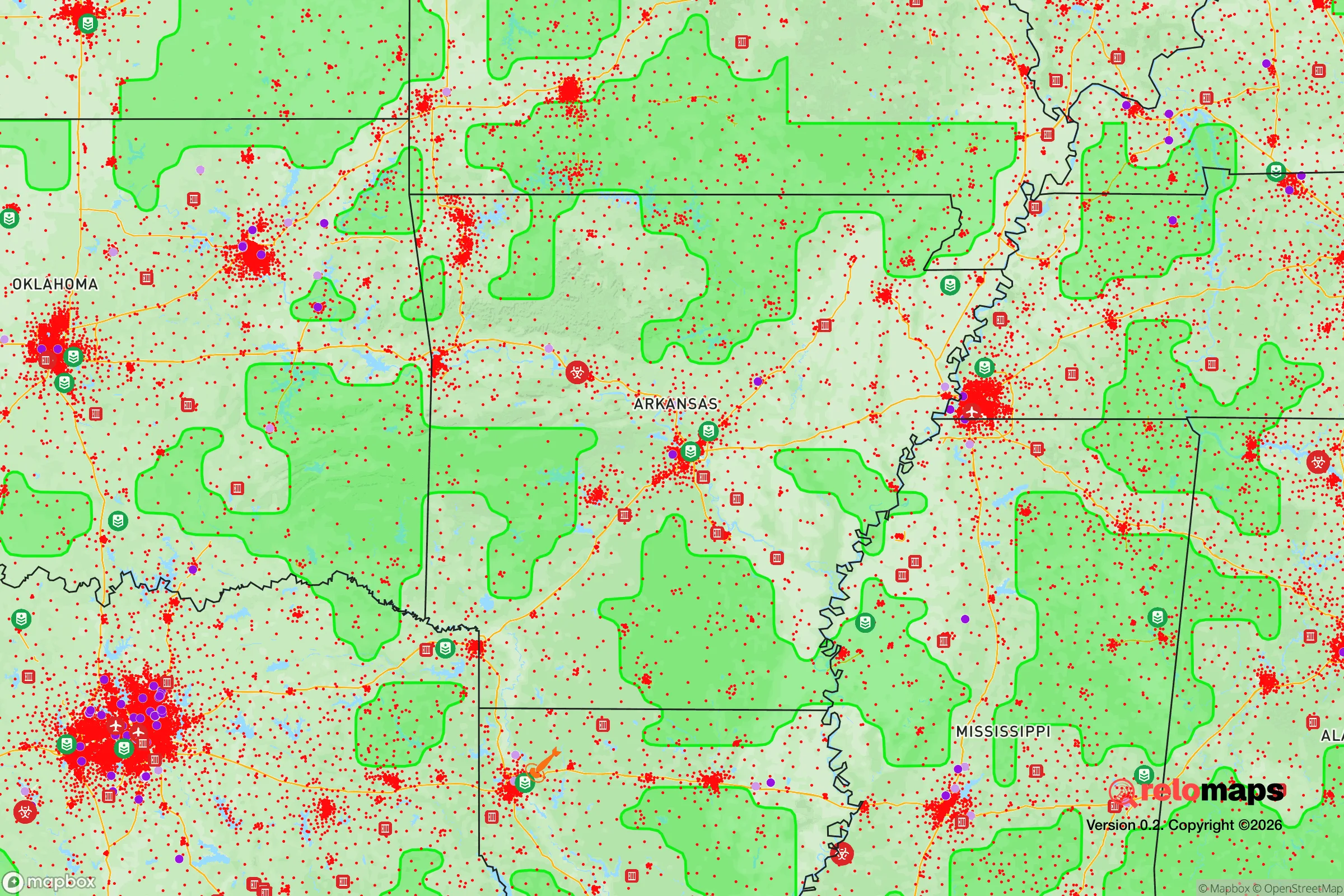
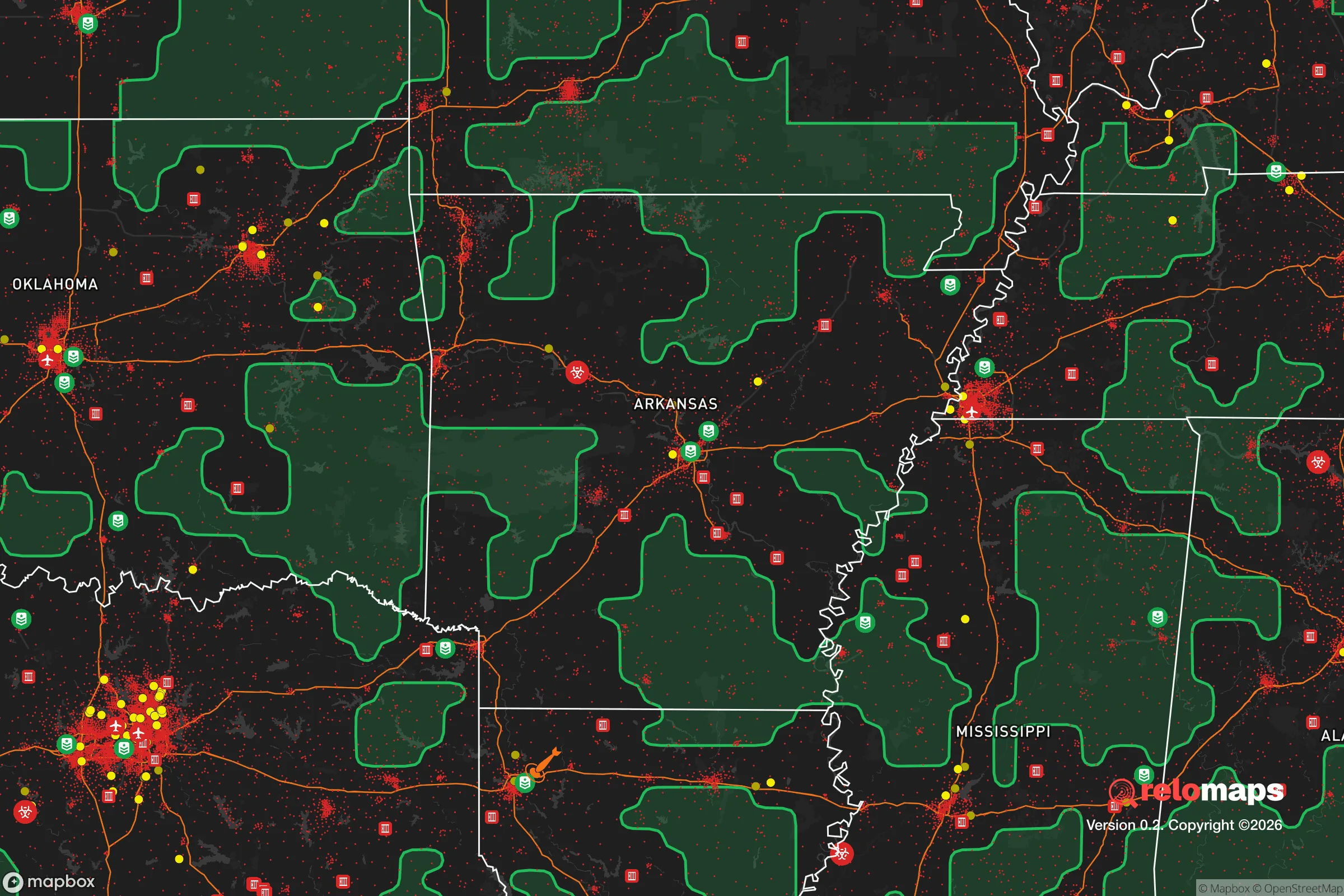


Important Note: For informational purposes only. This does not mean nothing bad ever happens in the green zones. Please use common sense. This is based on public data and modeled with AI. We tried to take a conservative approach but mistakes happen. We update this regularly as new information becomes available.
Solar Generator Recommendations
Backup power matters more here than in safer locations. We've picked three solar generators across budgets and capacity tiers — start with the budget unit if you only need a few essentials, or step up if you want to run a fridge and HVAC for days at a time.

Jackery Portable Power Station Explorer 300
Budget OptionPower on the Go: Weighing only 11 lbs, it's convenient to set up and store with book-sized foldable solar panels

BLUETTI Portable Power Station AC180
Designed for both indoor and outdoor scenarios, AC180 is highly capable as it has a robost capacity and continuous output power.

EF ECOFLOW DELTA Pro Ultra Power Station
Upgraded PickEcoFlow DELTA Pro Ultra is a whole-home energy system designed to grow with your family. Integrated with the Smart Home Panel 2, it scales to meet your evolving energy needs — keeping your home powered, intelligent, and secure through every stage of life.
We earn a commission, at no additional cost to you.
Strategic Assessment Analysis
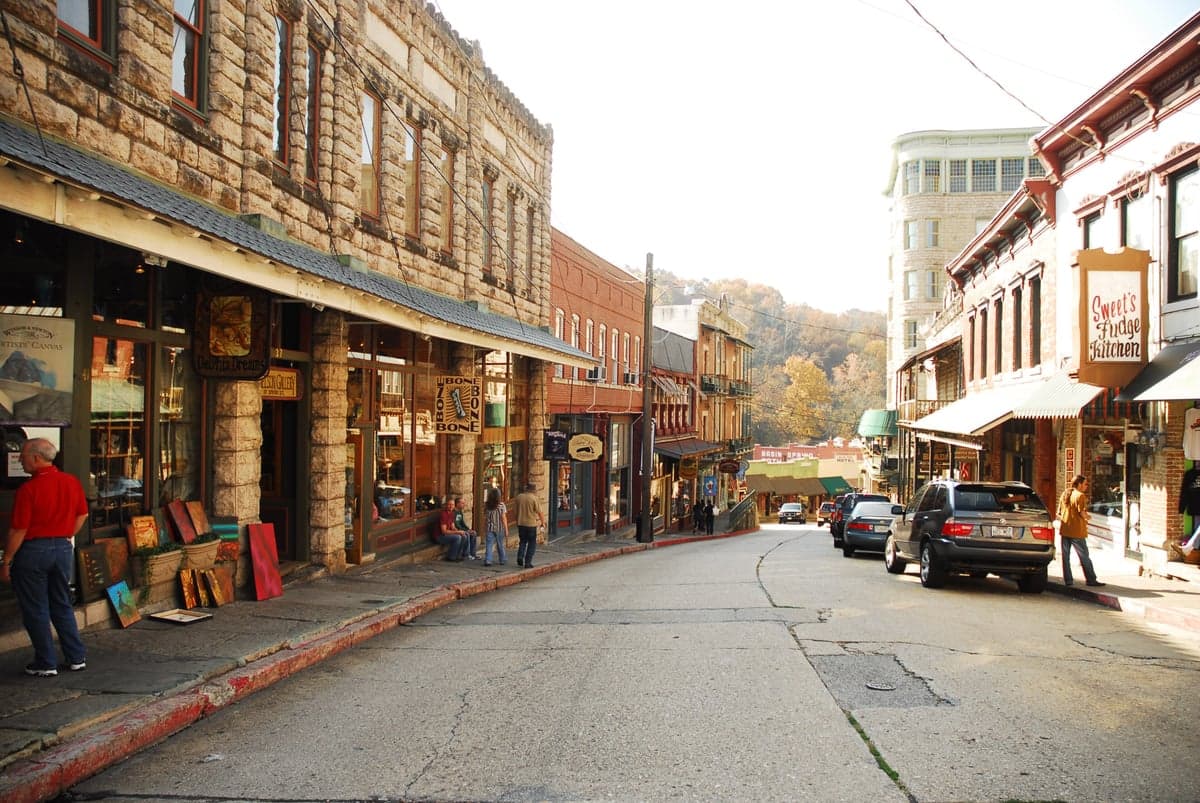
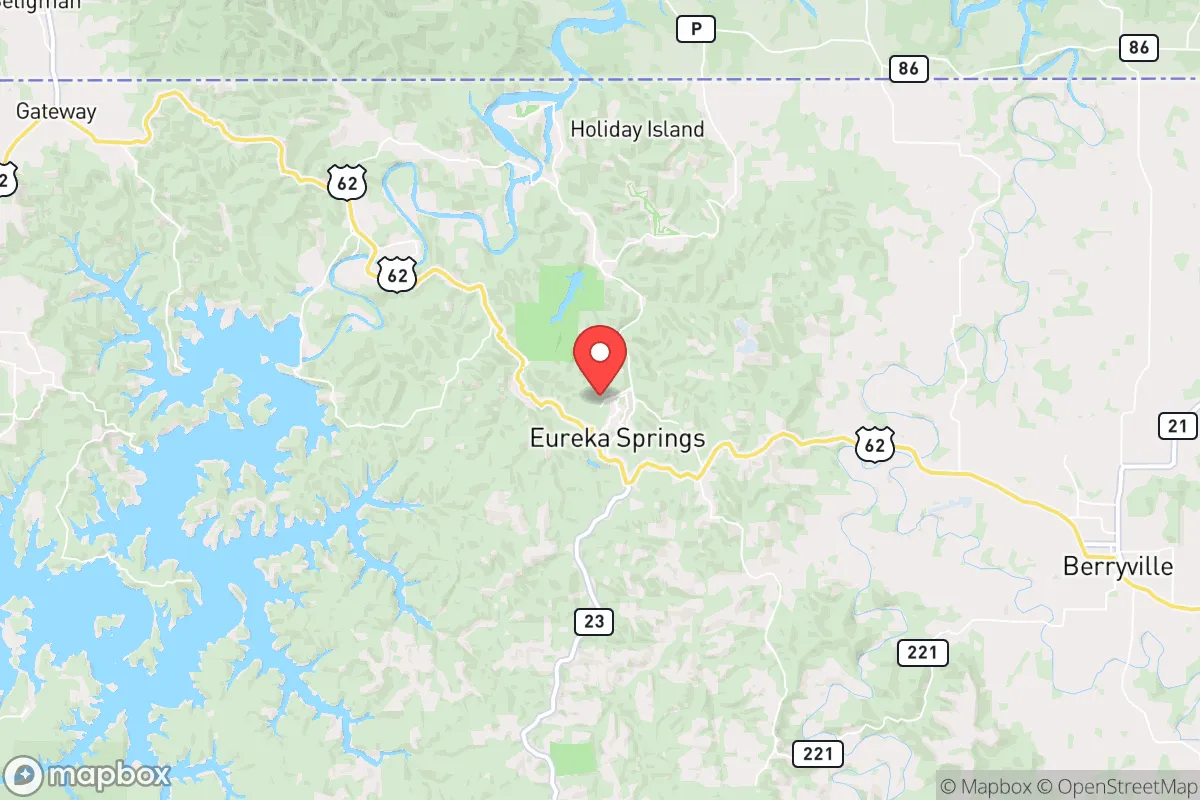
Eureka Springs, Arkansas, offers a distinctive strategic profile for the relocation-minded reader focused on resilience and self-sufficiency. Nestled deep in the Ozark Mountains of Carroll County, this small town of roughly 2,100 permanent residents sits about 45 miles northeast of Fayetteville and 30 miles south of the Missouri border. Its primary strategic advantage is geographic isolation combined with rugged terrain that naturally limits access and provides significant defensive depth, while its primary drawback is proximity to the Northwest Arkansas metroplex and the associated infrastructure that could become a target in a major disruption scenario.
Geographic position and natural advantages for long-term resilience
Eureka Springs occupies a uniquely defensible position within the Ozark Plateau, a region characterized by steep ridges, deep hollows, and limestone karst topography. The town itself is built on a series of steep hillsides around a spring-fed basin, which means the road network is winding, narrow, and easily chokepointed. The primary routes—US 62, AR 23, and AR 187—all pass through tight valleys and over ridges that could be monitored or blocked with minimal effort. This natural funneling effect is a double-edged sword: it makes ingress and egress difficult for outsiders, but also limits evacuation options for residents. The surrounding Ozark National Forest and numerous wildlife management areas provide a vast buffer of undeveloped land—over 1.2 million acres of public land within a 50-mile radius—that offers hunting, foraging, and timber resources. The area's elevation (ranging from 1,000 to 1,500 feet above sea level) keeps it above most floodplains, and the karst geology means surface water drains quickly, reducing standing water and mosquito-borne disease risks. The region's temperate climate supports a 180-day growing season, and the thin but workable mountain soils can sustain gardens with proper amendment. Critically, Eureka Springs sits outside the primary tornado alley that runs through central Arkansas; while severe weather occurs, the hilly terrain disrupts the long, flat fetch that produces the most violent tornadoes.
Risks, exposures, and proximity to fallout-relevant landmarks
The most significant strategic vulnerability for Eureka Springs is its location within the broader Northwest Arkansas economic zone. The town lies roughly 45 miles from the Fayetteville-Springdale-Rogers metro area (population 570,000), which hosts the University of Arkansas, Walmart's global headquarters, and Tyson Foods' corporate operations. In a major economic or geopolitical disruption, this metro area would likely become a focal point for population movement, resource competition, and potential infrastructure targeting. The nearby Beaver Lake Dam (about 20 miles southeast) is a critical piece of infrastructure; while not a nuclear target, its failure would flood downstream areas and could disrupt water supply for the region. Eureka Springs itself has no major industrial or military targets, but the town's reliance on tourism (over 1 million visitors annually pre-2020) means that in a crisis, the population could temporarily swell with stranded visitors, straining local resources. Natural disaster risks include flash flooding in the narrow hollows (particularly along the White River tributaries), ice storms that can knock out power for days or weeks, and the occasional wildfire in the surrounding forestlands. The area's isolation also means that emergency services are limited: the Carroll County Sheriff's Office has about 20 deputies for the entire county, and the nearest Level 1 trauma center is in Fayetteville, a 50-minute drive under good conditions. For the resilience-minded relocator, the key takeaway is that Eureka Springs offers strong natural defenses against most threats, but its proximity to a growing metro area introduces a human-factor risk that cannot be ignored.
Practical resilience for a relocator: food, water, energy, and defensibility
For a relocator serious about self-sufficiency, Eureka Springs presents a mixed but workable picture. Water availability is excellent: the town sits atop the Ozark aquifer, one of the largest freshwater sources in the country, and numerous springs, creeks, and the nearby White River provide surface water. However, most residential properties rely on wells, and drilling depths can range from 100 to 400 feet depending on location, with costs between $5,000 and $15,000. Rainwater catchment is viable, with annual precipitation averaging 45 inches, but the limestone geology means proper filtration is essential. Food production is feasible but requires effort: the growing season runs from April to October, and the region supports apples, berries, tomatoes, squash, and leafy greens. Deer, turkey, and squirrel are abundant for hunting, and the White River offers smallmouth bass and trout. However, the thin, rocky soil means raised beds or terraced gardens are often necessary, and the steep terrain limits large-scale agriculture. Energy independence is achievable: the area has good solar potential (about 4.5 peak sun hours per day), and many off-grid properties already use solar arrays with battery backup. Wood heating is common, with ample firewood available from the surrounding forests, though cutting permits are required on public land. The local power cooperative, Carroll Electric, has a history of multi-day outages after ice storms, so backup generation is strongly advised. Defensibility is the area's strongest suit: the narrow, winding roads and steep terrain make the town naturally hard to approach. Many properties are set back from main roads, hidden in hollows or on ridge tops, providing both privacy and tactical advantage. The local culture is heavily armed—Arkansas has constitutional carry and no state-level firearm registration—and the community is tight-knit, with a strong tradition of mutual aid. However, the same terrain that provides defense also complicates logistics: moving supplies, equipment, or building materials can be challenging, and heavy snow or ice can make some roads impassable for days.
Overall, Eureka Springs offers a strong strategic position for the resilience-minded relocator who values natural defensibility, abundant water, and a low-target profile. The town's isolation from major industrial and military targets is a genuine asset, and the surrounding Ozark landscape provides a buffer that few other locations in the central United States can match. The primary trade-offs are the proximity to Northwest Arkansas's growing population center, which introduces a risk of secondary disruption, and the practical challenges of living on steep, rocky terrain. For a single individual or family willing to invest in well-drilling, solar infrastructure, and soil improvement, Eureka Springs represents a viable long-term base with good natural defenses and a community that understands self-reliance. It is not a bug-out location for a weekend—it is a place to build a life that is already oriented toward resilience, with the understanding that no location is perfect, and that preparation, not geography alone, determines outcomes.

* Values derived from national, state, county, city and local statistics and may differ in a specific area. Last updated: 2026-10-08T19:29:15.000Z
Narrative content on this page is AI-generated and may contain mistakes. Verify any details that matter before acting on them.
ReloMaps may earn a commission from affiliate links at no extra cost to you.

