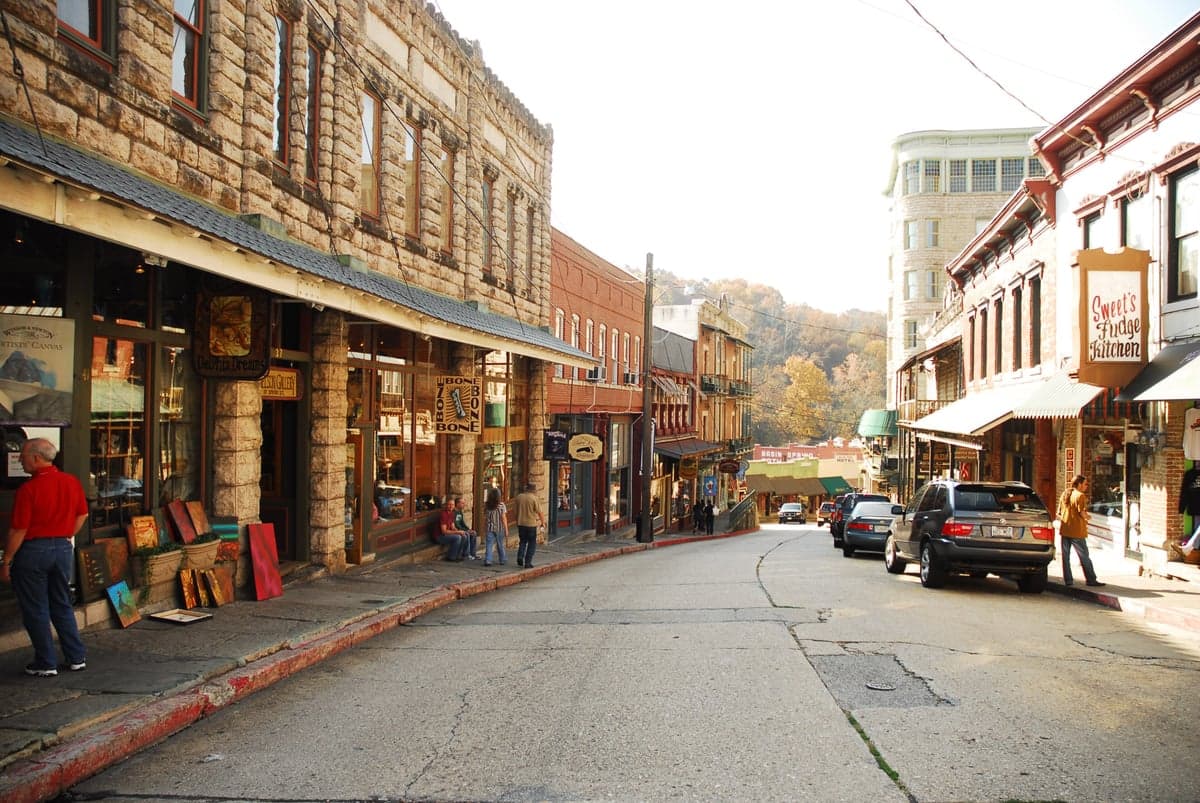
Photo: Wikipedia
Personal Sovereignty in Eureka Springs, AR
Viable for self-reliance. Generally workable, though some barriers may limit total independence.
What does Personal Sovereignty tell us?
Personal Sovereignty measures your capacity for self-reliance and independence with minimal government friction. Higher scores mean fewer barriers between you and the way you want to live... but it assumes you have the space you need and good neighbors.
What does this tell us?
Personal Sovereignty measures your capacity for self-reliance and independence with minimal government friction. Higher scores mean fewer barriers between you and the way you want to live... but it assumes you have the space you need and good neighbors.
State Policy
Energy independence: Importer (35% of energy produced in-state)
Personal Liberty
Homesteading

Personal Liberty Analysis
Eureka Springs offers a notably high degree of personal sovereignty relative to most of the United States, driven by Arkansas's broad constitutional protections and a local culture that prizes nonconformity and self-reliance. While the town itself leans progressive and artsy, the state-level legal framework provides a light-touch regulatory environment on taxes, guns, and property rights that appeals to individuals and families who prioritize autonomy. The combination of a low cost of living, minimal state interference in daily life, and a community that largely minds its own business makes this a compelling option for those seeking to maximize personal freedom without moving to a remote, unincorporated area.
Tax burden and regulatory posture in Arkansas
Arkansas maintains one of the lower overall tax burdens in the nation, which directly supports personal financial sovereignty. The state's individual income tax is a flat rate of 4.4% as of 2026, down from a progressive structure a decade ago, and there is no state-level estate or inheritance tax. Property taxes in Carroll County, where Eureka Springs sits, are among the lowest in the state, with effective rates typically ranging from 0.5% to 0.7% of assessed value — roughly half the national average. Sales tax in Eureka Springs is 9.125% (state plus local), which is moderate but notable because groceries and prescription drugs are exempt. The regulatory posture at the state level is deliberately hands-off: there is no state-level occupational licensing for many common trades (e.g., landscaping, photography, pet sitting), and business formation is straightforward with a simple online filing process. Zoning in the city itself is more restrictive than in unincorporated parts of the county — the historic district has design review for exterior changes — but outside city limits, land use is largely unregulated. For a reader comparing to states like California or New York, Arkansas's approach is unmistakably light-touch: fewer permits, lower fees, and less bureaucratic friction in everyday economic life.
Self-defense and gun law specifics in Arkansas
Arkansas is a strong constitutional carry state, meaning no permit is required to carry a concealed or open firearm for anyone legally allowed to possess one. This went into full effect in 2021 and remains unchanged. Eureka Springs itself is located in a county that is generally supportive of Second Amendment rights, though the town's city council has occasionally passed symbolic resolutions — none of which have any legal force against state preemption. State law explicitly preempts local governments from enacting their own gun ordinances, so the rules are uniform: no waiting periods, no magazine capacity limits, and no registration requirements. Stand-your-ground protections are codified in Arkansas law, with no duty to retreat in any place where a person is lawfully present. Castle doctrine applies to homes, vehicles, and occupied structures. For a family or individual who views self-defense as a core personal responsibility, the legal environment here is unambiguous: the state trusts law-abiding citizens to arm themselves without bureaucratic hurdles. The only notable restriction is that carrying a firearm into a posted business or government building can result in trespassing charges, but that is a matter of private property rights, not state overreach.
Self-reliance and homesteading viability in the Eureka Springs area
The Ozark terrain around Eureka Springs makes homesteading and off-grid living genuinely viable, though with some practical caveats. Lot sizes in unincorporated Carroll County can be as small as one acre for a single-family home, but many parcels available for purchase range from 5 to 40 acres, offering room for gardens, livestock, and timber management. Zoning outside city limits is minimal: no county-wide building codes, no mandatory inspections for owner-built homes, and no restrictions on rainwater collection or composting toilets. Off-grid solar is common, and the region's moderate climate (average 45 inches of rain per year) makes well water and rainwater harvesting reliable. The city of Eureka Springs itself does require permits for new construction and has a historic district overlay, but the county is essentially unregulated. For someone wanting to build a cabin with their own hands, raise chickens and goats, and generate their own power, this area is one of the more accommodating in the lower 48. The main limitation is that the rocky, steep terrain can increase foundation costs, and some rural properties lack broadband internet — though Starlink has largely solved that for those willing to pay the upfront equipment cost. The local culture includes a strong DIY ethic, with numerous workshops and community groups focused on permaculture, canning, and small-scale farming.
Personal liberties: parental rights, medical autonomy, speech, and property
Arkansas law provides broad protections for parental rights, including a 2023 law that affirms parents have the fundamental right to direct the upbringing, education, and healthcare of their children. This means no state-mandated vaccine requirements for school attendance (only opt-out forms are needed), and parents can choose to homeschool with minimal reporting — just a simple notice of intent and annual standardized test results or portfolio review. Medical autonomy is similarly expansive: Arkansas does not have a state-level individual mandate for health insurance, and alternative medicine practitioners (naturopaths, herbalists, direct-primary-care doctors) operate with little interference. The state has also passed laws protecting medical conscience rights for providers and patients. Free speech is protected under the Arkansas Constitution, which has its own free speech clause that courts have interpreted as at least as protective as the First Amendment. Property rights are strong: there is no state-level rent control, no forced annexation without a vote, and eminent domain is limited to public use projects with just compensation. The one area where personal liberty is more constrained is cannabis: while medical marijuana is legal (with a state-issued card), recreational use remains illegal, and possession of even small amounts can result in a misdemeanor. For a conservative-leaning audience, the overall picture is one of a state that deliberately leaves individuals alone to make their own choices in family, health, and property matters.
Compared to other regions of the country, Eureka Springs and its surrounding county offer an unusually high degree of personal sovereignty across the dimensions that matter most to self-reliant individuals and families. The tax burden is low, gun laws are permissive and uniform, homesteading is practically unregulated, and parental and medical autonomy are codified in state law. The trade-off is that the local economy is small (around 2,200 year-round residents) and the nearest major city (Fayetteville) is 45 minutes away, so access to specialized services is limited. But for someone whose primary relocation criteria is maximizing personal freedom — the ability to live, work, build, and defend on their own terms — this area ranks among the most accommodating in the South, with a culture that values independence as much as the legal framework supports it.

* Values derived from national, state, county, city and local statistics and may differ in a specific area. Last updated: 2026-10-08T19:29:15.000Z
Narrative content on this page is AI-generated and may contain mistakes. Verify any details that matter before acting on them.
ReloMaps may earn a commission from affiliate links at no extra cost to you.

