Photo: Wikipedia
Political ClimatePolitical Climate in Eureka Springs, AR
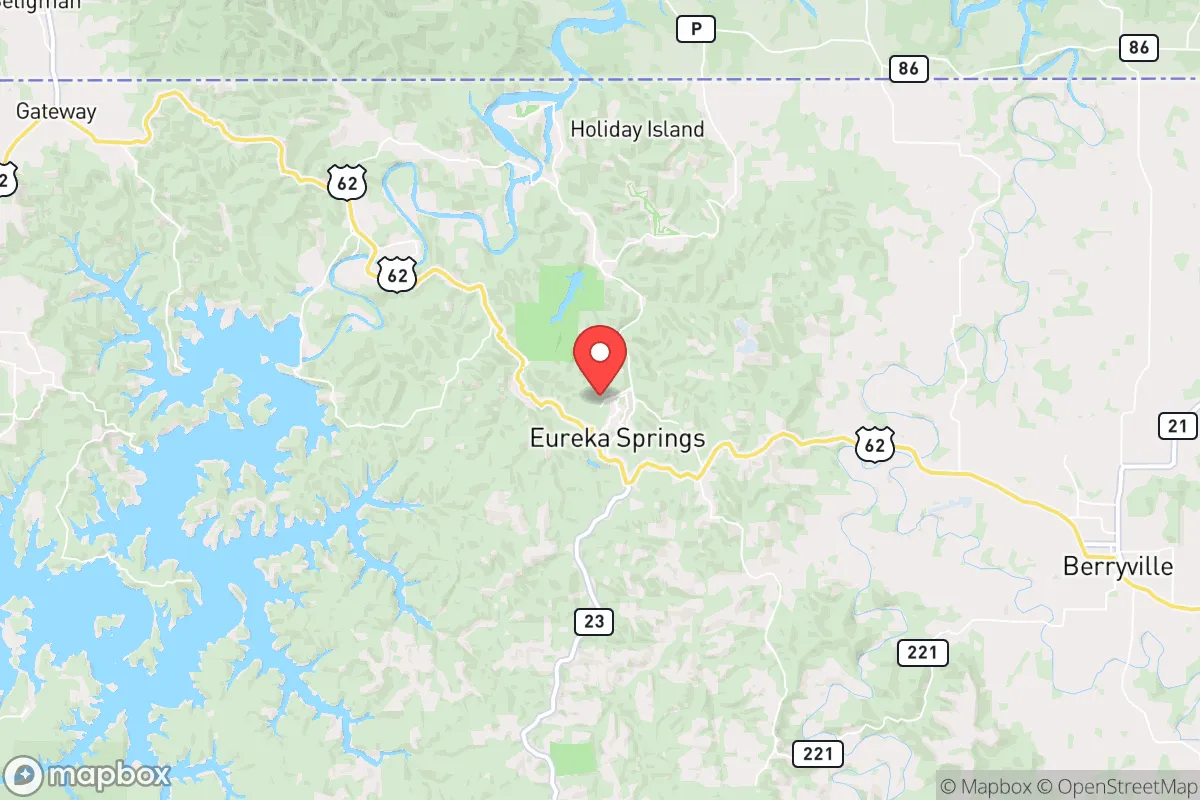
District shown is the primary district for this city’s centroid. Cities may span multiple districts.
Local Political AnalysisPolitical Analysis of Eureka Springs, AR
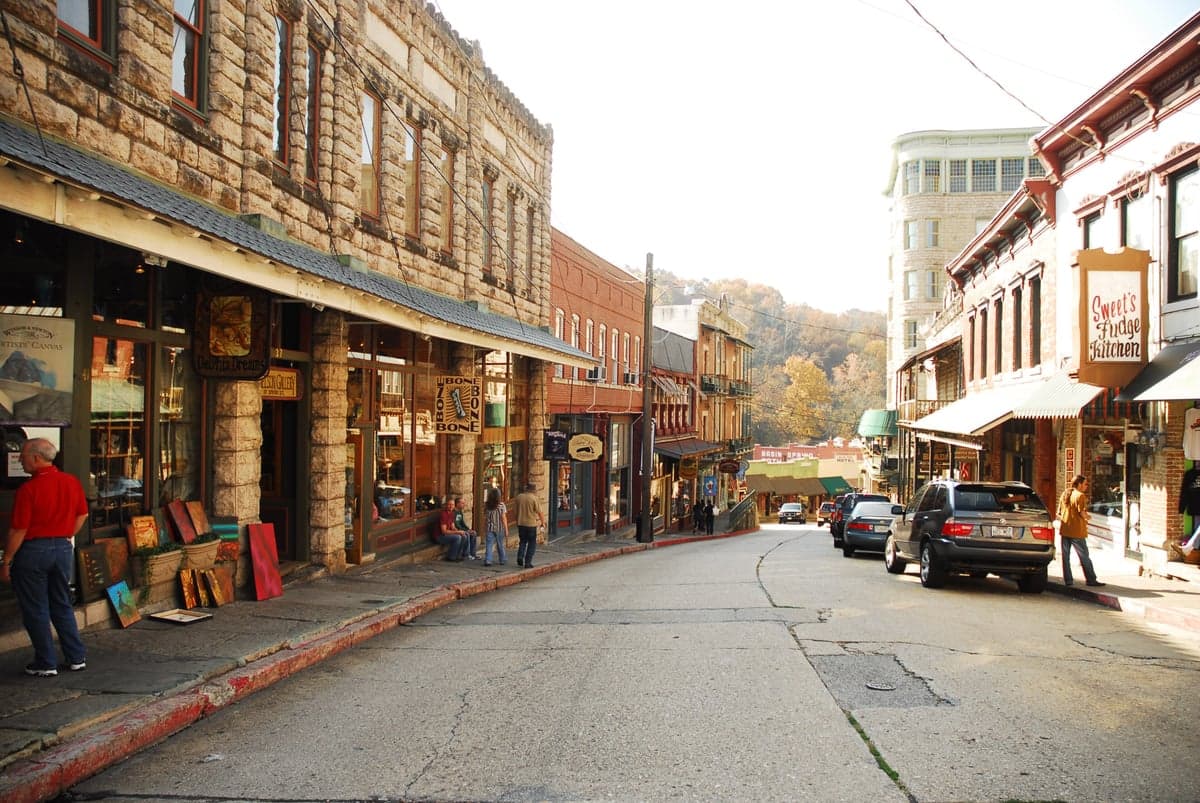
Eureka Springs is a blue dot in a deep red state, and that’s been its political identity for decades. While Arkansas as a whole carries a Cook PVI of R+16, Eureka Springs and surrounding Carroll County lean more moderate, with the county itself voting about 10 points more Democratic than the state average in recent presidential elections. The city’s liberal tilt is driven by its historic LGBTQ+ community, arts scene, and tourism economy, but the surrounding rural areas—think Berryville, Green Forest, and the farmlands east of town—vote heavily Republican, creating a sharp urban-rural split that defines local politics.
How it compares
Compared to the rest of Arkansas, Eureka Springs is an outlier. The state’s R+16 PVI means Republicans dominate statewide races—no Democrat has won a U.S. Senate seat here since 2010, and the legislature is supermajority Republican. In Eureka Springs, however, local elections often see competitive races, and the city council and school board have included openly progressive members for years. The contrast is starkest with nearby towns like Harrison (Boone County), which is known for its conservative activism, or Bentonville (Benton County), where the Walmart influence creates a more corporate Republican vibe. Eureka Springs feels more like a small slice of the Pacific Northwest dropped into the Ozarks—politically, it’s closer to Fayetteville’s liberal pockets than to anything in the Arkansas Delta or the River Valley.
What this means for residents
For liberal residents, Eureka Springs offers a rare sanctuary in a conservative state. You can find openly gay city officials, pride flags on downtown storefronts, and a general tolerance that’s uncommon in rural Arkansas. But the trade-off is that state-level policies—like abortion restrictions, gun laws, and education funding—are set by a legislature that doesn’t reflect local values. Conservative residents here are a minority within the city limits but part of the statewide majority; they may feel out of step with local cultural norms but find their views well-represented in state government. The practical effect is that Eureka Springs operates with a kind of live-and-let-live pragmatism: the city focuses on tourism and historic preservation, while state politics remain a distant, often frustrating, backdrop for both sides.
Culturally, Eureka Springs stands apart from Arkansas’s Bible Belt reputation. The city has a long history as a health resort and artists’ colony, and that legacy includes a tolerance for alternative lifestyles that predates the modern culture wars. You’ll see more tie-dye than camo at the grocery store, and the local paper covers city council meetings with the same seriousness as the annual UFO conference. Policy-wise, the city has passed non-discrimination ordinances and maintained a strong rental inspection program, while the county remains more hands-off. The trajectory is stable: Eureka Springs will likely stay a liberal enclave as long as tourism and second-home buyers keep the economy humming, but it will never flip the state’s politics. For anyone moving here, the key is understanding that your vote matters most at the local level—statewide, you’re swimming against a strong current.

State Political ClimatePolitical Climate in Arkansas
State Political AnalysisPolitical Environment in the State
Arkansas is a deeply red state with a Cook PVI of R+16, meaning it votes about 16 points more Republican than the national average in presidential elections. The state hasn't backed a Democrat for president since Bill Clinton’s 1996 re-election, and the GOP now holds every statewide office, both U.S. Senate seats, and supermajorities in the state legislature. Over the last 10-20 years, the shift has been dramatic—Arkansas was a reliably Democratic state at the state and local level as recently as the early 2000s, but a combination of national party realignment, rural cultural conservatism, and the collapse of the old “Blue Dog” Democratic coalition has turned it into one of the most reliably Republican states in the country.
Urban vs. rural divide
The political map breaks down along a classic urban-rural axis, but with a twist. The state’s two major metros—Little Rock (Pulaski County) and Fayetteville/Springdale (Washington and Benton Counties in Northwest Arkansas)—are the only real blue or purple areas. Pulaski County voted for Joe Biden in 2020 by about 15 points, driven by the city of Little Rock’s Black population and liberal-leaning white professionals. Washington County, home to the University of Arkansas, has been trending blue and went for Biden by a slim margin in 2020. But the rest of the state is deeply red. Fort Smith (Sebastian County) is a conservative stronghold, and rural counties like Baxter County (Mountain Home) and Craighead County (Jonesboro) routinely vote 70-80% Republican. The Delta counties along the Mississippi River—like Lee County and Phillips County—are the only remaining Democratic strongholds outside Little Rock, driven by majority-Black populations, but they have tiny populations and shrinking influence. The real story is the exurban and rural vote: places like Bentonville and Rogers in Northwest Arkansas are growing fast but remain solidly red, while the Ozark and Ouachita mountain counties are among the most Republican in the nation.
Policy environment
Arkansas’s policy environment is aggressively conservative. The state has a flat income tax of 4.4% (down from 6% in 2015), a 6.5% state sales tax (with local add-ons that can push it over 10% in some cities), and no property tax on vehicles. The regulatory posture is business-friendly: Arkansas is a right-to-work state with weak unions and minimal environmental permitting hurdles. Education policy is a flashpoint: the state passed the LEARNS Act in 2023, which created a universal school voucher program, eliminated teacher tenure, and banned “critical race theory” and “indoctrination” in K-12 classrooms. Healthcare is a mixed bag: Arkansas expanded Medicaid under the private option (Arkansas Works) in 2014, but the state has some of the strictest abortion laws in the country—a near-total ban with no exceptions for rape or incest, only to save the mother’s life. Election laws are restrictive: the state requires a photo ID to vote, has limited early voting (15 days), and passed a law in 2021 that made it a felony to collect absentee ballots for others (ballot harvesting ban). Gun laws are among the most permissive in the nation: permitless carry for adults 18 and older, no state-level red flag law, and a “stand your ground” statute.
Recent policy direction
The last three years have seen a hard right turn. On gun and self-defense law, Arkansas passed Act 777 in 2021, which prohibits state and local law enforcement from enforcing any future federal gun bans or registration—a de facto nullification measure. On parental and education rights, the LEARNS Act (2023) also banned “social-emotional learning” and “diversity, equity, and inclusion” programs in schools, and created a parental bill of rights that requires schools to notify parents about any changes to a student’s mental, emotional, or physical health. On speech, the state passed Act 372 in 2023, which allows public schools and universities to discipline students for “disruptive” speech that violates “community standards”—critics call it a campus free-speech chill. On privacy and surveillance, Arkansas has no comprehensive data privacy law, but it passed Act 690 in 2023, which requires age verification for websites with adult content—a move that privacy advocates say sets a precedent for broader internet surveillance. On medical and bodily autonomy, the abortion ban is total, and the state also passed Act 626 in 2023, which bans gender-affirming care for minors, including puberty blockers and hormone therapy. On property rights, Arkansas is a “Dillon’s Rule” state, meaning local governments have only the powers the state grants them—this has been used to block local rent control and zoning reforms. On taxation, the state has been cutting income taxes steadily: the top rate dropped from 6.9% to 4.4% between 2015 and 2025, and the state is on track to phase out the income tax entirely by 2030. On voting and ballot access, Act 249 (2021) shortened the absentee ballot application window and required notarization for absentee ballots—a change that disproportionately affects elderly and disabled voters.
Civil unrest & political movements
Arkansas has seen relatively little large-scale civil unrest compared to states like Oregon or Georgia, but there have been notable flashpoints. In 2020, Black Lives Matter protests in Little Rock and Fayetteville drew hundreds of participants, with some property damage in the downtown Little Rock area. The state’s response was swift: Governor Asa Hutchinson deployed the National Guard, and the legislature later passed a law (Act 1029) that increased penalties for blocking highways during protests and created a new crime of “aggravated rioting.” On the right, the “Arkansas Freedom Fund” and local chapters of Moms for Liberty have been active in school board races, particularly in Benton County and Faulkner County (Conway). Immigration politics are less heated than in border states, but the legislature passed Act 1169 in 2023, which requires local law enforcement to cooperate with ICE and bans “sanctuary city” policies—though no Arkansas city had declared itself a sanctuary. Election integrity controversies flared in 2022 when the state’s Republican Secretary of State, John Thurston, purged over 40,000 inactive voter registrations, drawing lawsuits from voting rights groups. There is no serious secession or nullification movement, though the 2021 gun nullification law (Act 777) is a symbolic gesture in that direction. A new resident would notice the political divide mostly in the cultural markers: “Let’s Go Brandon” flags on pickup trucks in rural areas, and “In This House We Believe” signs in Fayetteville and the Hillcrest neighborhood of Little Rock.
Projection
Over the next 5-10 years, Arkansas is likely to stay deeply red, but the nature of that red is shifting. The biggest demographic change is the explosive growth of Northwest Arkansas—Benton County grew by 30% between 2010 and 2020, driven by the Walmart headquarters in Bentonville and the broader corporate ecosystem. This influx is bringing in younger, more educated, and slightly more moderate voters—but they are still mostly conservative, just less culturally hardline. The Delta counties will continue to shrink and lose political clout. The state’s Republican Party is likely to remain dominated by the conservative wing, but internal fights are brewing between the “business conservative” faction (pro-growth, pro-Walmart, pro-infrastructure) and the “cultural conservative” faction (anti-vaccine, anti-public school, pro-nullification). Expect continued income tax cuts, further restrictions on abortion and transgender rights, and a push to privatize more of the education system through expanded vouchers. The biggest wild card is whether the state’s Medicaid expansion (Arkansas Works) survives—it has been a lifeline for rural hospitals, but the conservative wing wants to phase it out. A new resident moving in now should expect a state that is politically stable in its Republican dominance, but with a growing tension between the pragmatic, business-friendly conservatism of Northwest Arkansas and the more populist, culture-war-focused conservatism of the rural counties.
Bottom line for a new resident: If you’re a conservative, you’ll find a state that largely aligns with your values on taxes, guns, education, and abortion—and you’ll have the political power to keep it that way. If you’re a liberal, you’ll find a few blue bubbles in Little Rock and Fayetteville where you can live comfortably, but you’ll be voting in a state where your vote for president or Senate is effectively meaningless. The practical takeaway is that Arkansas offers low taxes, low regulation, and a high degree of personal freedom on gun ownership and property rights, but at the cost of limited social services, a restrictive healthcare environment, and a political culture that is increasingly hostile to LGBTQ+ rights and abortion access. Know what you’re signing up for, and you’ll be fine.
* Values derived from national, state, county, city and local statistics and may differ in a specific area. Last updated: 2026-10-08T19:29:15.000Z
Narrative content on this page is AI-generated and may contain mistakes. Verify any details that matter before acting on them.
ReloMaps may earn a commission from affiliate links at no extra cost to you.

