Photo: Wikipedia
Demographics of Eureka Springs, AR
Affluence Level in Eureka Springs, AR
A middle-class area roughly in line with national averages across income, home values, education, and employment.
People of Eureka Springs, AR
The people of Eureka Springs, Arkansas today number 2,269, forming a community that is 84.3% White and notably homogenous, with a foreign-born population of just 0.6%. The city is characterized by a distinctive blend of Ozark natives, a long-standing LGBTQ+ and arts community drawn by its historic tolerance, and a growing number of conservative-leaning retirees and remote workers seeking small-town life. With 25.3% of adults holding a college degree—above the state average—the population is older, whiter, and more educated than the surrounding Carroll County, giving the town a unique cultural identity that balances progressive artistic roots with a traditional rural Arkansas character.
How the city was settled and grew
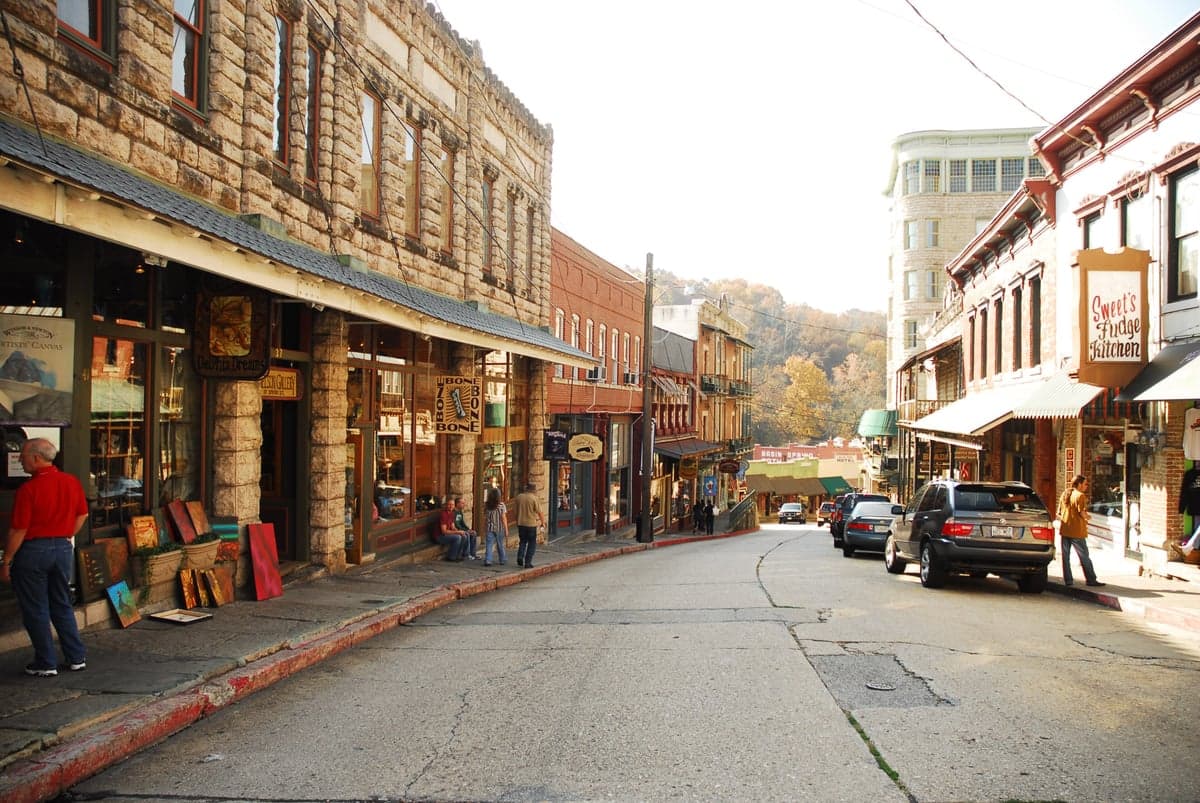
Eureka Springs was founded in 1879 after a local doctor discovered the area's natural springs, sparking a land rush and the city's rapid incorporation in 1880. The original population was a mix of Ozark hill farmers, railroad workers, and health-seekers drawn by the purported healing properties of the 63 springs. The town's steep, winding terrain dictated a compact, walkable layout, with the historic Downtown Commercial District built by German, Irish, and Anglo-American merchants who constructed the iconic Victorian storefronts and hotels. The Spring Street corridor became the commercial spine, while the Historic Loop—a winding road through the hills—was lined with boarding houses and bathhouses catering to wealthy tourists from the Midwest. By 1900, the population had swelled to over 3,000, making it the fourth-largest city in Arkansas, but the decline of the spring tourism industry after World War I led to a steady population drop. The Pivot Rock and Blue Spring areas remained sparsely settled by subsistence farmers, while the Lake Leatherwood area, developed in the 1930s as a Civilian Conservation Corps project, attracted a small working-class population.
Modern era (post-1965)
The post-1965 era brought two distinct demographic waves to Eureka Springs. The first, beginning in the 1970s, was an influx of counterculture artists, hippies, and LGBTQ+ individuals seeking refuge in the Ozarks' affordable land and relative isolation. They settled primarily in the Historic District and the Magnetic Spring area, restoring dilapidated Victorian homes and opening galleries, cafes, and bed-and-breakfasts. This wave transformed the town's economy from fading tourism to a year-round arts and hospitality hub, and it established Eureka Springs as one of the few openly gay-friendly towns in the rural South. The second wave, accelerating after 2000, has been domestic in-migration of conservative-leaning retirees, remote workers, and second-home buyers from Texas, Oklahoma, and Missouri. They have concentrated in newer subdivisions like Pleasant Ridge and the Lake Leatherwood Estates area, drawn by low property taxes, scenic beauty, and a slower pace of life. The city's racial composition has remained overwhelmingly White—84.3% in the latest data—with no Black residents recorded and only 4.9% Hispanic. The 0.6% foreign-born population is negligible, and there are no recorded East/Southeast Asian or Indian subcontinent residents, reflecting the area's limited immigration history and geographic isolation from major job centers.
The future
Eureka Springs' population is projected to remain stable or decline slightly, as the city's housing stock is constrained by steep terrain and historic preservation rules that limit new construction. The population is aging, with a median age likely above 50, as younger residents leave for college or jobs in larger cities like Fayetteville and Bentonville. The Hispanic share (4.9%) may grow slowly, driven by agricultural and service-sector work in surrounding Carroll County, but the city's high housing costs and limited rental supply will likely keep overall diversity low. The cultural identity is evolving toward a more conservative, retiree-dominated character, as the aging arts and LGBTQ+ population is not fully replaced by younger cohorts. New residents are dispersing into the Lake Leatherwood and Pleasant Ridge areas rather than the Historic District, which is increasingly a tourist zone rather than a residential neighborhood. The next 10-20 years will likely see Eureka Springs become a quieter, more conventional Ozark retirement town, with its bohemian edge fading into a curated historic ambiance.
For someone moving in now, Eureka Springs offers a tight-knit, walkable community with a rich architectural heritage and a strong sense of place, but it is a place where demographic change is slow and the population is becoming more homogenous and older. The town's future is as a niche destination for those seeking a low-tax, scenic lifestyle rather than a growing, diverse community, making it best suited for retirees, remote workers, and small-business owners who value historic character over economic dynamism.

* Values derived from national, state, county, city and local statistics and may differ in a specific area. Last updated: 2026-10-08T19:29:15.000Z
Narrative content on this page is AI-generated and may contain mistakes. Verify any details that matter before acting on them.
ReloMaps may earn a commission from affiliate links at no extra cost to you.

