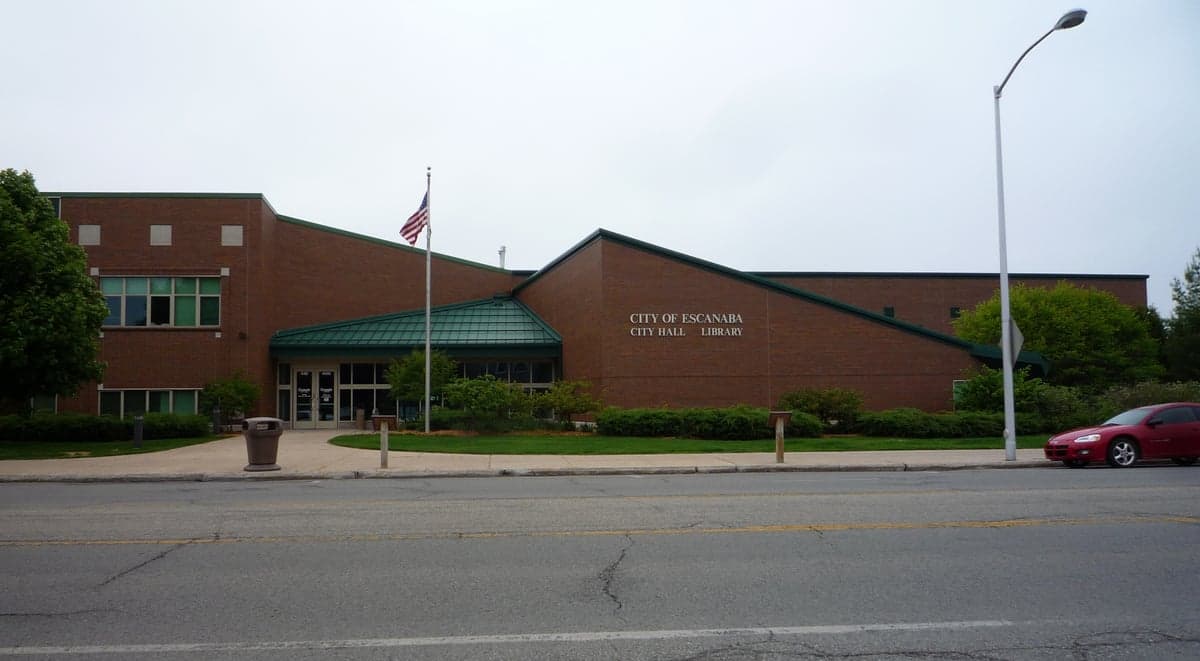
Photo: Wikipedia
Political ClimatePolitical Climate in Escanaba, MI
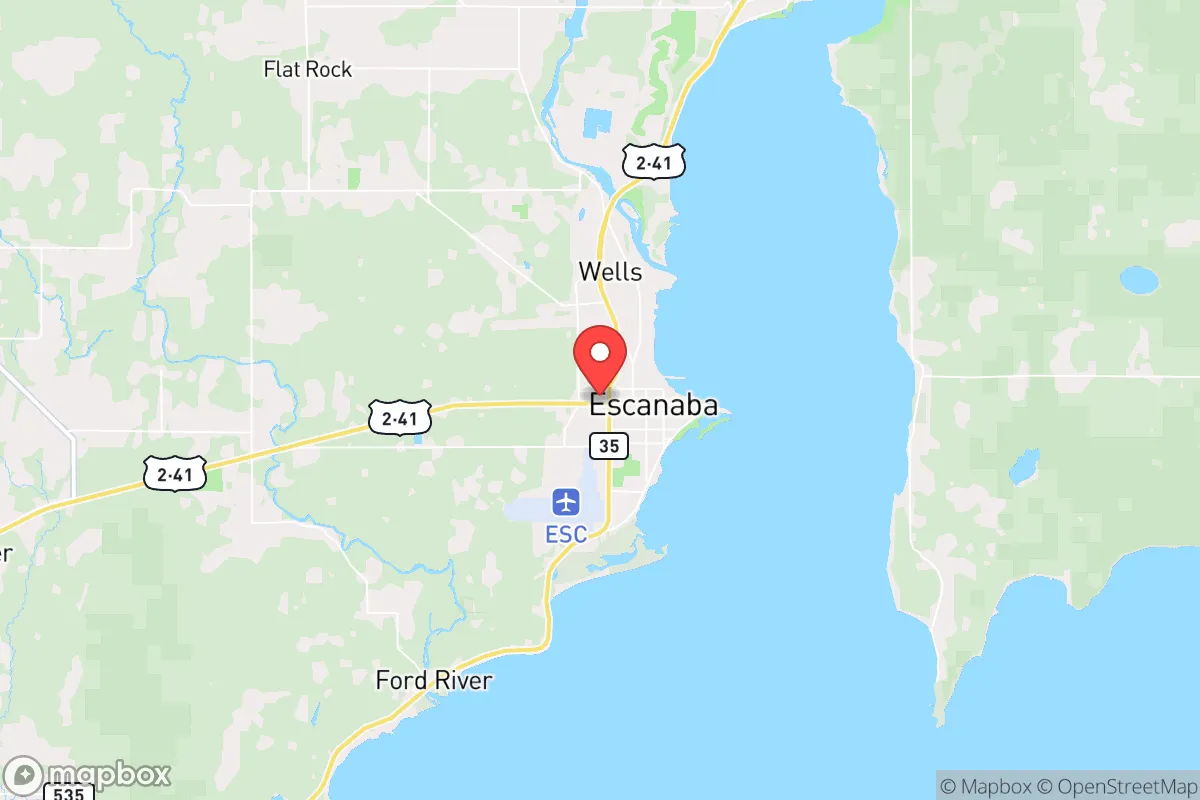
District shown is the primary district for this city’s centroid. Cities may span multiple districts.
Local Political AnalysisPolitical Analysis of Escanaba, MI
Escanaba leans reliably Republican, with a Cook Partisan Voting Index of R+11, meaning the area votes about 11 points more conservative than the national average. That’s a stark contrast to the state of Michigan as a whole, which sits at EVEN on the PVI—a perfect swing-state balance. In practice, Delta County has voted for the GOP presidential candidate in every election since 2000, often by double digits, while Michigan itself flipped from Obama to Trump to Biden and back to Trump in 2024. If you’re moving here from downstate or the coasts, the political vibe is noticeably more red than the state average, but it’s not a monolith—the city of Escanaba itself tends to be a bit more purple than the surrounding rural townships.
How it compares
Drive 15 minutes north to Gladstone or 30 minutes west to Bark River, and you’ll find even deeper Republican territory—those precincts often push R+15 or higher. Head south toward Menominee, near the Wisconsin border, and the politics stay conservative but with a slightly more moderate streak, thanks to a mix of retired union workers and cross-border commuters. The real contrast is with Michigan’s swing counties: compare Escanaba to places like Kent County (Grand Rapids) or Oakland County (Detroit suburbs), which have trended Democratic in recent cycles. Here in the Upper Peninsula, the Democratic brand still has some pull among older union households and tribal communities—the Hannahville Indian Community near Bark River leans more Democratic—but the overall trajectory has been steadily rightward since the 2012 Obama years. Locals will tell you that the area used to be a Democratic stronghold back when the paper mill and iron mines were booming, but those days are long gone.
What this means for residents
For conservative residents, Escanaba feels like home turf. Local government, county commission, and school board races are dominated by Republicans, and you’ll hear plenty of talk about Second Amendment rights, lower taxes, and opposition to state-level environmental regulations on mining and logging. Liberal residents aren’t isolated, but they’re definitely a minority. You’ll find like-minded folks in the arts scene, at Bay College, or among younger professionals moving in for remote work. The practical reality is that most political conversations stay civil—people here value neighborliness over partisanship—but you won’t see many Biden or Harris yard signs in the summer. The biggest cultural distinction is the area’s fierce independence from Lansing: many residents feel the state government in southern Michigan doesn’t understand U.P. issues like winter road maintenance, rural broadband, or the economic importance of natural resource extraction.
Looking ahead, Escanaba’s political climate is likely to stay R+11 or even drift a point or two redder as older Democratic-leaning residents pass on and younger families move in from more conservative parts of the Midwest. The 2024 election saw Delta County shift slightly right compared to 2020, mirroring a broader U.P. trend. For newcomers, the key takeaway is that Escanaba offers a stable, predictable conservative environment where local issues—jobs, infrastructure, and schools—matter more than national culture wars. Whether you’re a conservative who’ll feel right at home or a liberal who’ll need to find your niche, the area’s politics are straightforward and unlikely to surprise you.

State Political ClimatePolitical Climate in Michigan
State Political AnalysisPolitical Environment in the State
Michigan is the ultimate swing state, with a Cook PVI of EVEN that perfectly captures its knife-edge political reality. Over the past 20 years, the state has lurched from reliably blue (voting for Democrats in every presidential election from 1992 to 2012) to a true battleground that flipped to Trump in 2016 by 0.2 points, then flipped back to Biden in 2020 by 2.8 points. The dominant coalitions are a shrinking but still potent union-heavy, urban Democratic base in Southeast Michigan and a growing, energized conservative coalition in the rural Lower Peninsula and Upper Peninsula, with the critical swing voters living in the suburban ring counties around Detroit, Grand Rapids, and Lansing.
Urban vs. rural divide
The political map of Michigan is a study in stark contrasts. Wayne County (Detroit) and Washtenaw County (Ann Arbor) are the Democratic engine rooms, delivering margins of 60-70% for Democratic candidates. Detroit alone provides roughly 150,000-vote cushions for statewide Democrats. In contrast, the rural Lower Peninsula — counties like Oscoda, Alcona, and Montmorency — routinely vote 70-75% Republican. The real action is in the suburbs. Oakland County, once a Republican stronghold, has shifted dramatically blue over the past decade, driven by college-educated voters in places like Royal Oak, Ferndale, and Birmingham. Meanwhile, Macomb County (north of Detroit) remains the quintessential swing county — working-class, culturally conservative, and the place where Trump made his biggest gains in 2016 and 2020. Out west, Kent County (Grand Rapids) has shifted from reliably red to competitive, with the city of Grand Rapids itself becoming increasingly Democratic while the surrounding townships stay conservative. The Upper Peninsula is a unique hybrid: historically Democratic due to mining unions, but now trending Republican as cultural issues overtake economic ones, with counties like Dickinson and Iron flipping red in 2016 and staying there.
Policy environment
Michigan’s policy environment is a patchwork that reflects its swing-state status. The state has a flat income tax rate of 4.25% (scheduled to drop to 4.05% in 2026 under a 2015 law), and no state-level sales tax on groceries or prescription drugs. Property taxes are relatively high, with an average effective rate of 1.54%, but the Headlee Amendment and Proposal A (1994) cap annual assessment increases at the rate of inflation or 5%, whichever is less, providing long-term stability for homeowners. The state is a right-to-work state as of 2012, though Democrats repealed that law in 2023 (the repeal takes full effect in 2024). Education policy is a battleground: the state has a robust school choice system with charter schools and inter-district open enrollment, but funding disparities between wealthy and poor districts remain a flashpoint. On healthcare, Michigan expanded Medicaid under the Affordable Care Act in 2014, and the state runs its own exchange. Election laws are relatively accessible: no-excuse absentee voting was approved by voters in 2018 via Proposal 3, and same-day voter registration is available. However, voter ID is required at the polls (with a signed affidavit as an alternative).
Recent policy direction
The last two years have seen a dramatic shift in policy direction under the Democratic trifecta (Governor Gretchen Whitmer, state House, and state Senate) that held from January 2023 through the end of 2024. Key legislation includes: repeal of the 1931 abortion ban and codification of abortion rights via the 2022 Proposal 3 ballot measure; repeal of right-to-work (2023); expansion of the Elliott-Larsen Civil Rights Act to include sexual orientation and gender identity (2023); and universal background checks and red flag laws for firearms (2023). On the gun front, Michigan now requires background checks on all firearm sales (including private sales) and allows courts to issue extreme risk protection orders. For conservatives, these are significant restrictions. On the other hand, the state has constitutional carry (permitless concealed carry) for those 21 and older, a law that predates the recent restrictions. On education, the 2023 budget included a record $24 billion in school funding and a new free community college program (Michigan Reconnect). On taxes, the state repealed the pension tax in 2023, a major win for retirees. On property rights, the state has no statewide zoning preemption, meaning local governments retain significant control over land use. On privacy and surveillance, Michigan has no comprehensive data privacy law, though a bill is pending. On voting, the 2022 Proposal 2 enshrined nine days of early voting, drop boxes, and automatic voter registration into the state constitution.
Civil unrest & political movements
Michigan has been a flashpoint for political activism on both sides. The 2020 Whitmer kidnapping plot and the Operation Gridlock protests at the state capitol (where armed protesters entered the building in April 2020) remain defining images of the state’s political intensity. The Wolverine Watchmen militia group was central to the kidnapping plot, and militia activity remains visible in rural areas, particularly around Lapeer and Livingston counties. On the left, the Michigan Democratic Party has been energized by the post-2016 resistance, with groups like Indivisible and Our Revolution maintaining active chapters in Ann Arbor, Detroit, and Grand Rapids. Immigration politics are relatively low-key compared to border states, but the city of Detroit is a self-declared sanctuary city (since 2017), and Washtenaw County has similar policies. Election integrity remains a live issue: the 2020 election in Michigan was subject to numerous lawsuits and audits, all of which affirmed the results, but distrust persists among a significant portion of the electorate. The Antrim County clerical error (where a software glitch initially showed incorrect results) became a national talking point. A new resident will notice the prevalence of political yard signs and bumper stickers, especially in swing suburbs like Rochester Hills and Novi, where both parties compete aggressively.
Projection
Over the next 5-10 years, Michigan is likely to remain a competitive swing state, but the demographic trends favor a slight Democratic lean. The in-migration from the Rust Belt is slowing, but the state is seeing growth in the Grand Rapids and Traverse City areas, driven by remote workers and retirees. The aging population in rural areas will continue to shrink the Republican base in absolute terms, while the diversification of the Detroit suburbs (particularly Oakland County) will solidify Democratic margins. However, the union vote — once a reliable Democratic bloc — is fracturing, with many rank-and-file union members voting Republican on cultural issues. The 2024 election will be a critical test: if Democrats can hold the state while losing the national popular vote, it signals a realignment; if Republicans win it back, it suggests the 2020 result was an aberration. For a new resident, the practical takeaway is that Michigan will continue to swing between divided government and narrow trifectas, meaning policy will be volatile. A conservative moving here should expect a state that is generally moderate on taxes and property rights but increasingly progressive on social issues and gun control. A liberal moving here will find a state that is friendly to unions and abortion rights but still has a strong conservative counterweight in the legislature and judiciary.
For a relocator, the bottom line is that Michigan offers a genuinely competitive political environment where your vote actually matters. You won’t be in a deep blue or deep red bubble — you’ll be living in a state where every election is a fight, and where the policy direction can shift dramatically every two years. If you value being in a place where your political engagement can make a tangible difference, Michigan is one of the few states left where that’s true. If you prefer political stability and predictability, you might find the constant whiplash exhausting. Either way, you’ll be part of a state that is defining the future of American politics.
* Values derived from national, state, county, city and local statistics and may differ in a specific area. Last updated: 2026-11-05T17:51:37.000Z
Narrative content on this page is AI-generated and may contain mistakes. Verify any details that matter before acting on them.
ReloMaps may earn a commission from affiliate links at no extra cost to you.

