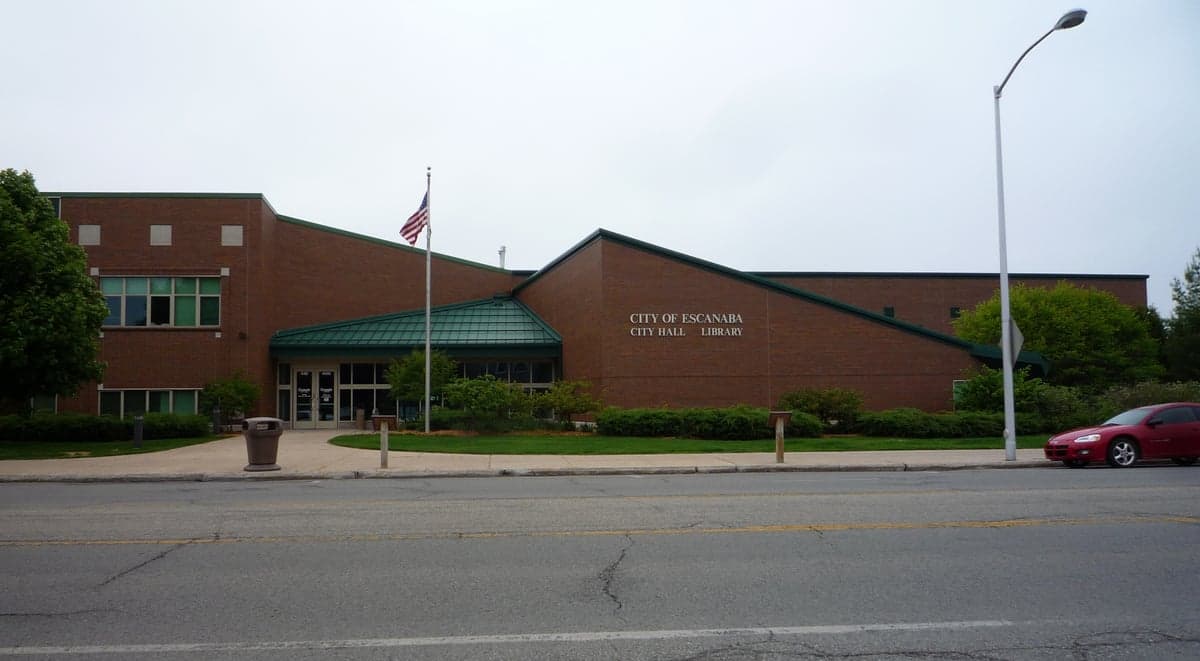
Photo: Wikipedia
Demographics of Escanaba, MI
Affluence Level in Escanaba, MI
A below-average socioeconomic profile. Incomes, home values, and educational attainment trail the U.S., with higher poverty and unemployment.
People of Escanaba, MI
The people of Escanaba, Michigan, today number 12,374, forming a predominantly white (86.4%) and culturally rooted community shaped by a long history of industrial labor and ethnic enclaves. With a foreign-born population of just 0.3%, the city remains one of the least diverse in the Upper Peninsula, where a strong sense of local identity is tied to its Finnish, Swedish, and French-Canadian heritage. The population is notably older and less college-educated (18.9%) than state averages, reflecting a working-class character that has persisted through the rise and fall of the region's timber and shipping industries. For a relocation-minded reader, Escanaba offers a tight-knit, family-oriented environment where community ties run deep, but demographic change is slow and limited.
How the city was settled and grew
Escanaba’s population history begins with the Ojibwe people, who used the sheltered bay as a seasonal fishing and trading site long before European arrival. The first permanent white settlers arrived in the 1830s, drawn by the region's vast white pine forests. The real population boom came in the 1860s when the Chicago & North Western Railway built a rail line to the harbor, making Escanaba the primary shipping point for iron ore from the Marquette Range. This industrial pivot brought waves of immigrants: Finnish, Swedish, and Norwegian laborers arrived first to work the docks and lumber camps, followed by French-Canadians who took jobs in the sawmills and railroad yards. These groups settled in distinct neighborhoods that still carry their ethnic imprint. The Finnish community concentrated in the "Finn Town" area along the waterfront near 6th Avenue South, where boarding houses and saunas dotted the streets. Swedish families clustered in the Swede Town district around 12th Avenue and Stephenson Street, while French-Canadians built homes in the Flat Rock neighborhood south of the downtown core. By 1900, the population had reached roughly 9,000, and the city's character as a working-class port town was firmly established. The 1920s saw a secondary wave of Italian and Polish immigrants, who settled in the Ludington Park area near the paper mill, adding Catholic parishes and fraternal halls to the city's social fabric.
Modern era (post-1965)
After the 1965 Hart-Cellar Act, Escanaba saw virtually no new foreign immigration—its foreign-born share today is 0.3%, among the lowest in Michigan. Instead, the modern era has been defined by domestic out-migration and suburbanization. The city's peak population of 15,400 in 1970 has declined steadily as the paper mill and ore docks automated and downsized. The white population share has remained stable at 86.4%, while Hispanic residents (2.0%) and Black residents (0.4%) have arrived in very small numbers, mostly as service workers and healthcare employees. These newer residents have not formed distinct ethnic enclaves; instead, they are dispersed across the Danforth Park and North 30th Street areas, where affordable housing stock from the 1950s and 1960s offers entry points. The East/Southeast Asian community (0.3%) is tiny and concentrated among a few families connected to the local hospital and university system. The Indian subcontinent population is effectively zero. The most notable demographic shift has been the aging of the population: the median age has risen to 44, as younger adults leave for jobs in Green Bay, Marquette, or downstate. The West Escanaba neighborhood, once a thriving middle-class area of mill workers, now shows the highest share of vacant homes and rental properties.
The future
Escanaba’s population is projected to continue a slow decline, with the Michigan Department of Technology, Management & Budget forecasting a drop to roughly 11,500 by 2040. The city is not becoming more diverse in any meaningful sense: the white share is expected to remain above 85%, with Hispanic growth limited to a few percentage points driven by seasonal agricultural and construction workers. The East/Southeast Asian and Black populations will likely remain below 1% each. The most significant demographic trend is the concentration of remaining families in the Ludington Park and Escanaba Township fringe areas, where newer single-family subdivisions have attracted a small number of remote workers and retirees from downstate. The cultural identity is evolving slowly: the old ethnic neighborhoods (Finn Town, Swede Town) are now mostly symbolic, with few residents who speak the ancestral languages. The city's future character will likely be that of a stable, older, predominantly white community with a strong local identity rooted in hunting, fishing, and high school sports—a place where newcomers are welcomed but expected to adapt to established norms.
For someone moving in now, Escanaba offers a low-cost, safe, and family-friendly environment with a clear sense of place, but little demographic dynamism. The population is not growing or diversifying, and the economic base remains narrow. The kind of person who thrives here is someone seeking a quiet, community-oriented life in a setting where neighbors know each other and the pace is slow—not someone looking for career mobility or cultural variety. The city is becoming a smaller, older version of its industrial-era self, and that trajectory shows no sign of reversing.

* Values derived from national, state, county, city and local statistics and may differ in a specific area. Last updated: 2026-11-05T17:51:37.000Z
Narrative content on this page is AI-generated and may contain mistakes. Verify any details that matter before acting on them.
ReloMaps may earn a commission from affiliate links at no extra cost to you.

