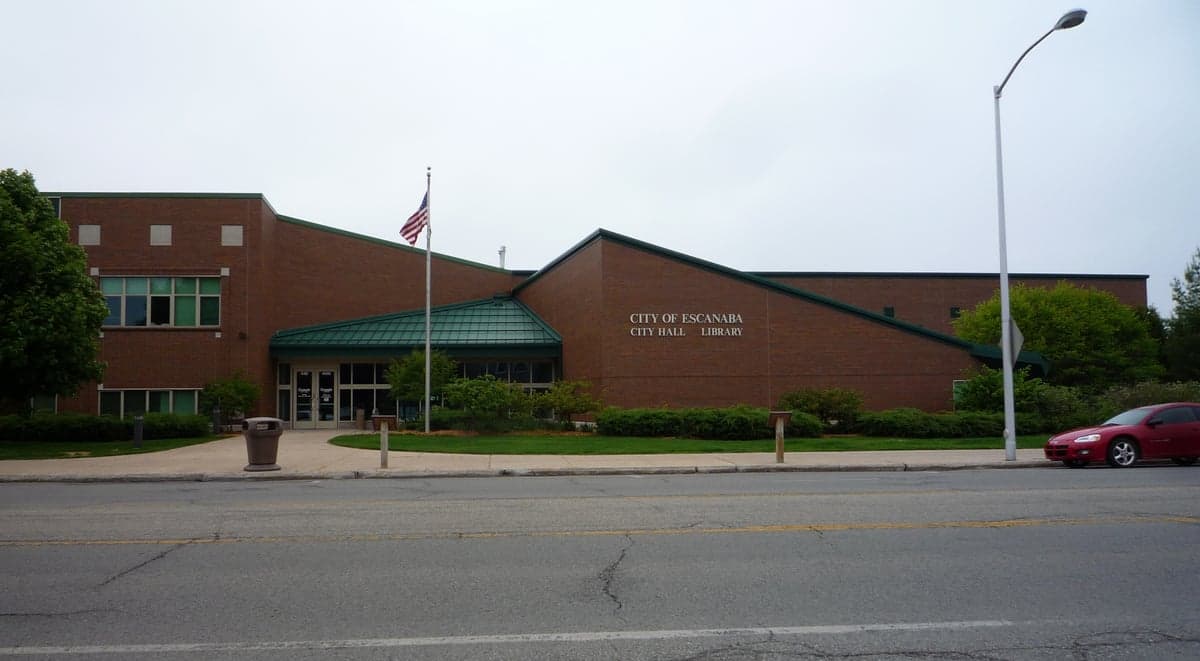
Photo: Wikipedia
Personal Sovereignty in Escanaba, MI
Strong independent fundamentals that actively favor personal liberty and low regulation.
What does Personal Sovereignty tell us?
Personal Sovereignty measures your capacity for self-reliance and independence with minimal government friction. Higher scores mean fewer barriers between you and the way you want to live... but it assumes you have the space you need and good neighbors.
What does this tell us?
Personal Sovereignty measures your capacity for self-reliance and independence with minimal government friction. Higher scores mean fewer barriers between you and the way you want to live... but it assumes you have the space you need and good neighbors.
State Policy
Energy independence: Importer (22% of energy produced in-state)
Personal Liberty
Homesteading

Personal Liberty Analysis
Escanaba, Michigan, offers a notably high degree of personal sovereignty relative to many other parts of the Midwest, largely due to Michigan's status as a right-to-work state and its relatively permissive regulatory environment for individuals. The city itself, while a small urban center in Delta County, sits within a broader region where self-reliance is not just a lifestyle choice but a practical necessity, given the rural geography and colder climate. For a single person or family prioritizing autonomy, Escanaba provides a legal and cultural framework that supports independent decision-making, though it operates within the constraints of state-level taxation and local zoning that are worth understanding in detail.
Tax burden and regulatory posture for residents and small businesses
Michigan's tax structure is moderate compared to high-tax states like California or New York, but it is not a zero-tax environment. The state levies a flat 4.25% individual income tax on all earned income, which is predictable and straightforward. Property taxes in Delta County are a more significant consideration: the average effective property tax rate is approximately 1.5% of assessed value, which is slightly above the national average but typical for Michigan's Upper Peninsula. For a home valued at $150,000, this translates to roughly $2,250 annually. Escanaba itself does not impose a city income tax, which is a distinct advantage over many Michigan cities like Detroit or Grand Rapids that levy additional local income taxes. The regulatory posture for small businesses is light-touch at the local level; Escanaba's zoning and business licensing requirements are straightforward, with no onerous permitting delays for home-based businesses or small retail operations. Michigan's right-to-work law, which remains in effect as of 2026, means that no employee can be forced to join a union or pay dues as a condition of employment, a factor that appeals to those who value workplace autonomy. However, the state's regulatory environment for environmental and land use matters is more active than in some Western states, particularly regarding shoreline development on Lake Michigan and wetland protections, which can affect property use near water.
Self-defense rights and gun law specifics in Michigan
Michigan is a "shall-issue" state for concealed pistol licenses (CPL), meaning that if a resident meets the statutory requirements—including a background check, fingerprinting, and completion of an approved safety course—the county sheriff must issue the license. Delta County's gun culture is strong, and the sheriff's office processes CPL applications efficiently, typically within the 45-day statutory window. Escanaba residents enjoy constitutional carry for long guns and, as of 2024, the state allows open carry of handguns without a permit for individuals 18 and older, though a CPL is still required for concealed carry. Michigan does not have a "stand your ground" law in the purest sense; it operates under a "castle doctrine" that presumes a reasonable fear of death or great bodily harm when an intruder unlawfully enters a home or occupied vehicle, but there is a duty to retreat in public spaces if safely possible. This is a meaningful distinction for those accustomed to the broader self-defense laws of states like Florida or Texas. Magazine capacity is not restricted at the state level, and there is no state-level assault weapons ban, though local ordinances in Escanaba do not further restrict firearms. The state does require a background check for all handgun purchases from private sellers, but long gun private sales remain unregulated. For a family prioritizing self-defense, Escanaba offers a permissive environment with the notable caveat of the duty-to-retreat rule in public.
Self-reliance and homesteading viability: lot sizes, zoning, and off-grid feasibility
Escanaba's city limits feature standard residential lot sizes of around 6,000 to 10,000 square feet, which limits large-scale homesteading within town. However, the surrounding Delta County and rural townships just outside the city offer a dramatically different picture. Unincorporated areas often allow parcels of 1 to 5 acres with minimal zoning restrictions, and agricultural zoning permits livestock, poultry, and substantial gardening. The city's zoning code does not explicitly prohibit backyard chickens or small-scale beekeeping, but homeowners should verify with the Delta County Planning Department, as some subdivisions have covenants. Off-grid feasibility is high in the region: Michigan's net metering policy allows homeowners with solar panels to sell excess electricity back to the grid at the retail rate, and the state's Right to Farm Act provides strong protections for agricultural activities, even on small parcels, as long as they follow generally accepted practices. Rainwater collection is legal without restriction, and composting toilets are permitted under the state's plumbing code for remote properties not connected to municipal sewer. The primary regulatory hurdle for off-grid living is the requirement for a septic system permit from the Delta County Health Department, which mandates a soil test and system design approval—a process that typically costs $500–$1,000 and takes 2–4 weeks. Wood heat is common and unregulated for personal use, though wood stoves must meet EPA emissions standards if purchased new. For a family seeking genuine self-reliance, the land outside Escanaba's city limits—particularly in areas like Ford River Township or Bark River—offers affordable acreage (often $3,000–$8,000 per acre) with very light regulatory oversight.
Personal liberties: parental rights, medical autonomy, speech, and property
Michigan's legal framework for parental rights is robust. The state's Parental Rights Restoration Act (MCL 722.601) explicitly affirms that parents have the fundamental right to direct the upbringing, education, and health care of their children, and this is generally respected by local school districts in Escanaba. The Escanaba Area Public Schools district does not have a mask or vaccine mandate for students as of 2026, and parents can opt their children out of sex education or specific health curricula without hassle. Medical autonomy is more mixed: Michigan has a broad medical marijuana program (allowing up to 2.5 ounces of usable marijuana and 12 plants per patient), and recreational cannabis is legal for adults 21 and over, with dispensaries operating in Escanaba. However, the state's vaccine mandate for schoolchildren remains in effect for standard immunizations, with only medical and religious exemptions available (philosophical exemptions were eliminated in 2015). For speech and property rights, Escanaba is a typical small city: there are no local hate speech ordinances that go beyond state law, and property rights are protected under Michigan's strong eminent domain laws, which require just compensation and a public purpose. The city's noise ordinance is reasonable (quiet hours from 11 p.m. to 7 a.m.), and there are no restrictions on political signage on private property beyond standard size limits. For those who value the ability to make personal health decisions, including vaccine choice, the environment is permissive but not as libertarian as states like Idaho or Alaska.
Overall, Escanaba offers a solid baseline of personal sovereignty that is competitive with most of the Upper Midwest, though it does not reach the extremes of the most libertarian-leaning states. The combination of no city income tax, a shall-issue concealed carry system, affordable rural land with light zoning, and strong parental rights creates a practical environment for self-reliant individuals and families. The primary trade-offs are Michigan's moderate income tax, the duty-to-retreat rule in public self-defense situations, and the state's vaccine mandates for schoolchildren. For a relocation-minded person who values independence but is not seeking a zero-regulation frontier, Escanaba represents a balanced, livable option where autonomy is respected without requiring a complete withdrawal from society.

* Values derived from national, state, county, city and local statistics and may differ in a specific area. Last updated: 2026-11-05T17:51:37.000Z
Narrative content on this page is AI-generated and may contain mistakes. Verify any details that matter before acting on them.
ReloMaps may earn a commission from affiliate links at no extra cost to you.

