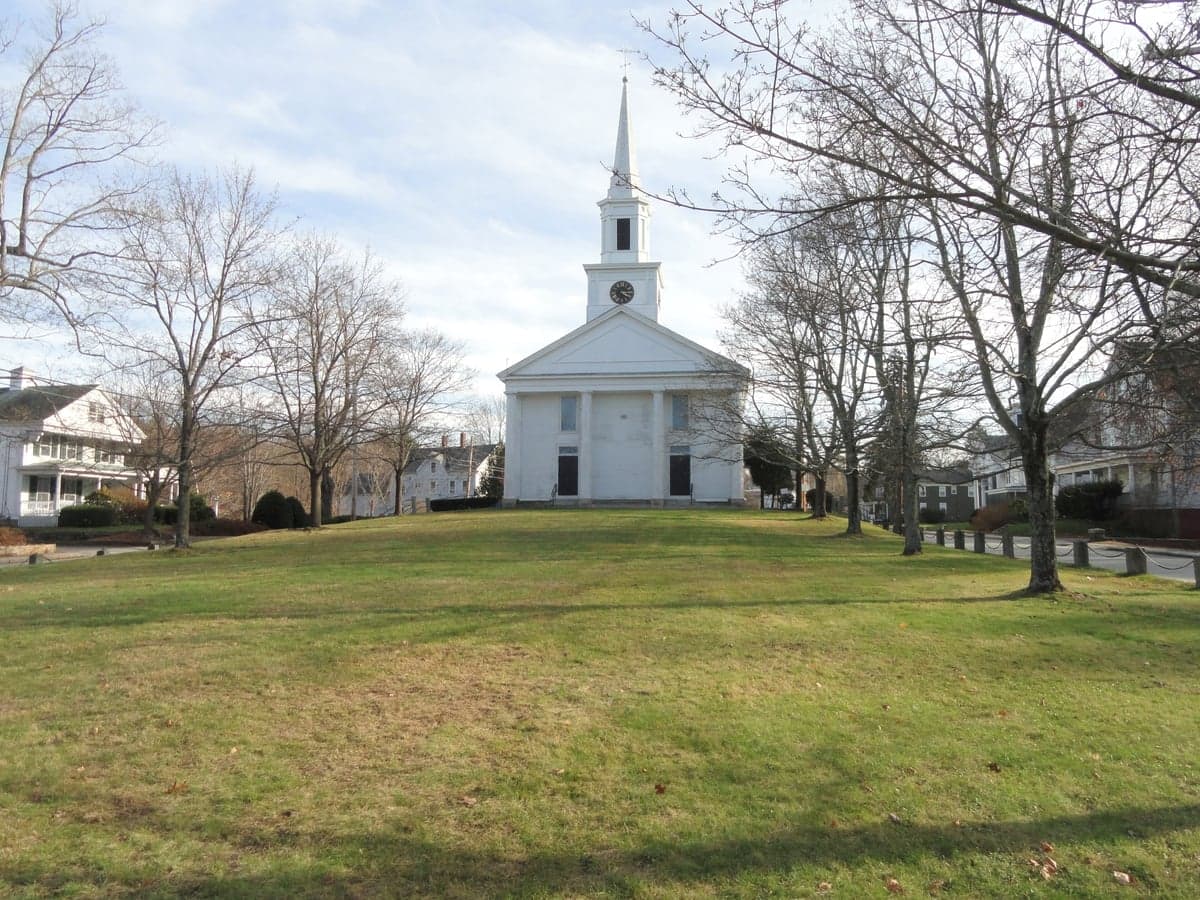
Photo: Wikipedia
Personal Sovereignty in Douglas, MA
Moderate friction. Expect trade-offs in some aspect of personal liberty and independence.
What does Personal Sovereignty tell us?
Personal Sovereignty measures your capacity for self-reliance and independence with minimal government friction. Higher scores mean fewer barriers between you and the way you want to live... but it assumes you have the space you need and good neighbors.
What does this tell us?
Personal Sovereignty measures your capacity for self-reliance and independence with minimal government friction. Higher scores mean fewer barriers between you and the way you want to live... but it assumes you have the space you need and good neighbors.
State Policy
Energy independence: Importer (5% of energy produced in-state)
Personal Liberty
Homesteading

Personal Liberty Analysis
Douglas, Massachusetts, offers a nuanced personal sovereignty environment where the town’s rural character and local governance provide meaningful autonomy, but residents must navigate one of the nation’s densest state-level regulatory frameworks. Located in Worcester County near the Rhode Island border, Douglas combines a small-town, low-density feel with the full weight of Massachusetts state law, creating a trade-off: significant day-to-day freedom in land use and community life, paired with higher taxes and stricter state mandates on firearms, healthcare, and property rights than most of the country. For a relocation-minded individual or family prioritizing independence, Douglas represents a pocket of relative local control within a high-regulation state, where personal sovereignty is exercised more through property stewardship and community engagement than through legal or fiscal liberty.
Tax burden and regulatory posture in Douglas
Massachusetts imposes a heavy tax and regulatory burden overall, and Douglas residents are fully subject to it. The state’s income tax is a flat 5.0% on all earned income, with no standard deduction, and the sales tax is 6.25%. Property taxes in Douglas are moderate for Massachusetts—the 2025 rate is approximately $15.50 per $1,000 of assessed value, which on a median home value of roughly $450,000 yields an annual bill around $6,975. This is lower than many Boston suburbs but still high by national standards. The state’s regulatory posture is notably heavy: Massachusetts has a strict building code, extensive environmental regulations under the Wetlands Protection Act, and a rigorous Title 5 septic system approval process that can complicate rural property development. Zoning in Douglas is primarily residential and agricultural, with most lots requiring at least one acre for single-family homes, which preserves the town’s rural feel but limits subdivision and commercial use. For a resident seeking to minimize regulatory friction, Douglas’s local government is relatively hands-off compared to denser towns, but state-level mandates—especially around environmental permitting and building—are unavoidable and can add months to any construction or renovation project.
Self-defense and gun law specifics in Douglas
Massachusetts has some of the strictest firearm laws in the United States, and Douglas residents must comply fully. The state requires a License to Carry (LTC) for any handgun possession, whether open or concealed, and a Firearm Identification (FID) card for long guns and ammunition. Both require a background check, fingerprinting, a firearms safety course, and approval from the local police chief, who has discretion to deny or restrict licenses. In Douglas, the police department is generally considered shall-issue in practice for qualified applicants, but the process takes several months and costs around $100. The state bans "assault weapons" by name and feature, limits magazine capacity to 10 rounds, and requires all firearm transfers to go through a licensed dealer with a background check. Stand-your-ground laws do not exist in Massachusetts; instead, the state imposes a duty to retreat if safely possible before using deadly force in self-defense. Castle doctrine is limited—there is no presumption that a home intruder justifies deadly force, though self-defense is a legal affirmative defense. For a gun owner accustomed to more permissive states like New Hampshire or Texas, Douglas will feel restrictive. However, for those willing to navigate the licensing process, legal firearm ownership is achievable, and the town’s low crime rate means self-defense needs are minimal compared to urban areas.
Self-reliance and homesteading viability in Douglas
Douglas is one of the more viable towns in eastern Massachusetts for self-reliance and homesteading, thanks to its large lot sizes and agricultural zoning. The minimum lot size for most residential parcels is one acre, and many properties range from 2 to 10 acres, providing ample space for gardens, small orchards, and livestock. The town allows chickens, goats, and up to two cows on lots of one acre or more, with no special permit required for personal use. Beekeeping is also permitted. Off-grid living is legally challenging: Massachusetts requires all habitable dwellings to be connected to the electrical grid or have an approved alternative energy system with utility interconnection, and Title 5 septic systems must meet strict state standards, making composting toilets or outhouses illegal for permanent residences. Rainwater collection is allowed but limited to 250 gallons per property without a permit, and well water is common—most rural homes have private wells. Solar panels are permitted and encouraged, with net metering available, but battery storage for full off-grid independence is expensive and not incentivized. For a family wanting to grow food, keep animals, and reduce reliance on grocery stores, Douglas offers strong potential. For those seeking complete off-grid autonomy, the state’s building and health codes create significant barriers.
Personal liberties in Douglas: parental rights, medical autonomy, speech, and property
Personal liberties in Douglas are shaped by a mix of local norms and state mandates. Parental rights are generally respected in the school system—Douglas Public Schools, which serve about 1,200 students across three schools, allow parents to opt children out of sex education and certain health screenings, and the district has a conservative-leaning school committee that emphasizes local control. However, Massachusetts state law mandates LGBTQ-inclusive curriculum and prohibits schools from notifying parents of a student’s gender identity without the student’s consent, a point of tension for some families. Medical autonomy is limited: Massachusetts has mandatory childhood vaccination requirements for school attendance (with medical and religious exemptions, but no philosophical exemption), and the state imposed strict COVID-19 mandates during the pandemic, including vaccine requirements for healthcare workers and school staff. Vaccine mandates for students were not enforced statewide, but individual districts could impose them. Free speech is protected under the First Amendment, and Douglas has no local ordinances restricting political expression or assembly. Property rights are strong in practice—the town has no rent control, no inclusionary zoning, and minimal historic district restrictions. However, the state’s Chapter 40B law allows developers to override local zoning for affordable housing projects, which has occasionally led to tensions over density. Eminent domain is rarely used in Douglas, and property taxes, while high, are predictable.
Overall, Douglas offers a moderate-to-high level of personal sovereignty relative to other Massachusetts towns, but it is not a low-regulation haven by national standards. Compared to rural towns in New Hampshire or Maine, Douglas is more expensive, more regulated, and less permissive on guns and off-grid living. Compared to Boston suburbs like Framingham or Newton, it is far more autonomous—lower taxes, larger lots, less zoning interference, and a stronger sense of local community control. For a relocation-minded individual or family who values self-reliance and is willing to comply with state-level mandates, Douglas provides a workable balance: enough land and local freedom to live independently, within a state framework that demands compliance on taxes, firearms, and health regulations. The key trade-off is that personal sovereignty in Douglas is exercised more through property stewardship and community participation than through legal or fiscal liberty, making it a solid choice for those who prioritize rural living and local control over maximum individual autonomy.

* Values derived from national, state, county, city and local statistics and may differ in a specific area. Last updated: 2026-10-21T14:14:07.000Z
Narrative content on this page is AI-generated and may contain mistakes. Verify any details that matter before acting on them.
ReloMaps may earn a commission from affiliate links at no extra cost to you.

