Photo: Wikipedia
Demographics of Deer Isle, ME
Affluence Level in Deer Isle, ME
A below-average socioeconomic profile. Incomes, home values, and educational attainment trail the U.S., with higher poverty and unemployment.
People of Deer Isle, ME
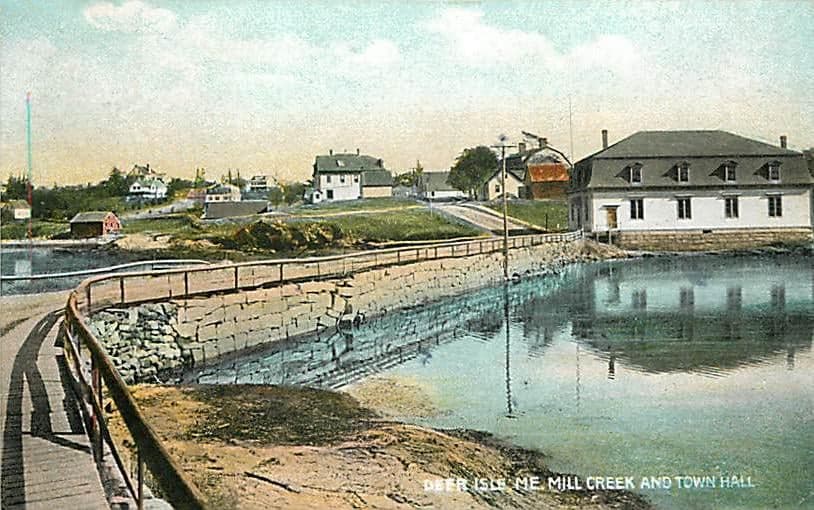
Deer Isle, Maine, is a coastal island community of 3,180 year-round residents whose character is defined by deep Yankee roots, a working waterfront, and a notable artistic overlay. The population is overwhelmingly white (96.1%) and native-born, with only 2.9% foreign-born residents, making it one of the more ethnically homogeneous communities on the Maine coast. Despite its small size, the island supports a distinctive dual identity: commercial fishing families and boatbuilders alongside a summer colony of artists and writers that has reshaped the local economy and social fabric.
How the city was settled and grew
Deer Isle was first settled in the 1760s by English colonists from Massachusetts, who were drawn by the island's abundant timber, shellfish, and protected harbors. The original settlement clustered around the village of Deer Isle (the island's main commercial center), where the first meetinghouse and wharves were built. These early families—the Haskell, Eaton, and Billings clans—were subsistence farmers and fishermen who cleared the rocky land and established a pattern of dispersed, family-based homesteads that persists today.
By the mid-19th century, the island's granite quarries became the dominant industry, drawing skilled Scottish and Irish stonecutters who settled in the Sunkenland and Green's Landing districts. The quarries shipped granite to Boston, New York, and Washington, D.C., and at their peak employed hundreds of workers. When the granite industry collapsed after World War I, many quarry families left, but those who remained shifted to lobstering and sardine canning. The Stonington village (the island's southernmost settlement) became the center of the fishing fleet, while the northern Mountainville area remained more agricultural and residential.
Modern era (post-1965)
The Immigration and Nationality Act of 1965 had virtually no effect on Deer Isle's demographics; the island never attracted the immigrant waves that transformed urban Maine. Instead, the post-1965 period brought a different kind of migration: back-to-the-land homesteaders and artists from Boston, New York, and California who arrived in the 1970s and 1980s. These newcomers settled primarily in the Sunkenland and Little Deer Isle areas, where they bought former farmhouses and established galleries, craft studios, and organic farms. The Haystack Mountain School of Crafts, founded in 1950 on the island's western shore, became the anchor of this artistic community, drawing a seasonal influx of students and instructors each summer.
The racial composition has remained remarkably stable: the 2020 census shows 96.1% white, 1.4% Hispanic, and 0.4% Black residents, with no measurable East/Southeast Asian or Indian-subcontinent population. The small Hispanic presence is largely tied to seasonal agricultural and hospitality work, while the tiny Black population reflects a handful of long-term professional families. The island's college-educated share stands at 32.3%, a figure that has risen steadily since 2000 as the artist community and remote workers have grown. The Stonington waterfront has seen the most visible change, with former sardine factories converted to art galleries and high-end seafood restaurants, though the working fleet still operates alongside them.
The future
Deer Isle's population is aging and slowly declining, with a median age well above the state average and limited in-migration of young families. The island is becoming slightly more diverse at the margins—the Hispanic share has crept up from under 1% to 1.4% over the past decade—but the overall trajectory is toward continued homogeneity. The most significant demographic pressure is economic: housing prices have risen sharply as wealthy summer residents and remote workers buy up year-round homes, pushing younger working families to the mainland towns of Blue Hill and Ellsworth.
The next 10-20 years will likely see the island's population skew older and wealthier, with the artist and second-home communities growing while the fishing population contracts. The Little Deer Isle causeway area and the village of Deer Isle are absorbing most new residential development, while Stonington remains the working heart. The cultural identity is evolving from a purely working-class fishing community to a hybrid of maritime tradition and creative-class tourism, a shift that is already visible in the island's galleries, farm-to-table restaurants, and summer concert series.
For someone moving to Deer Isle today, the island offers a stable, safe, and scenic environment with a strong sense of place—but it is not a diverse community, and it is becoming less affordable for working families. The people who thrive here are those who value isolation, natural beauty, and a pace of life tied to the tides rather than the clock. The island is becoming a place of creative professionals and retirees, with the fishing heritage preserved more as cultural memory than as a dominant economic force.

* Values derived from national, state, county, city and local statistics and may differ in a specific area. Last updated: 2026-09-05T23:41:10.000Z
Narrative content on this page is AI-generated and may contain mistakes. Verify any details that matter before acting on them.
ReloMaps may earn a commission from affiliate links at no extra cost to you.

