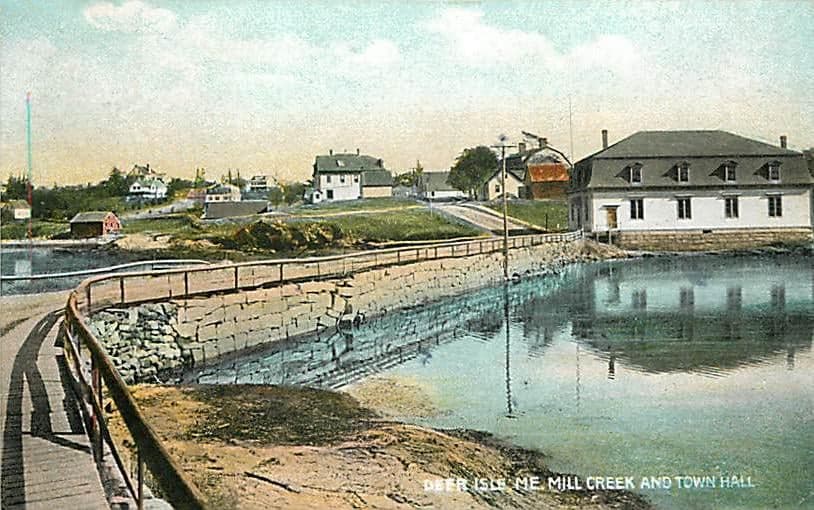
Photo: Wikipedia
Personal Sovereignty in Deer Isle, ME
Viable for self-reliance. Generally workable, though some barriers may limit total independence.
What does Personal Sovereignty tell us?
Personal Sovereignty measures your capacity for self-reliance and independence with minimal government friction. Higher scores mean fewer barriers between you and the way you want to live... but it assumes you have the space you need and good neighbors.
What does this tell us?
Personal Sovereignty measures your capacity for self-reliance and independence with minimal government friction. Higher scores mean fewer barriers between you and the way you want to live... but it assumes you have the space you need and good neighbors.
State Policy
Energy independence: Importer (30% of energy produced in-state)
Personal Liberty
Homesteading

Personal Liberty Analysis
Deer Isle, Maine, offers a distinctly light-touch autonomy environment compared to most of coastal New England, driven by its geographic isolation, small year-round population of roughly 1,900, and a Hancock County regulatory culture that leans permissive on private property use. For a relocation-minded individual or family weighing personal sovereignty, the island presents a mix of genuine self-reliance advantages — low property tax pressure, minimal land-use interference, and strong state-level gun protections — tempered by Maine’s broader tax structure and a few notable regulatory constraints. The practical question is whether the island’s rural remoteness and local laissez-faire attitudes outweigh the state-level fiscal and legal realities.
How the tax burden and regulatory posture compare to mainland Maine
Maine’s statewide tax climate is moderately heavy, but Deer Isle’s local mill rate softens the blow. The island’s property tax rate typically lands around $11–$13 per $1,000 of assessed value, which is noticeably lower than the Portland metro area’s $18–$22 range and competitive with most of rural Hancock County. The state income tax is a flat 5.75% on most earned income, and the sales tax sits at 5.5% — neither is punishing, but both are higher than the zero-income-tax states further south. What matters more for sovereignty-minded residents is the regulatory posture: Deer Isle has no zoning ordinance covering most of the island’s land area, and the town’s planning board operates on a complaint-driven basis rather than proactive enforcement. Building permits are required, but the process is informal and typically takes days, not months. The state’s Site Location of Development Act triggers review only for projects over 20 acres or 60,000 square feet of floor area, which effectively exempts nearly all residential homestead projects. The Maine DEP does assert jurisdiction over shoreline development within 250 feet of tidal waters — a meaningful constraint on an island — but inland parcels face minimal state oversight.
Self-defense law and gun rights specifics for island residents
Maine is a shall-issue state with no permit required for open carry or concealed carry for residents 21 and older, and Deer Isle’s local culture treats firearms as ordinary household tools rather than a political statement. The state’s constitution explicitly protects the right to keep and bear arms, and Maine law preempts local municipalities from enacting their own gun ordinances — so the island’s town government cannot restrict firearms beyond state statute. Maine does not require a permit to purchase a firearm, does not mandate registration, and has no waiting period for private sales. The state’s Castle Doctrine provides a legal presumption that a resident using deadly force against an intruder in their home acted reasonably, and there is no duty to retreat in any place where the person is lawfully present. One caveat: Maine’s yellow-flag law allows law enforcement to petition for temporary removal of firearms if a medical professional certifies a person poses a danger — a provision that is narrower than red-flag laws in neighboring states but still present. For practical self-defense on Deer Isle, the nearest sheriff’s substation is in Ellsworth, roughly 45 minutes away by road, which means response times are long and personal preparedness is the operative security strategy.
Self-reliance and homesteading viability: lot sizes, zoning, and off-grid feasibility
Deer Isle’s homesteading potential is genuinely strong, provided you understand the island’s specific constraints. Minimum lot size for a new dwelling is one acre in most of the island’s unzoned areas, and the median lot price for raw land runs $30,000–$60,000 per acre — affordable by coastal Maine standards. The town has no agricultural zoning restrictions, so keeping chickens, goats, or a small herd of cattle is unrestricted on parcels of any size. Off-grid living is feasible: the island is not served by natural gas, so most homes already rely on propane, wood, or heat pumps, and the town does not require connection to any municipal water or sewer system — private wells and septic are the norm. Solar installations require only a standard electrical permit, and Maine’s net-metering rules allow surplus generation to offset grid purchases. The main regulatory friction points are the state’s shoreland zoning (which restricts clearing and construction within 250 feet of the water) and the Maine Uniform Building and Energy Code, which applies to new construction over a certain size but is lightly enforced on the island. Wood heat is the dominant supplemental heating source, and the island’s working waterfront supports a commercial fishing culture that normalizes physical self-reliance as a daily practice.
Personal liberties: parental rights, medical autonomy, speech, and property
Maine’s state-level policies on parental rights and medical autonomy are more interventionist than many rural areas, which is the most significant sovereignty trade-off for Deer Isle residents. Maine has no parental rights statute comparable to Florida’s or Texas’s, and the state mandates school curricula that include comprehensive health education, with limited opt-out provisions. On medical autonomy, Maine has no vaccine mandate for adults, but it does require certain childhood immunizations for school attendance, and the state’s medical marijuana program is well-established — possession of up to 2.5 ounces is legal for adults 21 and older, and home cultivation of up to six plants is permitted. Free speech protections are robust, and the island’s small-town culture tolerates a wide range of political expression, though the social pressure of a tight-knit community can be more constraining than any ordinance. Property rights are the strongest liberty on Deer Isle: the town does not enforce rental caps, short-term rental restrictions, or occupancy limits, and there is no rent control anywhere in Hancock County. The state’s Tree Growth Tax Program allows landowners to reduce property taxes on forested parcels by up to 70% if they maintain a timber management plan — a meaningful financial incentive for those who want to hold larger acreage for privacy and self-sufficiency.
Overall, Deer Isle ranks among the higher-sovereignty locations in New England, but it is not a libertarian enclave. The island’s unzoned character, low property taxes, permissive gun laws, and off-grid feasibility create a genuinely self-directed living environment that is rare within 100 miles of the coast. The counterweights are Maine’s statewide income and sales taxes, its moderately interventionist education and health policies, and the practical logistics of island life — ferry-dependent supply chains and long distances to emergency services. For a family that values hands-on self-reliance and is willing to accept state-level constraints on schooling and medical autonomy, Deer Isle offers a level of personal freedom that is difficult to match elsewhere in the Northeast; for those seeking maximal legal independence across every domain, states with no income tax and stronger parental rights statutes would be a more complete fit.

* Values derived from national, state, county, city and local statistics and may differ in a specific area. Last updated: 2026-09-05T23:41:10.000Z
Narrative content on this page is AI-generated and may contain mistakes. Verify any details that matter before acting on them.
ReloMaps may earn a commission from affiliate links at no extra cost to you.

