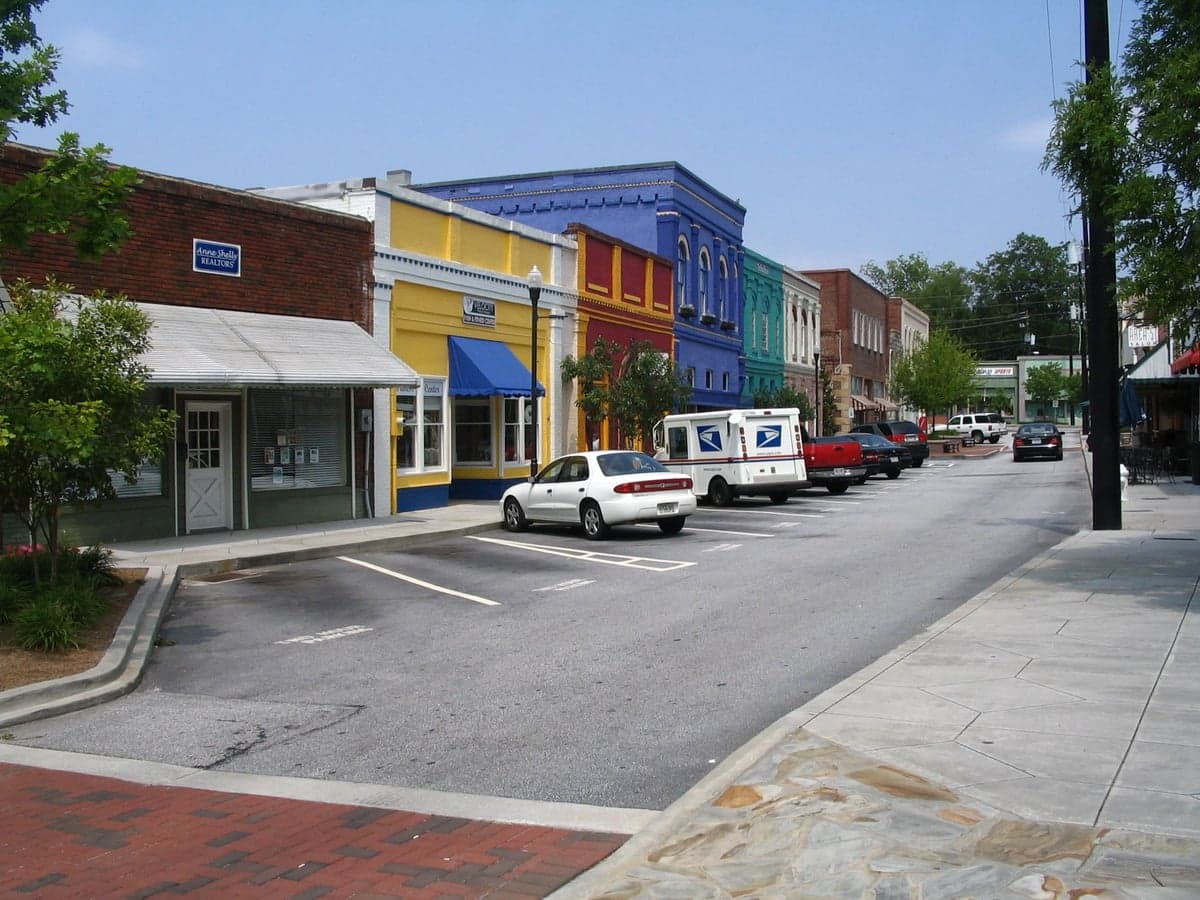
Photo: Wikipedia
Political ClimatePolitical Climate in Conyers, GA
District shown is the primary district for this city’s centroid. Cities may span multiple districts.
Local Political AnalysisPolitical Analysis of Conyers, GA
Conyers, Georgia, sits in Rockdale County with a Cook Partisan Voting Index of D+21, making it one of the most reliably Democratic-leaning areas in metro Atlanta. That’s a pretty stark shift from even 15 years ago, when the county was a swing district that occasionally backed Republicans. The trajectory here has been steady blueward, driven by rapid suburbanization, an influx of younger and more diverse residents from Atlanta, and a local Democratic Party organization that’s become deeply entrenched in county government. If you’re looking at the 2024 presidential results, Rockdale County went for Joe Biden by about 30 points, while the rest of Georgia—especially exurban and rural counties like neighboring Newton and Walton—voted heavily Republican. So Conyers is an island of deep blue in a state that’s purple trending red.
How it compares
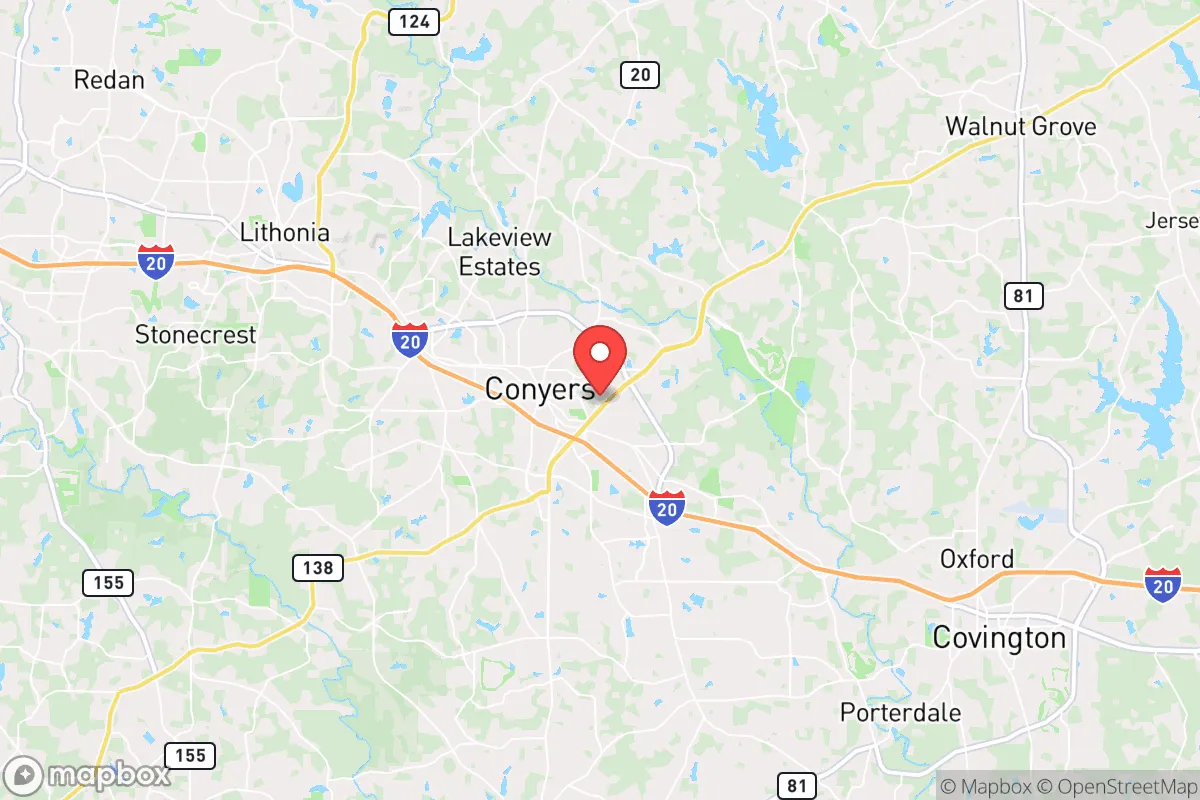
Compared to Georgia as a whole, Conyers is an outlier. The state’s Cook PVI is unknown because it’s a true battleground—Georgia flipped blue for Biden in 2020 by less than 12,000 votes, then swung back toward Trump in 2024 by about 2 points. Rockdale County, by contrast, has become a Democratic stronghold on par with DeKalb or Clayton counties. Drive 15 minutes west to Covington in Newton County, and you’ll find a much more conservative electorate—Newton voted +12 for Trump in 2024. Head north to Loganville in Walton County, and it’s +35 Republican. Conyers’ political DNA is tied to its proximity to Atlanta (just 25 miles east on I-20) and its demographics: roughly 55% Black, 25% white, and a growing Hispanic and Asian population. The county commission, school board, and most municipal offices are held by Democrats, and local elections often turn on primary contests rather than general ones.
What this means for residents
For liberal residents, Conyers offers a comfortable environment where progressive policies—like the county’s livable wage ordinance for county employees and expanded public transit through the Rockdale Transit Authority—are the norm. You’ll find active Democratic clubs, regular voter registration drives, and a local government that prioritizes affordable housing and equity initiatives. For conservative residents, the reality is more nuanced. You’re not going to feel unwelcome—Conyers is still a Southern town with plenty of churches, gun shops, and a strong sense of community—but you’ll be in the minority politically. Local GOP meetings are small, and Republican candidates rarely win countywide races. That said, the state legislature and governor’s office are controlled by Republicans, so conservative residents can still see their values reflected in state-level policies like Georgia’s permitless carry law and restrictive abortion legislation. The tension between local blue governance and state red governance is a daily reality here.
Culturally, Conyers stands apart from much of Georgia because of its strong Black political leadership—the county has had a Black sheriff, school superintendent, and multiple county commissioners for over a decade. That’s not the case in most surrounding counties. You’ll also notice a more visible LGBTQ+ community and a handful of progressive nonprofits, like the Rockdale Coalition for Social Justice, that wouldn’t fly in Covington or Monroe. The policy distinction that matters most day-to-day is probably land use and development: Conyers has embraced mixed-use zoning and transit-oriented development around the old downtown depot, while neighboring counties lean toward low-density, car-dependent sprawl. For anyone moving here, the bottom line is this: Conyers is a blue dot in a red state, and that shapes everything from your property taxes to your neighbors’ yard signs. It’s a place where you can have a real conversation about politics without it turning into a fight, but you’ll know exactly where everyone stands by the second round of sweet tea.

State Political ClimatePolitical Climate in Georgia
State Political AnalysisPolitical Environment in the State
Georgia has transformed from a reliably red state into the nation’s most competitive battleground, with a partisan lean that now sits roughly even — Democrats won the presidential race here in 2020 by 0.2% and both Senate seats in 2020-21, while Republicans swept statewide offices in 2022 by margins of 5-10 points. The state’s political trajectory over the past 20 years has been a slow, steady shift leftward driven by explosive growth in the Atlanta metro, but the rest of the state remains deeply conservative, creating a political tug-of-war that makes Georgia the epicenter of American electoral politics.
Urban vs. rural divide
The political map of Georgia is a study in stark contrasts. The Atlanta metro — including Fulton, DeKalb, Cobb, Gwinnett, and Clayton counties — now accounts for roughly 60% of the state’s vote and leans heavily Democratic, with Fulton County delivering 72% for Biden in 2020 and DeKalb hitting 85%. This is the engine of the state’s leftward shift. Outside the I-285 perimeter, the picture flips dramatically. Rural south Georgia counties like Brooks, Irwin, and Tift routinely vote 70-80% Republican, while the exurban and small-city counties north of Atlanta — Cherokee, Forsyth, Hall — are among the fastest-growing and most conservative in the nation. The real story is in the suburbs: Cobb and Gwinnett counties, which voted Republican as recently as 2012, flipped to Democrats by 2020, driven by an influx of diverse, college-educated professionals. Meanwhile, cities like Savannah (Chatham County) and Augusta (Richmond County) are Democratic strongholds in otherwise conservative regions, while Columbus (Muscogee County) and Macon (Bibb County) have become more competitive but lean blue. The divide isn’t just urban vs. rural — it’s metro Atlanta vs. everywhere else, with the Atlanta region’s growth overwhelming the conservative vote from the rest of the state.
Policy environment
Georgia’s policy environment reflects its divided politics: a conservative state government with a Republican supermajority in the legislature and a GOP governor, but tempered by a growing Democratic constituency. The state has a flat income tax rate of 5.49% (scheduled to drop to 4.99% by 2029), a relatively low corporate tax rate, and a homestead exemption that keeps property taxes moderate for homeowners. Education policy is a flashpoint: the state has a robust school voucher program (the Georgia Promise Scholarship Act, passed in 2024) that allows students in low-performing schools to use public funds for private school tuition, but it’s capped and faces legal challenges. Healthcare is a major issue — Georgia is one of only 10 states that has not expanded Medicaid under the ACA, leaving roughly 300,000 low-income adults in a coverage gap. Election laws have been controversial: the 2021 Election Integrity Act (SB 202) added voter ID requirements for absentee ballots, limited drop boxes, and restricted third-party ballot collection, drawing national scrutiny. On the social front, Georgia has a six-week abortion ban (HB 481, the “Heartbeat Bill”) that took effect in 2022, with no exceptions for rape or incest. The state also has permitless carry for firearms (SB 319, 2022), allowing concealed carry without a license. Property rights are strong, with no state-level rent control and relatively permissive zoning in most areas outside Atlanta’s city limits.
Recent policy direction
The last three years have seen Georgia’s Republican legislature push a distinctly conservative agenda, but with notable limits. On gun and self-defense law, the 2022 permitless carry law was a major victory for gun rights advocates, though it didn’t go as far as some wanted — it still prohibits carry in certain sensitive places like government buildings and schools. On parental and education rights, the 2022 “Parents’ Bill of Rights” (SB 449) requires schools to notify parents of any changes to a student’s health or well-being, and the 2023 ban on teaching “divisive concepts” (HB 1084) restricts classroom discussion of race and gender. On speech and privacy, Georgia has a broad anti-SLAPP law (the Citizen Participation Act) that protects against frivolous lawsuits meant to silence critics, but it’s weaker than some states’ versions. On medical and bodily autonomy, the six-week abortion ban is among the strictest in the nation, but the law’s enforcement has been uneven — some hospitals have refused to treat miscarriages for fear of prosecution, creating a chilling effect. On property rights, the state has strong eminent domain protections (the 2006 Landowner Protection Act), and there’s no statewide rent control. On taxation, the trend is toward lower rates: the 2023 tax cut package accelerated the income tax reduction and doubled the standard deduction. On voting and ballot access, SB 202 tightened rules but also expanded early voting hours in rural counties — a trade-off that both sides claim as a win. The overall direction is a conservative state government pushing right on social issues while maintaining a business-friendly tax and regulatory environment.
Civil unrest & political movements
Georgia has been a focal point for political activism on both sides. The 2020 election aftermath saw massive protests in Atlanta over police brutality (the Rayshard Brooks killing) and the presidential election results, with Trump supporters staging rallies at the state capitol and Democratic activists mobilizing for the 2021 Senate runoffs. The state has a strong and visible activist left, centered in Atlanta, with groups like the Georgia NAACP, Fair Fight (Stacey Abrams’ voting rights organization), and the Georgia Coalition for the People’s Agenda. On the right, the Georgia Republican Party has been split between establishment conservatives and a more populist, Trump-aligned wing, with the 2022 primary for governor seeing a serious challenge from David Perdue. Immigration politics are less heated than in border states, but there’s a significant debate over the state’s role in housing refugees — Clarkston, a small city in DeKalb County, has become a national symbol of refugee resettlement, with a population that speaks over 60 languages. There’s no sanctuary city policy in Georgia; state law (HB 87, 2011) requires local law enforcement to cooperate with federal immigration authorities. Election integrity remains a live issue: the 2024 presidential election saw Georgia again at the center of controversy, with allegations of voter roll irregularities and a hand recount that confirmed Biden’s 2020 win. A new resident would notice the constant political advertising and the visible presence of campaign offices and yard signs — Georgia is a permanent swing state now, and it shows.
Projection
Over the next 5-10 years, Georgia is likely to remain a competitive swing state, but the demographic trends favor Democrats. The Atlanta metro continues to grow rapidly, adding roughly 100,000 new residents per year, and those new arrivals are disproportionately young, diverse, and college-educated — the demographic groups that lean Democratic. By 2030, the Atlanta region is projected to account for nearly 65% of the state’s vote, making it increasingly difficult for Republicans to win statewide without significant gains in the suburbs. However, the rural and exurban vote is also growing, particularly in the conservative counties north of Atlanta like Forsyth and Cherokee, which are among the fastest-growing in the nation. The wild card is the state’s growing Hispanic and Asian American populations, which are politically diverse and not reliably Democratic — in 2022, Republican Governor Brian Kemp won 38% of the Hispanic vote and 30% of the Asian vote, suggesting room for GOP gains. The state legislature will remain Republican-controlled through at least the 2030 redistricting cycle, thanks to gerrymandered maps, but the governor’s race and Senate races will be toss-ups. A relocator moving in now should expect a state that is politically divided, with a conservative state government but a Democratic-leaning electorate in presidential years, and a policy environment that will continue to seesaw between the two parties’ priorities.
For a new resident, the bottom line is that Georgia offers a unique blend: a low-tax, business-friendly environment with a conservative state government, but living in the Atlanta metro means being part of a diverse, Democratic-leaning community with all the cultural amenities that come with it. If you’re conservative, you’ll find a welcoming state government and strong gun rights, but you’ll also live in a state where the politics are constantly contested. If you’re liberal, you’ll find a vibrant activist community and a growing Democratic base, but you’ll also face a state government that is actively restricting abortion access and voting rights. The practical takeaway: Georgia is not a red state or a blue state — it’s a purple state where your experience will depend heavily on which county you choose to call home.
* Values derived from national, state, county, city and local statistics and may differ in a specific area. Last updated: 2026-10-16T23:56:59.000Z
Narrative content on this page is AI-generated and may contain mistakes. Verify any details that matter before acting on them.
ReloMaps may earn a commission from affiliate links at no extra cost to you.

