Photo: Wikipedia
Demographics of Conyers, GA
Affluence Level in Conyers, GA
A middle-class area roughly in line with national averages across income, home values, education, and employment.
People of Conyers, GA
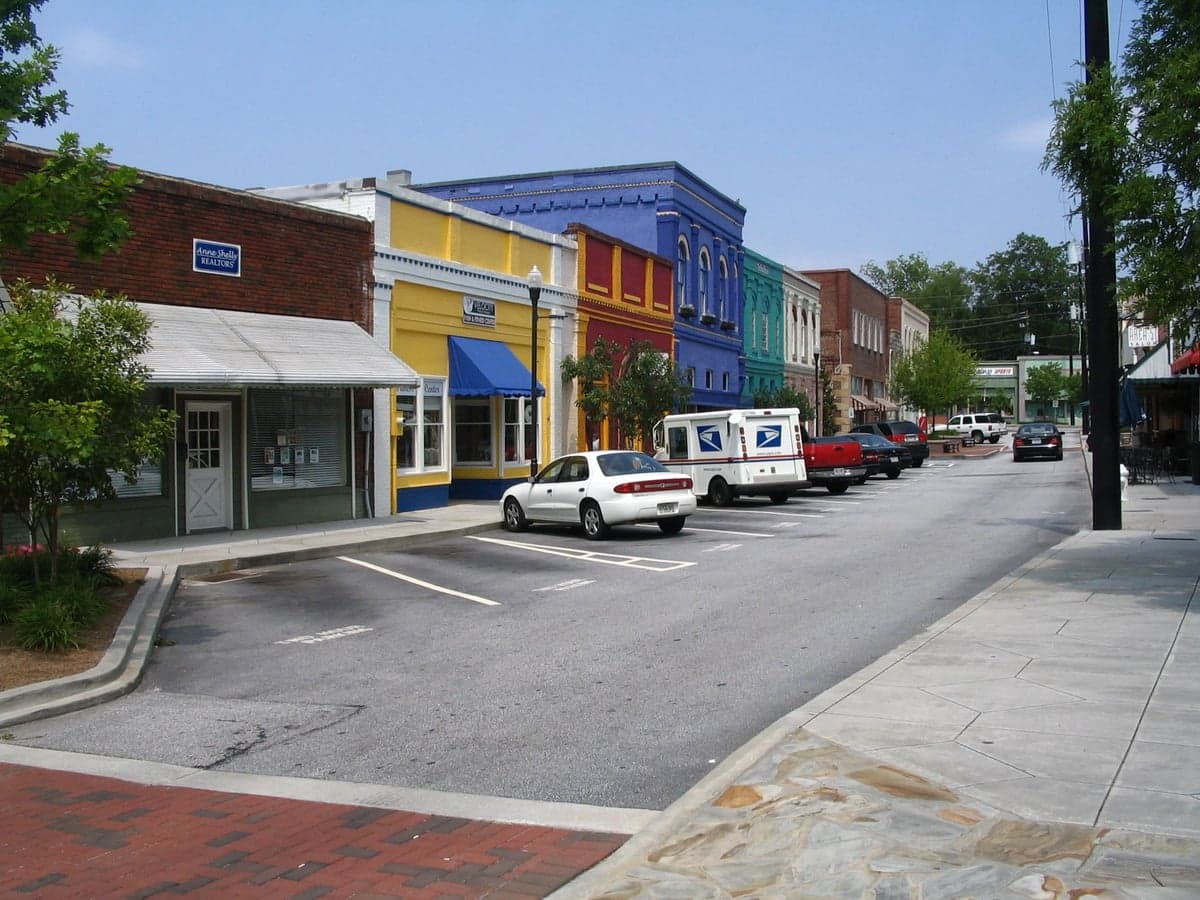
Conyers, Georgia, is a majority-Black city of 17,916 residents where African American heritage is deeply woven into the civic fabric, yet the population is becoming more diverse with a growing Hispanic community now at 12.0% and a small but present East/Southeast Asian population at 1.2%. The city retains a distinctly Southern, family-oriented character, with a median age around 36 and a college-educated rate of 29.6% that reflects a mix of working-class roots and professional commuters. Conyers feels like a close-knit small town that has absorbed multiple waves of newcomers while holding onto its identity as the Rockdale County seat.
How the city was settled and grew
Conyers was founded in 1845 as a railroad stop on the Georgia Railroad line connecting Augusta to Atlanta, and its early population was overwhelmingly white farmers and merchants drawn by the cotton trade and the promise of rail access. The original settlers clustered around what is now Olde Town Conyers, the historic commercial district along Railroad Street, where the depot anchored a bustling economy of cotton gins, general stores, and law offices. After the Civil War, newly freed African Americans established their own communities on the city's east side, particularly in the East Conyers neighborhood along Milstead Avenue, where Black churches, schools, and small businesses formed the backbone of a self-sufficient enclave. By 1900, the population had grown to roughly 1,500, with Black residents making up about 40% of the city, working primarily as domestic laborers, farmhands, and railroad workers. The early 20th century brought a second wave of white families from rural Georgia who settled in the West Conyers area near the current Rockdale County Courthouse, drawn by the expanding county government and the arrival of the textile industry.
Modern era (post-1965)
The post-1965 period transformed Conyers dramatically. The Immigration and Nationality Act of 1965 had a modest direct effect here—Conyers was not a primary destination for post-1965 immigrants—but the domestic migration patterns that followed reshaped the city. The 1970s and 1980s saw a steady outflow of white families to newer suburbs farther east, while Black families from Atlanta and surrounding rural counties moved into neighborhoods like Honey Creek and Magnet, drawn by affordable housing and the expansion of the Rockdale County school system. By 1990, Conyers had become a majority-Black city, a shift that accelerated through the 2000s as new subdivisions like Spring Valley and Lake Capri attracted middle-class Black professionals commuting to jobs in Atlanta, about 25 miles west. The Hispanic population began growing noticeably in the 1990s, concentrated in the West Avenue corridor near the intersection of GA-20 and I-20, where Mexican and Central American families found work in construction, landscaping, and the nearby poultry processing plants in Rockdale County. Today, the city's racial composition—61.2% Black, 19.4% white, 12.0% Hispanic, 1.2% East/Southeast Asian, and 0.8% Indian—reflects a pattern of Black majority with a growing Hispanic minority, while the white population has declined from over 70% in 1980 to less than a fifth today.
The future
Conyers is becoming more diverse, but the pace of change is moderate. The Hispanic share has risen from roughly 5% in 2000 to 12% today, driven by family reunification and continued demand for labor in construction and service industries, with new arrivals settling in the West Avenue and Sigman Road areas. The East/Southeast Asian and Indian populations remain small but are growing slowly, attracted by the relatively low cost of housing compared to Atlanta and the presence of a few tech-adjacent employers along the I-20 corridor. The Black population is projected to remain the majority for the foreseeable future, though the city may see a slight increase in white residents as younger families seek affordable alternatives to pricier Atlanta suburbs. Over the next 10-20 years, Conyers will likely become a more multiethnic city, with the Hispanic share potentially reaching 15-18% and the Asian and Indian populations each approaching 2%, while the Black majority holds steady around 55-60%. The cultural identity is evolving from a historically Black Southern town into a more layered community where African American heritage remains central but is increasingly shared with Latino festivals, Asian grocery stores, and a growing number of mixed-race families.
For someone moving to Conyers now, the city offers a stable, majority-Black community with a growing Hispanic presence and a small but visible Asian and Indian population—a demographic reality that is more diverse than many Southern suburbs of its size. The population is not rapidly changing in any single direction, but rather slowly broadening, making Conyers a place where newcomers can find established ethnic communities while also being part of a city that is still defining its modern identity. The bottom line: Conyers is a solid, family-oriented town where the past is present, the future is gradual, and the people are the story.

* Values derived from national, state, county, city and local statistics and may differ in a specific area. Last updated: 2026-10-16T23:56:59.000Z
Narrative content on this page is AI-generated and may contain mistakes. Verify any details that matter before acting on them.
ReloMaps may earn a commission from affiliate links at no extra cost to you.

