
Political ClimatePolitical Climate in Concord, MA
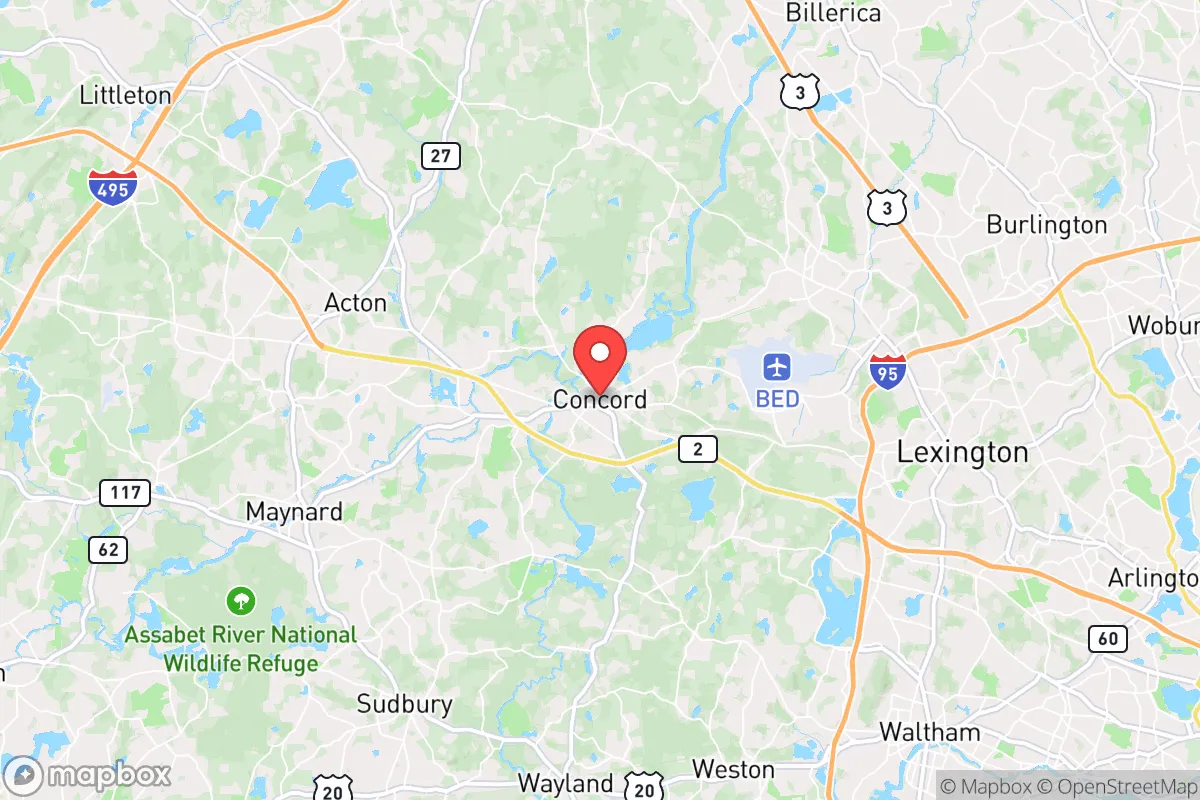
District shown is the primary district for this city’s centroid. Cities may span multiple districts.
Local Political AnalysisPolitical Analysis of Concord, MA
Concord leans solidly Democratic, with a Cook Partisan Voting Index (PVI) of D+11, meaning it votes about 11 points more Democratic than the national average. That’s a bit less blue than Massachusetts as a whole, which sits at D+15, but in practice, you’re still in a place where Democratic candidates win by comfortable margins in most elections. The town has been trending steadily leftward over the past decade, mirroring the broader suburban shift in Greater Boston, though it retains a small but vocal Republican minority, especially among older families who’ve been here for generations.
How it compares
Concord’s D+11 PVI puts it to the right of the state average (D+15) but still well within the deep-blue column. For context, neighboring towns like Acton (D+18) and Lexington (D+22) are significantly more liberal, while Carlisle (D+9) and Bedford (D+10) are closer to Concord’s lean. Head west to Stow (D+4) or Maynard (D+6), and you’ll find more moderate or swing territory. The real contrast is with towns like Sudbury (D+12) or Wayland (D+14), which are similar in wealth and education but vote a hair more Democratic. In state-level races, Concord typically backs Democratic candidates by 60-65% of the vote, while Massachusetts as a whole often hits 65-70% for the same races. The gap comes from Concord’s older, more established population—many of whom are fiscally conservative but socially moderate—compared to the heavily student-and-renter-heavy urban core of Boston or Cambridge.
What this means for residents
For liberal residents, Concord is a comfortable place to live: town meetings, school board elections, and local zoning debates are dominated by progressive voices, especially on environmental issues and public transit expansion. You’ll find strong support for renewable energy initiatives, affordable housing mandates, and diversity programs in the schools. For conservative residents, the reality is more about being a minority voice. You won’t face hostility, but you’ll often be outvoted on local issues like tax overrides or development projects. The town’s Republican committee is active but small, and most conservative-leaning residents I know focus on property rights and fiscal restraint rather than social issues. In practice, the political climate means property taxes are high (around 1.1% of assessed value) to fund top-tier schools and services, and there’s a strong expectation of civic engagement—town meeting attendance is high, and decisions are made face-to-face, not by remote ballot.
Culturally, Concord wears its history on its sleeve—the Revolutionary War sites, the Transcendentalist legacy—and that shapes a local identity that’s proudly independent and intellectually curious. You’ll see more “Keep Concord Green” lawn signs than partisan yard signs. The town has a strong tradition of ranked-choice voting in local elections and a robust public comment culture at select board meetings. Policy-wise, Concord was an early adopter of the state’s Community Preservation Act, which funds open space and historic preservation through a property tax surcharge, and it’s currently debating a ban on new fossil fuel hookups in buildings—a move that’s popular with the majority but rankles some long-time residents worried about costs. If you’re moving here, expect a politically engaged, environmentally conscious community where the biggest fights are over how fast to change, not whether to change at all.

State Political ClimatePolitical Climate in Massachusetts
State Political AnalysisPolitical Environment in the State
Massachusetts is one of the most reliably Democratic states in the country, with a Cook Partisan Voting Index of D+15, meaning it votes about 15 points more Democratic than the national average in presidential elections. Over the past 20 years, the state has shifted further left, driven by the consolidation of the Boston metro area and the emptying out of its once-competitive exurbs. In 2024, Kamala Harris won the state by roughly 25 points, a margin that has held steady since 2016, though the coalition beneath it has changed: the old moderate Republican strongholds in the western and central parts of the state have either flipped blue or shrunk, while the suburbs around Boston have become some of the most liberal in the nation.
Urban vs. rural divide
The political map of Massachusetts is a story of three zones. Greater Boston—including Boston proper, Cambridge, Somerville, and the inner-ring suburbs like Brookline and Newton—is deep blue, routinely delivering 80-85% of the vote to Democratic candidates. The western part of the state, centered on Springfield and Pittsfield, is also reliably Democratic, though with a more working-class, union-driven flavor. The real divide is in the central and southeastern exurbs and rural towns. Places like Worcester County’s Holden and Paxton, or Plymouth County’s Carver and Middleborough, have trended redder over the last decade, but they lack the population to offset the Boston metro’s weight. The only county that voted for Donald Trump in 2020 was tiny, rural Dukes County (Martha’s Vineyard), and even that flipped back to Biden in 2024. The old “Republican towns” like Wellesley and Weston are now solidly blue, leaving the GOP with a rump of voters in the far western hill towns and a few southeastern communities like Fall River, where a populist, blue-collar streak still runs strong.
Policy environment
Massachusetts has a high-tax, high-service policy environment that reflects its Democratic supermajority. The state income tax is a flat 5% (reduced from 5.15% in 2023 via a voter-approved amendment), and the sales tax is 6.25%. Property taxes are locally set and vary widely—Boston’s effective rate is around 0.6%, while rural towns like Becket can hit 1.5%. The state has a robust regulatory apparatus: rent control was banned statewide in 1994, but Boston and Cambridge have their own rent stabilization rules. Education policy is dominated by the 1993 Education Reform Act, which created the MCAS test and a school accountability system; charter schools are capped, and the state has a strong teachers’ union. Healthcare is near-universal thanks to the 2006 Romneycare law, which served as the model for the ACA. Election laws are among the most liberal in the country: no-excuse mail-in voting, same-day registration, and early voting are all permanent fixtures. Gun laws are strict—the state requires a license to purchase (LTC) with a background check and a firearms safety course, and “assault weapons” are banned under a 1998 law that has survived court challenges.
Recent policy direction
Over the last five years, Massachusetts has moved decisively left on several fronts. In 2022, the state passed the Work and Family Mobility Act, allowing undocumented immigrants to obtain driver’s licenses. In 2023, the legislature overrode Governor Maura Healey’s veto to pass the “Parentage Act,” which allows same-sex couples to be listed on birth certificates without a court order. On gun policy, the 2024 “Massachusetts Gun Safety Act” expanded the assault weapons ban, required microstamping on new handguns, and created a state-level “red flag” law with a 10-day waiting period. On education, the state has resisted parental opt-out movements for LGBTQ curriculum, and in 2023, the Department of Elementary and Secondary Education issued guidance requiring schools to affirm transgender students’ identities without parental notification if the student requests it. On property rights, the state has a strong “Chapter 40B” law that allows developers to bypass local zoning if a town has less than 10% affordable housing, which has been a flashpoint in suburbs like Lexington and Arlington. On voting, the 2022 VOTES Act made mail-in voting permanent and expanded early voting. On privacy, the state has a strong data privacy law (the 2018 CCPA-style “Massachusetts Data Privacy Act” is still pending, but a 2023 law restricts facial recognition use by police). On medical autonomy, Massachusetts has no gestational limit on abortion and protects providers from out-of-state lawsuits under the 2022 “ROE Act.”
Civil unrest & political movements
Massachusetts has a long history of organized activism, but the flashpoints have shifted. The 2020 Black Lives Matter protests in Boston were large but largely peaceful, leading to police reform legislation in 2021 that banned chokeholds and created a civilian oversight commission. The state’s sanctuary policy—codified in 2017’s “Safe Communities Act”—limits local police cooperation with ICE, and has been a target of conservative backlash, though no serious repeal effort has gained traction. In 2023, a small but vocal “parental rights” movement emerged in suburbs like Woburn and Tewksbury, protesting LGBTQ-inclusive curriculum and library books, but it has not translated into electoral wins. The state’s Republican Party is a shell of its former self—it holds no statewide offices and only a handful of legislative seats—but there is a persistent libertarian streak in the western hill towns, where “Free the People” rallies and Second Amendment sanctuary resolutions have passed in towns like Sturbridge and Hardwick. Election integrity controversies are minimal; the state’s mail-in voting system has been widely accepted, and there have been no major fraud allegations. Immigration politics are a live issue in gateway cities like Lawrence and Lowell, where the state’s “right to shelter” law (the only one in the country) has strained resources as migrant arrivals have increased since 2022.
Projection
Over the next 5-10 years, Massachusetts will likely become even more Democratic, but the nature of that dominance will shift. The Boston metro area is growing faster than the rest of the state, driven by the biotech and tech sectors, and those new residents are overwhelmingly liberal. The exurban and rural areas that have trended red will continue to lose population share, making the state’s overall partisan lean even more lopsided. However, the internal politics will become more contested between the progressive wing (which wants rent control, a wealth tax, and single-payer healthcare) and the moderate wing (which favors business-friendly policies and fiscal restraint). The 2024 ballot question to eliminate the MCAS graduation requirement failed, but the issue will return. The state’s housing crisis—driven by restrictive zoning in the suburbs—will force more state intervention, likely through stronger Chapter 40B enforcement or a statewide zoning overhaul. A conservative relocator should expect a policy environment that continues to expand government services and regulation, with little chance of a political realignment. A liberal relocator will find a state that is largely aligned with their values, but with a high cost of living and a housing market that is increasingly exclusionary.
For a new resident, the bottom line is this: Massachusetts is a state where your vote in a general election will not affect the national outcome, but your local vote—in city council, school board, and state legislative races—matters a great deal. The state’s political culture is one of high engagement, high taxes, and high expectations for public services. If you are conservative, you will find a small but active community in the western hill towns and a few southeastern suburbs, but you will be swimming against a strong tide. If you are liberal, you will find a state that is largely on your side, but with a cost of living that may test your patience. Either way, the state’s politics are stable, predictable, and unlikely to surprise you—for better or worse.
* Values derived from national, state, county, city and local statistics and may differ in a specific area. Last updated: 2026-08-29T03:40:00.000Z
Narrative content on this page is AI-generated and may contain mistakes. Verify any details that matter before acting on them.
ReloMaps may earn a commission from affiliate links at no extra cost to you.

