
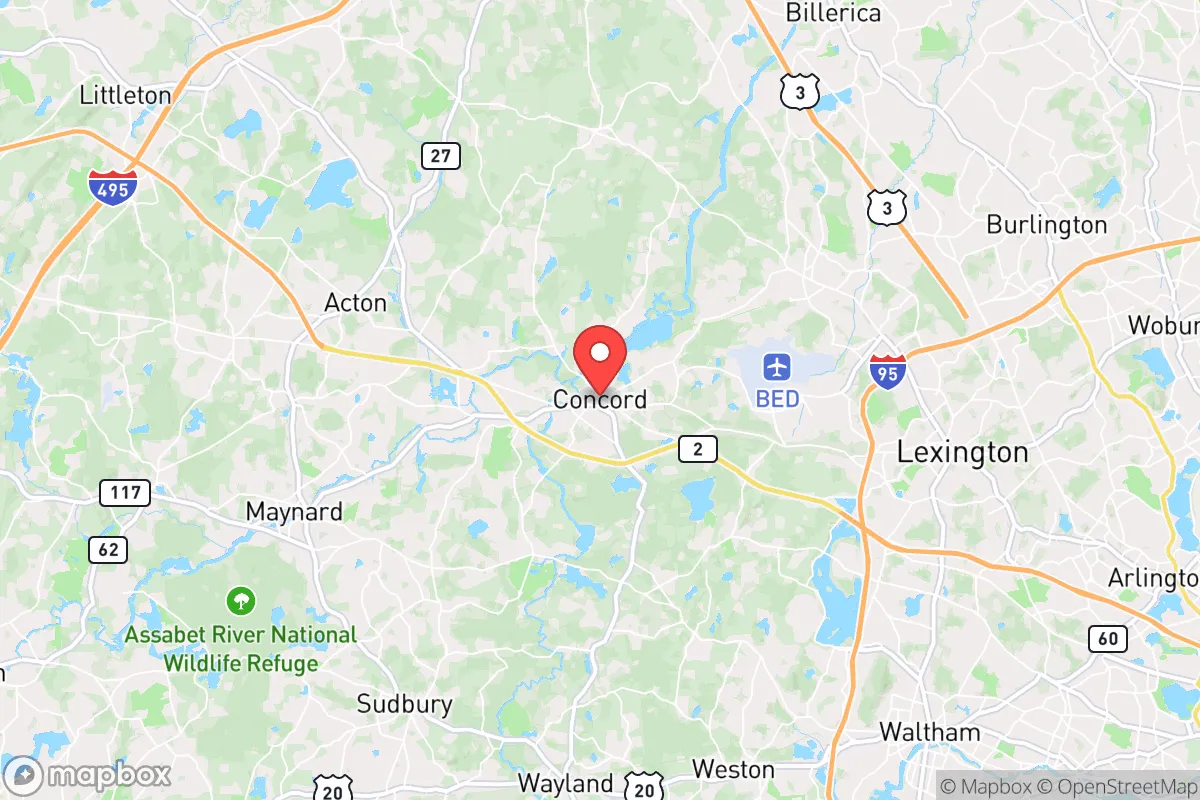
Personal Sovereignty in Concord, MA
Moderate friction. Expect trade-offs in some aspect of personal liberty and independence.
What does Personal Sovereignty tell us?
Personal Sovereignty measures your capacity for self-reliance and independence with minimal government friction. Higher scores mean fewer barriers between you and the way you want to live... but it assumes you have the space you need and good neighbors.
What does this tell us?
Personal Sovereignty measures your capacity for self-reliance and independence with minimal government friction. Higher scores mean fewer barriers between you and the way you want to live... but it assumes you have the space you need and good neighbors.
State Policy
Energy independence: Importer (5% of energy produced in-state)
Personal Liberty
Homesteading

Personal Liberty Analysis
Concord, Massachusetts presents a complex personal sovereignty environment where deep-rooted traditions of self-governance collide with one of the nation's most active state regulatory frameworks. While the town's Revolutionary-era spirit of independence remains culturally present, modern residents navigate a jurisdiction where state-level mandates significantly constrain individual autonomy in taxation, self-defense, property use, and medical choice. For a relocation-minded reader prioritizing personal freedom, Concord offers a high-quality, historically rich setting but demands careful consideration of the trade-offs between collective governance and individual liberty.
Tax burden and regulatory posture: How heavy is the hand of government?
Massachusetts carries a substantial tax and regulatory load that directly impacts personal sovereignty in Concord. The state's income tax rate is a flat 5.0% as of 2026, applied to most earned income, with no standard deduction for state purposes—meaning every dollar earned is taxed from the first dollar. Property taxes in Concord are significant: the 2025 rate is approximately $12.80 per $1,000 of assessed value, placing the town in the upper tier of Middlesex County. A median home valued at $1.2 million yields an annual property tax bill near $15,360. The state also imposes a 6.25% sales tax on most goods, with no local option to reduce it. Regulatory posture is heavy-touch: Massachusetts has a robust state building code, strict environmental regulations under the Wetlands Protection Act, and local conservation commissions that review nearly any property alteration near water or wetlands—common in Concord. Zoning is administered locally but must comply with state Chapter 40B affordable housing mandates, which can override local zoning for certain developments. For a resident seeking to minimize government interaction, Concord's tax burden is among the highest in the nation, and the permitting process for home improvements or business operations is thorough and time-consuming.
Self-defense and gun law specifics: What are the limits on the right to keep and bear arms?
Massachusetts has some of the most restrictive firearm laws in the United States, and Concord residents must comply fully. The state requires a License to Carry (LTC) for any handgun possession, whether open or concealed. Issuance is "may-issue" in practice: the local police chief in Concord has discretion to deny an LTC based on "suitability," which can include subjective factors like character or prior mental health history. The licensing process includes a background check, fingerprinting, a firearms safety course, and a fee of approximately $100. Renewal is required every five to six years. Assault weapons as defined by state law are banned for civilian possession, including many common semi-automatic rifles. Magazine capacity is limited to 10 rounds. The state also has a strict "safe storage" law requiring firearms to be locked in a container or with a trigger lock when not under the owner's direct control, even inside the home. Stand-your-ground laws do not exist; Massachusetts follows a duty-to-retreat doctrine, meaning a person must attempt to avoid a confrontation before using deadly force, unless inside their own home. Castle doctrine is limited to the dwelling itself, not extending to vehicles or property. For a self-defense-minded individual, Concord's legal environment is highly restrictive, with significant administrative hurdles and limited legal protection for defensive firearm use.
Self-reliance and homesteading viability: Lot sizes, zoning, and off-grid feasibility
Concord's zoning and land-use regulations make traditional homesteading or off-grid living challenging but not entirely impossible. Minimum lot sizes vary by district: most residential zones require one to two acres per dwelling unit, with some conservation areas requiring larger parcels. The town's Right to Farm bylaw protects agricultural activities, including keeping chickens, bees, and small livestock on properties of one acre or more, subject to setback and nuisance regulations. However, off-grid systems face substantial regulatory barriers. Solar panels are permitted but must connect to the grid; net metering is available but requires utility approval. Rainwater collection for outdoor use is allowed, but potable rainwater systems are not recognized by state plumbing codes. Composting toilets are permitted only as part of a state-approved alternative septic system, which requires engineering review and a variance from the Board of Health. Well water is possible on larger lots but requires a permit, testing, and compliance with state drinking water standards. Burning of household trash is prohibited, and open burning of yard waste is limited to a few months per year with a permit. For a family seeking genuine self-reliance—growing food, harvesting water, generating power independently—Concord's regulatory environment is moderately restrictive, with the greatest hurdles in water and waste systems. The town's strong conservation ethic and active agricultural community provide cultural support for homesteading, but legal compliance is non-negotiable.
Personal liberties: Parental rights, medical autonomy, speech, and property
Personal liberties in Concord are shaped by a mix of state mandates and local culture. Parental rights are robust in theory but limited in practice: Massachusetts has mandatory vaccination requirements for school attendance (with medical and religious exemptions, but no philosophical exemption), and the state's 2024 "parental bill of rights" law affirms parents' authority to direct their child's education and medical care, though it does not override state health mandates. School curriculum is set locally, but Concord Public Schools follow state frameworks that include comprehensive sex education and social-emotional learning standards. Medical autonomy is constrained: Massachusetts has no right-to-try law for terminally ill patients seeking experimental treatments, and the state's health insurance mandate requires all residents to carry coverage or face a tax penalty. Alternative medicine practitioners are licensed by the state, with limited scope for unlicensed providers. Free speech is protected under the First Amendment, but Massachusetts has a strong anti-SLAPP law that can deter certain types of public criticism, and local noise ordinances restrict amplified speech in residential areas. Property rights are significantly limited by state and local regulations: the Massachusetts Historical Commission has jurisdiction over properties listed on the National Register (common in Concord's historic districts), and any exterior alteration visible from a public way may require a Historic Districts Commission review. The state's Chapter 40B allows developers to bypass local zoning for affordable housing projects, which can override a property owner's objections. For a resident who values maximum personal discretion, Concord's legal environment is moderately restrictive, with the heaviest constraints on property use and medical choice.
Overall, Concord's personal sovereignty profile is one of high collective governance with strong local character. The town's tax burden, gun laws, and regulatory density place it among the least autonomous areas in the United States for individuals seeking minimal government involvement. However, for those who value community standards, environmental protection, and historical preservation—and who are willing to work within a structured legal framework—Concord offers a stable, safe, and culturally rich environment where personal freedom is exercised through civic participation rather than individual autonomy. Compared to rural New Hampshire or Maine, where tax burdens are lower and gun laws are more permissive, Concord represents a trade-off: less personal sovereignty in exchange for more public services and a tightly regulated community fabric. For the relocation-minded reader, the key question is whether that trade-off aligns with their definition of freedom.

* Values derived from national, state, county, city and local statistics and may differ in a specific area. Last updated: 2026-08-29T03:40:00.000Z
Narrative content on this page is AI-generated and may contain mistakes. Verify any details that matter before acting on them.
ReloMaps may earn a commission from affiliate links at no extra cost to you.

