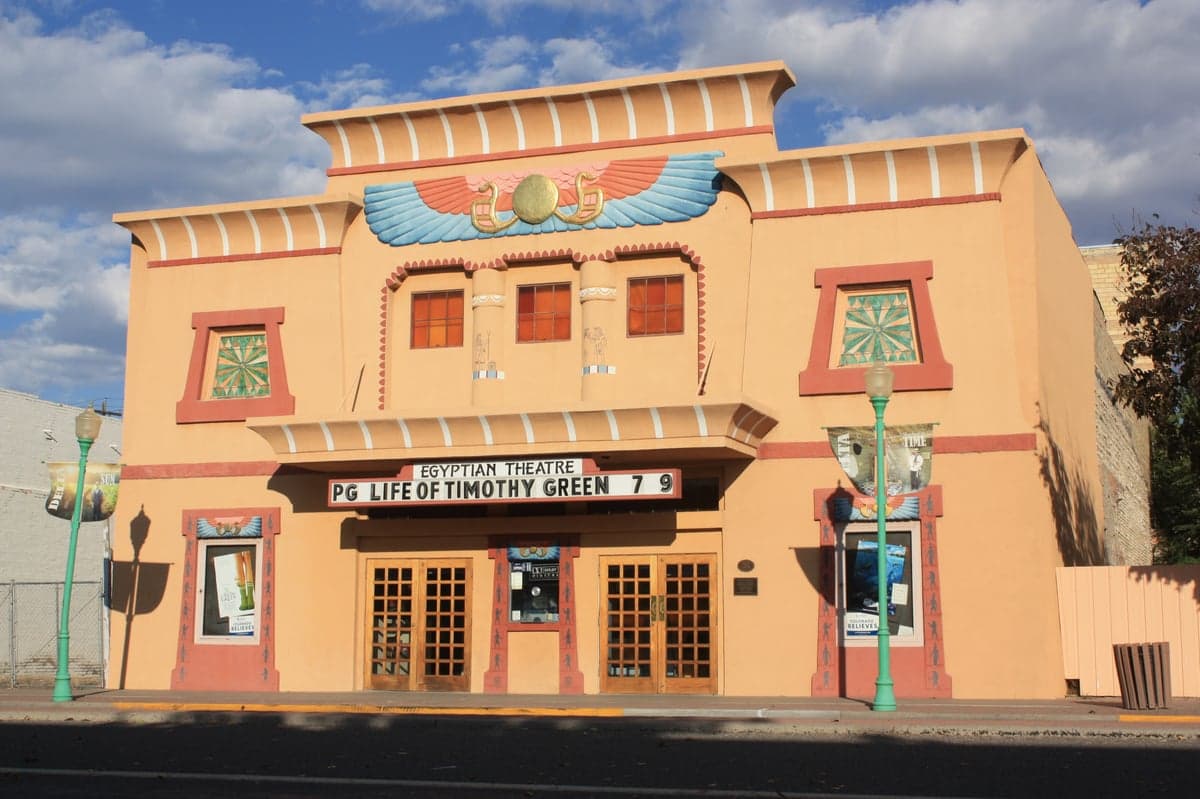
Photo: Wikipedia
Political ClimatePolitical Climate in Delta County
Showing district-level results — no local-only data available.
Local Political AnalysisPolitical Analysis of Delta County
Delta County sits at R+5 on the Cook Partisan Voting Index, which means it votes about five points more Republican than the national average, but it's not a monolith. If you've spent time here, you know the political lean varies significantly from town to town. The county seat, Delta, is the most moderate – it's where you'll find the swing precincts, especially around the river corridor and newer subdivisions. Head up the North Fork Valley, and Paonia breaks the stereotype: a small but vocal liberal enclave driven by the organic farming, winery, and artist community that's grown over the past two decades. Hotchkiss and Cedaredge, meanwhile, are solidly red, rooted in ranching, fruit growing, and oil and gas work. The trajectory is mostly steady red, but the valley floor around Paonia is slowly becoming more competitive as new residents arrive from the Front Range – though the county as a whole isn't flipping anytime soon.
How it compares
The contrast with Colorado as a whole is stark. The state's Cook PVI is D+6, meaning Colorado overall votes six points more Democratic than the national average – a gap of 11 points between Delta County and the state. In practice, Delta is one of the few reliably Republican counties left in a state that's now solidly blue at the statewide level. Neighboring Montrose County is R+9, and Mesa County is R+7, so Delta fits a regional pattern: the Western Slope tends to be more conservative than the Front Range, but Delta sits on the moderate end of that Western Slope spectrum. In the 2022 governor's race, for example, Republican candidate Heidi Ganahl won Delta County by about 12 points, while Jared Polis carried the state by nearly 20. That gap – a 32-point swing – sums up the disconnect between local and state politics.
What this means for residents
For conservative residents, life is comfortable locally: county commissioners, sheriff, school board, and most municipal councils lean Republican, so policy on land use, energy, and local taxes reflects that. The frustration comes with state-level mandates – gun control, renewable energy targets, and water regulations that can feel out of touch with rural needs. For liberal residents, especially in Paonia, the local reality can feel isolating, but there's a solid community infrastructure: the Paradise Theatre, local food co-op, and Democratic party meetings in Hotchkiss give a sense of belonging. The practical impact? Political conversations stay civil in most settings – locals tend to talk about water and wildlife more than party labels. Voting outcomes are predictable at the county level, but the swing precincts in Delta city mean that a close race for the state legislature (HD-54) can still break either way. If you're moving here, your experience depends heavily on which town you choose.
Culturally, Delta County is defined more by its economy and geography than by party affiliation. The old coal mines around the North Fork are mostly closed, but the oil and gas industry still matters in outlying areas. Water rights, grazing permits, and Second Amendment access are the issues that actually draw people to the polls – not national culture wars. The county has a pragmatic streak: even in conservative Cedaredge, you'll find support for local conservation efforts like the Surface Creek Trail and agricultural land preservation. That mix of old-school Western independence and a touch of new-agriculture progressivism means the political climate is less polarized than the raw voter numbers suggest. It's a place where you can disagree with your neighbor about the president but still help them haul hay.

State Political ClimatePolitical Climate in Colorado
State Political AnalysisPolitical Environment in the State
Colorado, for a long time, was considered a classic purple state, but over the past 15 years it has settled into a solidly blue, D+6 lean in statewide elections. The shift wasn't gradual—it snapped hard starting around 2016, and the state has only accelerated leftward since. Today, a coalition of suburban swing voters, younger transplants from the coasts, and a growing Hispanic electorate in the Front Range drives nearly every statewide win for Democrats, while Republicans have been reduced to a rump coalition holding the rural eastern plains, the Western Slope, and the southern mountain counties. For a conservative relocator, the reality is this: your vote in a statewide race will almost certainly land in the minority column, but your ability to live according to your values varies dramatically depending on whether you settle in El Paso County (Colorado Springs), Weld County (Greeley), or anywhere inside the Denver-Boulder-Aurora metroplex.
Urban vs. rural divide
The political map of Colorado is essentially three distinct regions. The Denver-Boulder-Aurora corridor, which alone holds roughly 60% of the state's population, is overwhelmingly Democratic—Boulder County gave Biden 76% of the vote in 2020, Denver County 80%. This metro bloc is the engine that flips the entire state blue every cycle. In contrast, Colorado Springs (El Paso County) remains a conservative stronghold, a military-and-evangelical hub that still votes Republican by double digits, though its margins have been shrinking as the city's tech sector grows. Further north, Weld County (Greeley) is one of the last reliably red, working-class, agriculture-and-oil counties that still delivers 60%+ for GOP candidates. Then you have the mountain resort counties—Pitkin (Aspen), San Miguel (Telluride), Summit (Breckenridge)—which are deep blue because of the wealthy, lifestyle-oriented transplant population. The rural eastern plains and the Western Slope (Mesa County/Grand Junction, Montrose, Delta) vote like Texas panhandle counties: 70-80% Republican, but there simply aren't enough people left out there to counterbalance Front Range growth.
Policy environment
Colorado's state-level policy is a case study in progressive governance applied with a pragmatic veneer. Income tax is a flat 4.4%—a rate that hasn't sparked mass exodus because it's still moderate by national standards. Property taxes are among the lowest in the country thanks to the Gallagher Amendment (repealed by voters in 2020, but its effects persist). Sales tax can stack high in cities—Denver's combined rate pushes 8.8%—but many suburban counties stay in the 7-8% range. The regulatory posture is business-friendly by coastal standards but increasingly aggressive on labor and environment: a statewide paid family leave program took effect in 2024, the oil and gas regulatory framework (SB 19-181) has been tightened significantly, and California-style electric vehicle mandates are on the books for 2032. Education policy tilts progressive—the state funds full-day kindergarten and has a rigorous school accountability system, but school choice, including charter schools and open enrollment, is broadly available and used heavily by families. Election laws are among the most accessible in the nation: automatic voter registration, same-day registration during early voting, universal mail-in ballots sent to every active voter—Colorado has been all-mail since 2013 with no major fraud incident, which conservatives find either reassuring or suspicious depending on who you ask.
Recent policy direction
The last four years have produced a legislative agenda that touches every liberty a relocator might care about. On gun policy, Colorado passed a sweeping package in 2023: a ban on "ghost guns" (untraceable homemade firearms), a minimum purchase age of 21 for all firearms (up from 18), and a three-day waiting period for any gun purchase. A 2024 law now allows private lawsuits against gun dealers or manufacturers who negligently distribute weapons—effectively the same mechanism used in New York's public nuisance statute. Self-defense law still includes "Make My Day" castle doctrine in your home, but there is no stand-your-ground law for public spaces, and the duty to retreat applies unless you're inside your residence. On parental and education rights, the state has trended against the national conservative wave: Colorado's 2023 law (part of the READ Act expansion) requires districts to follow state-approved, science-based reading curricula, limiting what parents can opt into, and transgender student protections require schools to allow students to use names, pronouns, and facilities matching their gender identity without parental notification if the student requests privacy. On speech, Colorado has no social media content moderation law like Florida or Texas, but it does have strong anti-SLAPP protections and shields for journalists. Privacy and surveillance: the Colorado Privacy Act (CPA, effective 2023) gives residents the right to opt out of data sale and access collected data, but lacks a private right of action—only the attorney general enforces it. Medical and bodily autonomy remains fully protected: abortion is codified into state law (2019's Reproductive Health Equity Act), and Colorado never restricted access during the post-Dobbs period; gender-affirming care for minors is protected from out-of-state prosecution or extradition under a 2023 shield law. Property rights have taken a hit with the 2024 oil and gas setback law that requires new wells to be 2,000 feet from homes and schools, which effectively bans new drilling in much of the Front Range and has triggered condemnation by mineral rights owners. Ballot access remains the gold standard—Colorado's all-mail system, same-day registration, and automatic voter rolls mean turnout consistently ranks in the top 5 nationally.
Civil unrest & political movements
Colorado has seen its share of visible political flashpoints in recent years. The 2020 protests in Denver over George Floyd's murder turned into several nights of property damage and looting along the 16th Street Mall, and the city's response—initially restrained, then heavy-handed—became a statewide political debate. The "Colorado Three" (a minor activist group attempting to secede from Colorado and form a new state of "North Colorado" in 2013) failed to get traction, but the sentiment that the Front Range ignores rural needs remains alive, driving periodic "county secession" ballot measures on the Eastern Plains. On immigration, Colorado's "Sanctuary State" label is overstated—there's no statewide ban on ICE cooperation, but Denver and several Front Range cities limit local law enforcement from detaining individuals solely for immigration status. The border politics of Colorado are more about trucking and fentanyl than migrant buses: in 2023, Governor Polis deployed the National Guard to the southern border as part of a multi-state agreement, a pragmatic move that defused some bipartisan anger. Election integrity was a major friction point in 2022 and 2024: Secretary of State Jena Griswold (Democrat) faced threats and a security detail after repeatedly debunking claims that Colorado's all-mail system was insecure. Meanwhile, Mesa County clerk Tina Peters (Republican) was convicted in 2024 for allowing unauthorized access to election equipment, a case that nationalized the debate. A new resident would notice that Colorado wears its politics on its sleeve—Boulder and Denver have BLM murals, Pride flags on state buildings, and "In This House We Believe" yard signs, while Colorado Springs and Grand Junction still fly Trump flags on pickup trucks. The culture war is visible but mostly polite; people coexist without much street-level animosity.
Projection
Over the next 5-10 years, Colorado's D+6 lean is likely to only deepen, not soften. The in-migration patterns are clear: the largest influx comes from California, Texas, and Illinois, and the demographics of those movers are younger, more educated, and more Democratic-leaning. The rural eastern plains will continue to depopulate as water scarcity and agricultural consolidation push people out. The suburban counties around Denver—Adams, Arapahoe, Jefferson—are filling up with transplants who vote blue, and even El Paso County (Colorado Springs) is inching toward swing territory as defense and aerospace jobs bring in a more professional class. The wild card is the Western Slope: Grand Junction and Montrose are growing modestly with remote workers from the Front Range, but that migration is more mixed. A conservative moving to Colorado in 2026 should expect that the governor's mansion, both US Senate seats, and the state legislature will remain under Democratic control for the foreseeable future. The state's Supreme Court is heavily Democratic-appointed. Ballot initiatives remain the one tool for conservatives—voters in 2024 passed a property tax reduction measure (Proposition HH's successor) and a school choice expansion, showing that the electorate still has a libertarian streak on fiscal and parental-rights issues. The 2026 gubernatorial election to succeed Polis (term-limited) will be a major test of whether any Republican can make inroads, but the structural math is punishing: the GOP needs to gain suburban voters it has lost permanently.
Bottom line for a new resident: If you're conservative and moving to Colorado, choose your county carefully. You can live in a red community in Colorado Springs, Greeley, or Grand Junction and feel culturally at home, but your statewide votes will rarely decide an election. You'll pay moderate taxes, have excellent school choice, and enjoy some of the best outdoor access in the country. But you'll also live under a policy regime that is unapologetically progressive on guns, gender, and abortion, with no realistic path to change that at the state level. If that tradeoff works for you, Colorado remains a genuinely good place to raise a family; if it doesn't, you'll likely find yourself frustrated every election cycle.
* Values derived from national, state, county, city and local statistics and may differ in a specific area. Last updated: 2026-06-24T22:31:14.000Z
Narrative content on this page is AI-generated and may contain mistakes. Verify any details that matter before acting on them.
ReloMaps may earn a commission from affiliate links at no extra cost to you.

