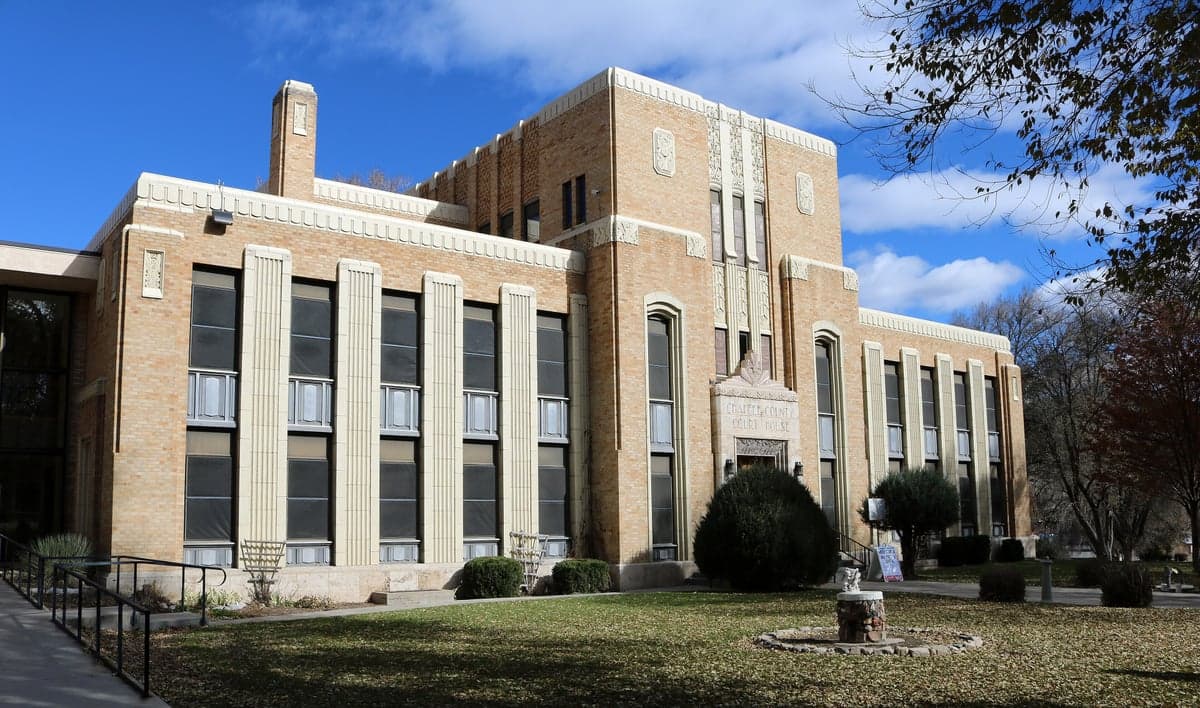
Photo: Wikipedia
Political ClimatePolitical Climate in Chaffee County
Showing district-level results — no local-only data available.
Local Political AnalysisPolitical Analysis of Chaffee County
Chaffee County has shifted notably to the left over the past decade, now carrying a Cook Partisan Voting Index of D+8, making it two points more Democratic than Colorado as a whole (D+6). This wasn't always the case—the county was a reliable swing area through the 2000s, but the influx of remote workers and retirees from Front Range cities has steadily pushed its politics leftward. The real story, though, is the sharp divide within the county itself: the liberal stronghold of Salinas anchors the blue vote, while the rural towns of Buena Vista and Poncha Springs still lean red, and the unincorporated areas around Nathrop and Maysville often swing the countywide results.
How it compares
Chaffee County’s D+8 rating puts it in a different political lane than most of rural Colorado. While the state as a whole trends D+6 thanks to Denver, Boulder, and the Front Range, Chaffee is an outlier among its mountain neighbors—Lake County is D+15, but Fremont County to the east is R+16. What makes Chaffee distinct is its internal polarization: Salida’s precincts routinely vote 65-70% Democratic, while Buena Vista’s outlying precincts hover around 55-60% Republican. The swing precincts are in the county’s central corridor along U.S. 285, where newer subdivisions and second-home owners have tipped the balance. In 2020, the county went for Biden by about 8 points, matching its PVI, but local races for county commissioner often come down to a few hundred votes between the Salida bloc and the rural conservative base.
What this means for residents
For liberal residents, especially in Salida, the county feels increasingly aligned with their values—local government has embraced renewable energy initiatives, and the city council has passed pro-housing policies that rankle some longtime ranchers. Conservative residents in Buena Vista and Poncha Springs still hold sway on the county commission, but they’ve had to adapt to a growing Democratic electorate that shows up reliably for school board and water district elections. The practical effect is a constant negotiation: the county’s land-use policies, for instance, balance conservation easements (popular with liberals) with agricultural rights (a conservative priority). Both sides agree on one thing—the influx of new residents is the biggest political force reshaping the area, and neither party fully controls the narrative.
One cultural distinction that cuts across party lines is the county’s fierce independence from state-level mandates. Whether it’s the 2021 debate over statewide wolf reintroduction or the 2023 housing density bill, Chaffee residents—left and right—tend to resent Denver telling them what to do. That shared skepticism of outside authority is the closest thing to a unifying political identity here, and it’s likely to persist even as the county’s Democratic lean deepens. For anyone moving in, the key takeaway is that Chaffee isn’t a monolith: you’ll find Trump signs on ranch fences in Nathrop and Pride flags on F Street in Salida, and the real political action happens in the messy middle where both sides have to live together.

State Political ClimatePolitical Climate in Colorado
State Political AnalysisPolitical Environment in the State
Colorado is a classic “purple state gone blue,” carrying a Cook Partisan Voting Index of D+6 as of 2026, but it didn't get there overnight and the map still tells a split story. Two decades ago, the state was a top presidential battleground, but a massive influx of out-of-state transplants – largely from California and the Northeast – has steadily pushed the Front Range toward Democrats, while the rest of the state has dug in deeper as Republican stronghold. The result is a state where a Denver or Boulder voter has vastly different political realities from someone in Colorado Springs or Grand Junction, and that tension defines nearly every policy fight you’ll see.
Urban vs. rural divide
The political geography of Colorado is a tale of two states. The urban core of the Denver-Aurora-Lakewood metro area, home to about 60% of the state’s population, is the engine of the Democratic majority – Denver County regularly votes 80-85% Democratic in presidential elections. Boulder County is even further left, with Boulder city itself a national epicenter of progressive activism. But drive even 20 miles east or west of I-25 and the landscape shifts abruptly. El Paso County, anchored by Colorado Springs, is the biggest Republican stronghold in the state, routinely voting 55-60% Republican. Weld County (Greeley) and Mesa County (Grand Junction) are also deeply red, with rural counties like Lincoln, Kit Carson, and Phillips often exceeding 80% for GOP candidates. The “flip” story that worries conservatives is that places like Larimer County (Fort Collins) and Jefferson County (Lakewood/Golden) – once competitive – have moved decisively blue in the last decade, driven by younger residents and tech-industry transplants. Arapahoe County (Centennial/Aurora) is now a bellwether swing county where elections are often decided by margins under 5%.
Policy environment
Colorado’s policy environment reflects its divided nature, but Democrats have held unified control of state government since 2019, and that’s left a clear leftward imprint. The state income tax is a flat 4.4% (down from 4.5% after a 2024 voter-approved reduction), and property taxes are relatively low compared to the national average, though a 2023 property tax overhaul added complexity. Business regulation is moderate – not as heavy as California, not as light as Texas. Education policy is a perennial battleground: Colorado funds its schools primarily through local property taxes, leading to vast disparities between wealthy Front Range suburbs and rural districts. The state has a “blue state” election system – universal mail-in ballots sent to every registered voter, same-day registration, and no-excuse absentee voting – which Republicans argue favors Democratic turnout. Colorado also has a hyper-competitive referendum process; citizens can put anything on the ballot, and they do, meaning policy can swing dramatically based on a single election cycle. Abortion access is broadly protected by state law, with a 2022 constitutional amendment (Proposition 115 was defeated, but the framework remains permissive). There is no state-level right-to-work law, though union membership is relatively low outside of government and construction sectors.
Recent policy direction
The last few years have produced a flurry of legislation that gives a clear picture of the state’s direction. On gun policy, Colorado passed a 2023 law raising the minimum purchase age to 21 and imposing a three-day waiting period, plus a 2024 “assault weapons” ban (currently tied up in litigation). For conservatives, this is the most visible flashpoint – Colorado is now one of the strictest states for gun rights West of the Mississippi. On parental rights and education, the state has moved left: a 2023 law explicitly protects LGBTQ+ curriculum and prohibits schools from requiring parental notification for a student’s chosen name or pronoun, which has drawn fierce opposition from conservative groups. Gender-affirming care for minors is protected via a 2023 shield law, while a 2024 ballot measure to limit or ban it failed. On property rights, a 2024 law restricts local zoning preemptions on accessory dwelling units (ADUs), effectively mandating higher density in single-family zones – popular with YIMBYs, unpopular with homeowner-rights advocates. Voting and ballot access remains among the most liberal in the nation: automatic voter registration via DMV, mail ballots, and no voter ID requirement at the polls (though signature matching is used). Republican-backed reforms like stricter signature verification or requiring in-person voting for new registrants have consistently died in the legislature. A 2022 law also eliminated the state's Gallagher Amendment (which capped residential property tax rates) and the Taxpayer’s Bill of Rights (TABOR) refund structure, replacing it with a more flexible system that critics say removes the main check on government growth.
Civil unrest & political movements
Colorado has seen its share of high-profile political turbulence. The 2020 protests in Denver (George Floyd) were large and occasionally violent, and the city still has an uneasy relationship with police reform – a 2021 law decertifying officers for misconduct was challenged and partially rolled back. A 2022 plot to attack a Democratic Party office in Colorado Springs was foiled, and the state remains one of the highest-risk targets for domestic extremist activity per DHS reports, due to the mix of open-carry laws, isolated rural areas, and anti-government sentiment. The “Colorado Ballot Security” movement is strong on the right; organizations like the Colorado Republican Party’s Election Integrity Task Force regularly challenge voter rolls and mail-ballot procedures, though they’ve lost most court battles. Immigration politics are hot, especially in the Denver metro area, which has seen a major influx of migrants via bus from Texas since 2022. The state has “sanctuary” policies limiting cooperation with ICE detainers, and Democratic mayors (Denver’s Mike Johnston, Aurora’s Mike Coffman – a former Republican now independent) have struggled to manage shelter capacity. On the left, activist groups like the Colorado People’s Alliance push for defund-police measures and rent control, while on the right, the “Free Colorado” movement (a series of county-level “Secession from Denver” proposals) has gained traction in Weld, Moffat and other rural counties, though none have succeeded.
Projection
Over the next 5-10 years, Colorado’s partisan drift is likely to continue, but at a slower pace. The in-migration wave that drove the blue shift is cooling – population growth was under 1% in 2025 – and the remaining newcomers are more evenly split between red and blue voters. The GOP’s best hope is in the growing Hispanic population in places like Pueblo County and the San Luis Valley, which have trended right in recent cycles (Pueblo voted for Trump in 2020 and 2024). The state could become a genuine swing state again if that trend accelerates, but as of 2026, Democrats still hold a narrow structural advantage thanks to the Denver-Aurora corridor. A new resident should expect that the policy environment will remain left of center on social issues (guns, abortion, LGBTQ+ rights, election law) but that economic policy will be more moderate – a mix of tax cuts and spending increases driven by the referendum system. Housing affordability, water rights, and wildfire management will be the dominant non-partisan issues that will shape every policy fight.
For a conservative moving to Colorado, the practical reality is this: you will live in a state where your votes for governor or senator will likely not prevail, but your local county – if you choose wisely – can be a redoubt. Stick to El Paso, Weld, or Mesa counties for elections you’ll win, and expect that state-level policy will be a persistent headwind on gun rights, education, and social issues. For a liberal incoming resident, Colorado is generally welcoming, but you’ll pay higher housing costs in the blue enclaves and face periodic ballot fights that could reverse hard-won gains. The bottom line: Colorado is no longer the independent-minded, middle-of-the-road state it was 20 years ago – it has chosen a side, and the side is blue, but the minority has real local power and a proven ability to block mischief through the ballot box. If you can live with that tension, the state offers incredible natural beauty and a strong economy. If you can’t, you’ll be exhausted by every election cycle.
* Values derived from national, state, county, city and local statistics and may differ in a specific area. Last updated: 2026-06-29T00:13:28.000Z
Narrative content on this page is AI-generated and may contain mistakes. Verify any details that matter before acting on them.
ReloMaps may earn a commission from affiliate links at no extra cost to you.

