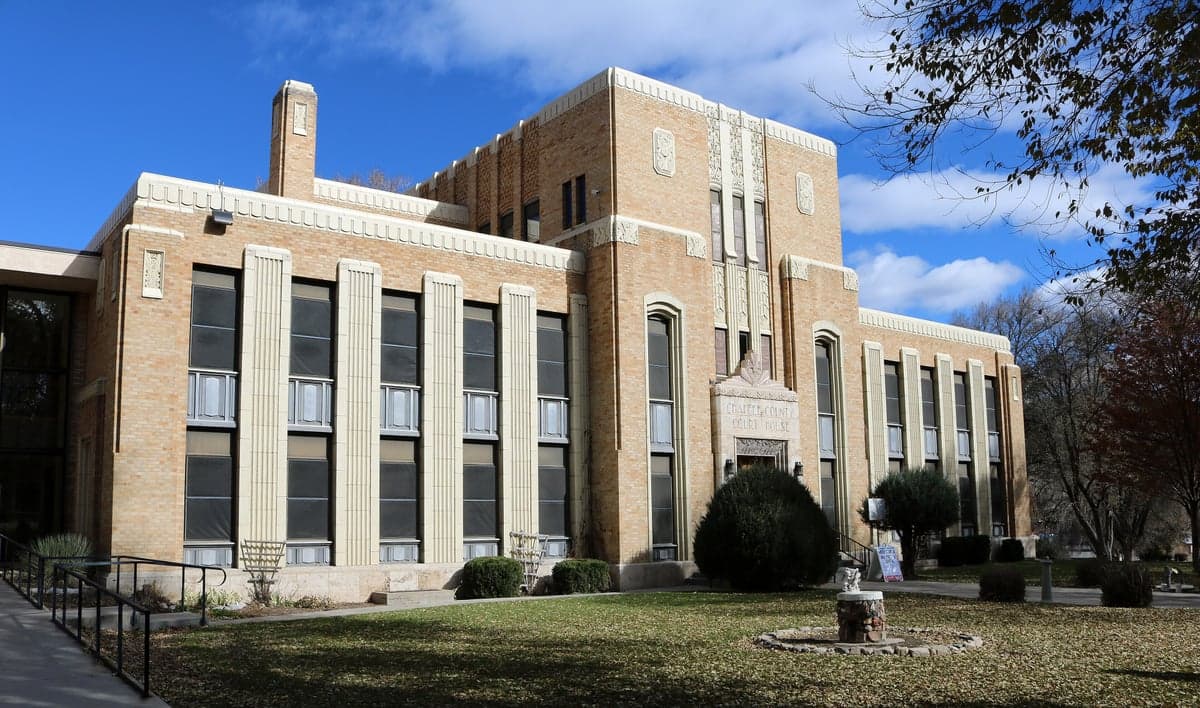
Photo: Wikipedia
Demographics of Chaffee County
Affluence Level in Chaffee County
A middle-class area roughly in line with national averages across income, home values, education, and employment.
People of Chaffee County
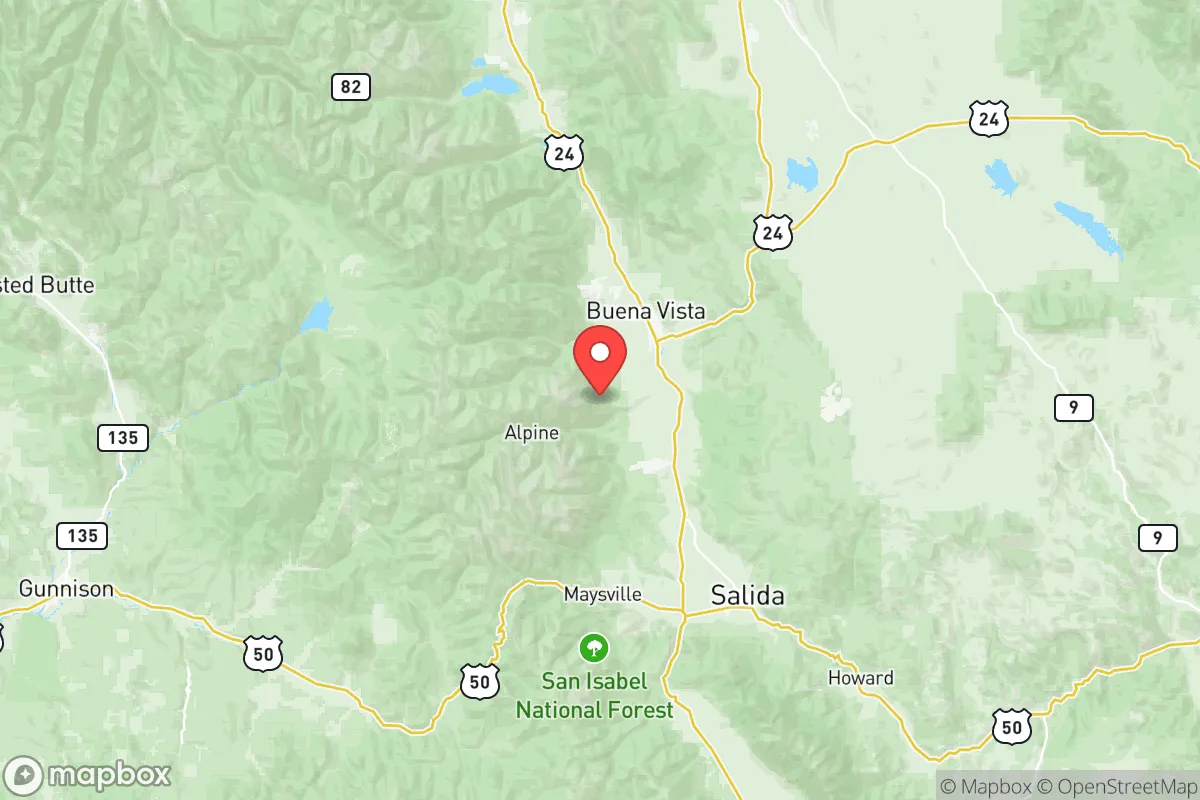
Today, the people of Chaffee County, Colorado — numbering approximately 19,876 residents — are predominantly white (84.5%), with a notable Hispanic minority (9.7%) and very small Black (1.0%) and East/Southeast Asian (0.7%) populations. The county is far less diverse than the state average, with a foreign-born share of just 1.6% compared to Colorado’s 10.7%. Distinctive markers include a high education level — 45.4% of adults hold a bachelor’s degree or higher — and a strong outdoor-recreation identity centered on the Arkansas River, the San Isabel National Forest, and the towns of Salida, Buena Vista, and Poncha Springs, which anchor a population that skews older and more politically independent than typical Colorado resort counties.
Settlement & growth (pre-1960)
Long before European arrival, the Ute people — specifically the Tabeguache (Uncompahgre) band — used the Arkansas River Valley and the mountain passes of Chaffee County as seasonal hunting and travel corridors. They called the area home for centuries, with summer camps near present-day Salida and Buena Vista. Spanish expeditions passed through as early as the 1770s, and the 1820s brought French and American fur trappers, but no permanent non-Native settlement took hold until after the 1848 Treaty of Guadalupe Hidalgo and the 1858 Pike’s Peak Gold Rush.
The first real population wave was a rush of Anglo-American prospectors and miners in the early 1860s, drawn by placer gold strikes along the Arkansas River and its tributaries. Towns like Granite (founded 1865), Nathrop (settled 1866), and St. Elmo (established 1880) boomed as supply hubs for nearby mining camps. The 1880 census recorded about 6,000 residents, nearly all native-born whites from Midwestern and Northeastern states. The railroad arrived in 1880 via the Denver & Rio Grande, linking the county’s smelters in Salida to national markets and transforming the town into a rail and smelting center. By 1890, Salida had over 3,000 people, making it the county’s largest settlement.
A second wave arrived between 1890 and 1910, driven by hard-rock mining of gold, silver, lead, and zinc. This period brought immigrants from Cornwall, England (skilled miners who settled in Salida and Buena Vista), along with smaller numbers of Irish, Italians, and Germans. These groups clustered in modest neighborhoods near the smelters and mines, but ethnic enclaves never solidified as strongly as in Colorado’s coal-mining counties — the mining economy here was smaller and more transient. By 1910, the county population peaked at roughly 8,000 before a long decline began as mining operations consolidated and then largely shut down after World War I.
The 1920s through 1950s saw a slow population bleed, with many families leaving for Front Range cities like Denver or Pueblo. Agricultural and ranching families — largely of Northern European descent — remained in the valley, raising cattle and hay along the Arkansas. The county bottomed out at about 5,000 residents in the 1950s, with Salida as the only real town and Buena Vista fading as a farm supply center. No major Dust Bowl migration or post-war suburban boom reached Chaffee; it was largely bypassed by the 20th century’s demographic currents.
Modern era (post-1965)
The 1965 Hart-Cellar Act had little direct impact on Chaffee County — its foreign-born share remained below 2% through 2020, and the small Hispanic population has deep roots in the region rather than being a product of post-1965 immigration waves. Most growth since the 1970s has come from domestic migration: retirees, second-home buyers, and outdoor recreationists from the Front Range, California, and Texas.
Beginning in the 1970s, the Arkansas River’s reputation as a world-class whitewater rafting destination drew a wave of younger, counterculture-oriented migrants — river guides, artists, and back-to-the-landers — who settled in Salida’s downtown and in smaller communities like Poncha Springs and Maysville. This infusion diversified the county somewhat socially if not racially, bringing a liberal-leaning population that has created a cultural tension with the more traditional ranching families and conservative-leaning retirees who arrived later.
From the 1990s through the 2010s, amenity migration accelerated. Retirees and telecommuters from Denver, Boulder, and out of state purchased homes in Buena Vista and along the county’s Highway 24 corridor, drawn by the lower cost of living relative to Summit County and the access to hiking, skiing (at Monarch Mountain), and hot springs. The Hispanic population — historically tied to agricultural work in the river valley — grew from about 5% in 1990 to nearly 10% by 2020, with most families concentrated in Salida’s working-class neighborhoods and in mobile home parks scattered along U.S. 50. The Black and Asian populations have remained negligible, held under 1.5% combined, as the county’s rural character and lack of diverse employment opportunities have not attracted significant non-white migration.
Suburbanization in the modern era has been minimal — Chaffee has no suburban subdivisions comparable to those in Front Range counties. Instead, growth has taken the form of scattered rural residential developments on former ranchland between Salida and Poncha Springs, and along the Arkansas River corridor south of Buena Vista. The county’s population rebounded to 19,876 by 2024, more than quadrupling from its 1950s low, but the cultural landscape remains bifurcated: a politically liberal, college-educated service sector anchored in Salida’s arts-and-recreation economy, and a more conservative, older, property-owning class concentrated in Buena Vista and the outlying valley.
The future
Chaffee County will likely continue to grow at a moderate pace — projections suggest 22,000–24,000 residents by 2040 — driven by domestic migration rather than immigration. The county is becoming slightly more diverse over time, but the gains are incremental: the Hispanic share may rise to 12–14% as families age in place and younger Hispanic workers fill service roles in the tourism economy, while Black and East/Southeast Asian populations will probably remain below 2% each. The most visible shift is generational: the median age has climbed to roughly 48, and the county is attracting a growing number of remote workers and retirees who bring higher incomes and push up housing prices, making it harder for younger, local families — both white and Hispanic — to stay. This dynamic is creating a nascent cultural conflict between preserving the area’s working-class heritage and catering to newcomers’ amenity demands.
Newer residents are dispersing across the county rather than concentrating in a single enclave, although Poncha Springs has seen the fastest housing growth as a more affordable satellite of Salida. The county’s Hispanic families are geographically stable in Salida’s core and the agricultural bottomlands, while the white majority is increasingly sprawling into former ranch subdivisions. Chaffee’s identity — once a mining-and-ranching society with a counterculture overlay — is settling into that of a high-country amenity destination with moderate political competition and a population that values outdoor access, rural feel, and a manageable scale above all else.
For someone moving in now, Chaffee County remains a predominantly white, educated, and politically divided place where community cohesion still depends on shared use of the river and trails rather than ethnic or economic common ground. The county is not diversifying quickly, but it is becoming more expensive, more oriented toward remote work, and more likely to elect officials who prioritize land conservation and tourism infrastructure over extractive industry. It offers a stable, low-crime environment with strong schools in Salida and Buena Vista, but the housing market is tightening, and cultural friction between newcomers and long-timers is an ongoing undercurrent rather than an acute conflict.

* Values derived from national, state, county, city and local statistics and may differ in a specific area. Last updated: 2026-06-29T00:13:28.000Z
Narrative content on this page is AI-generated and may contain mistakes. Verify any details that matter before acting on them.
ReloMaps may earn a commission from affiliate links at no extra cost to you.

