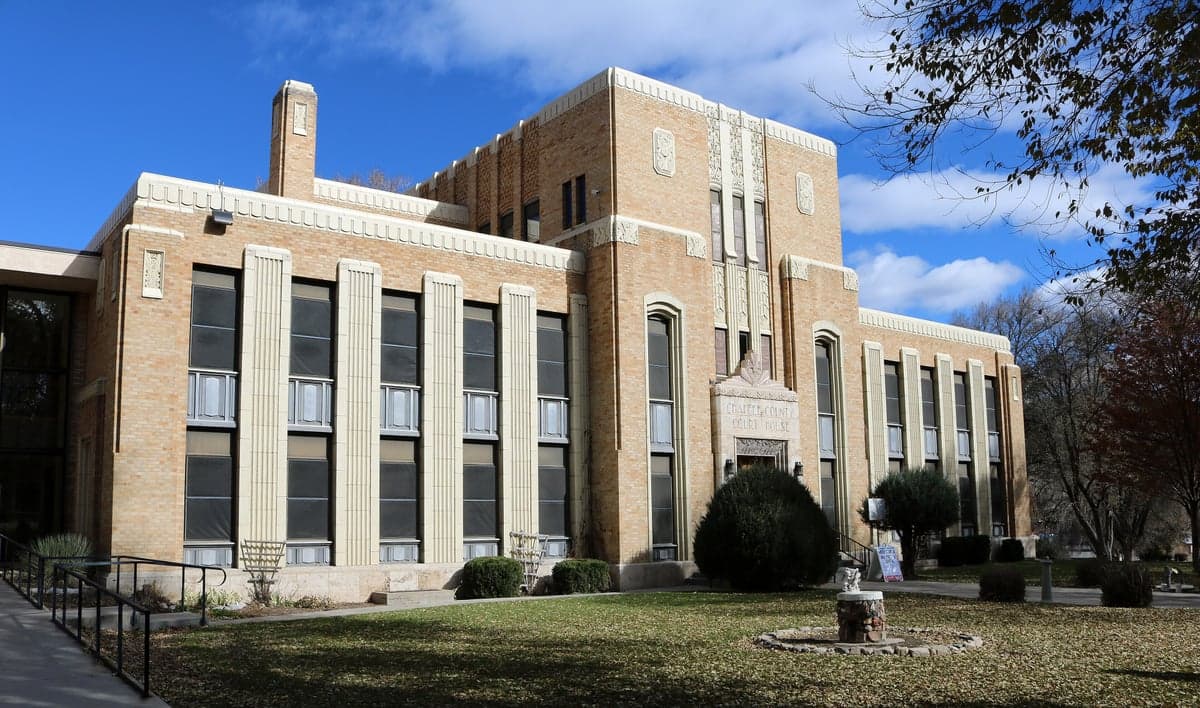
Photo: Wikipedia
Personal Sovereignty in Chaffee County
Viable for self-reliance. Generally workable, though some barriers may limit total independence.
What does Personal Sovereignty tell us?
Personal Sovereignty measures your capacity for self-reliance and independence with minimal government friction. Higher scores mean fewer barriers between you and the way you want to live... but it assumes you have the space you need and good neighbors.
What does this tell us?
Personal Sovereignty measures your capacity for self-reliance and independence with minimal government friction. Higher scores mean fewer barriers between you and the way you want to live... but it assumes you have the space you need and good neighbors.
State Policy
Energy independence: Net exporter (110% of energy produced in-state)
Personal Liberty
Homesteading

Personal Liberty Analysis
Chaffee County, Colorado, offers a notably high degree of personal sovereignty relative to the Front Range urban corridor, blending a strong Western libertarian ethos with the practical realities of high-altitude mountain living. The county seat of Salida and the smaller town of Buena Vista anchor a region where residents consistently demonstrate a preference for local control, lower taxes, and minimal government intrusion into daily life. While Colorado’s state-level framework imposes certain uniformities—particularly around water rights and building codes—Chaffee County’s local governance, zoning flexibility, and cultural norms create an environment where self-reliance is not just tolerated but expected. For individuals and families prioritizing autonomy, this area represents a meaningful alternative to the increasingly regulated Front Range, though the trade-offs include limited services and the necessity of personal preparedness.
Tax burden and regulatory posture: How Chaffee County compares to Colorado’s Front Range
Chaffee County’s tax burden is among the lighter in Colorado, a direct result of its rural character and voter-approved limits. The county’s property tax rate hovers around 0.49% of assessed value, significantly lower than Boulder County’s 0.73% or Denver’s 0.85%. This is partly due to the Gallagher Amendment’s legacy, which caps residential property tax at a fixed percentage of total state revenue, though the county’s lower home values amplify the effect. Sales tax in Salida is 8.0% (4.5% state, 1.0% county, 2.5% city), while Buena Vista’s combined rate is 7.5% and unincorporated areas like Nathrop or Poncha Springs sit at 6.5%—among the lowest in the state for a county with any services. Regulatory posture is similarly light-touch: Chaffee County has no countywide building code for residential structures under 5,000 square feet, though Salida and Buena Vista enforce the 2021 International Residential Code within town limits. This means a family building a home on 35 acres near Maysville can largely self-certify structural plans, a stark contrast to the permitting gauntlet in Jefferson County. The county’s land use code is permissive for agricultural and rural residential uses, with no urban growth boundary or mandatory inclusionary zoning—a deliberate choice reflecting voter rejection of such measures in 2018.
Self-defense and gun law specifics: What residents can expect in Chaffee County
Chaffee County is a strong Second Amendment area, with local culture and law enforcement aligned with permissive carry and use policies. Colorado is a shall-issue state for concealed carry permits, and Chaffee County’s sheriff’s office processes applications with a typical turnaround of 30-45 days—faster than Denver’s 90-day average. The county has no local ordinances restricting magazine capacity, firearm storage, or carry in parks, unlike the bans in Boulder or Denver. Open carry is legal without a permit throughout the county, including in Salida and Buena Vista, though private businesses may post signage. Use-of-force law follows Colorado’s Make My Day statute, which provides a legal presumption of reasonable fear when using deadly force against an unlawful intruder inside a residence. For defensive gun use outside the home, the state’s Stand Your Ground law applies, with no duty to retreat in any place where the person has a legal right to be. The sheriff’s office publicly states it will not enforce federal firearm regulations it deems unconstitutional, a stance shared by the county commissioners. Shooting ranges are accessible: the Chaffee County Shooting Range near Salida offers public rifle and pistol lanes, and BLM land south of Monarch Pass allows dispersed target shooting with standard safety precautions.
Self-reliance and homesteading viability: Lot sizes, zoning, and off-grid feasibility
Homesteading and off-grid living are genuinely viable in Chaffee County, particularly outside the incorporated towns. Minimum lot sizes in the county’s Agricultural (A) zone are 35 acres, while Rural Residential (RR) zones require 5 acres—both far larger than the quarter-acre lots typical in suburban Front Range counties. This acreage supports well-and-septic systems, livestock, and small-scale agriculture. Off-grid feasibility is high: Colorado law allows private wells for domestic use on parcels of 35 acres or more, and Chaffee County does not require connection to municipal water or sewer. Solar panels are permitted by right in all zones, with no county-level restrictions on battery storage or grid disconnection. The county’s building department does not mandate energy code compliance for off-grid structures, though Salida and Buena Vista require permits for electrical work. Composting toilets are legal under state health department guidelines, and rainwater collection is unrestricted for non-potable uses. Areas like Johnson Village and Smeltertown have a mix of off-grid cabins and full-time homesteads, while the Arkansas River Valley near Buena Vista offers irrigated pasture land for those with senior water rights. The primary constraint is water: new wells on parcels under 35 acres require a permit from the Colorado Division of Water Resources, and the Arkansas River Basin is fully appropriated, meaning new surface water diversions are nearly impossible. Winter access is another factor—county-maintained roads are plowed, but private driveways over 500 feet are the owner’s responsibility.
Personal liberties: Parental rights, medical autonomy, speech, and property
Chaffee County’s culture and local governance support a broad interpretation of personal liberties, particularly in areas where state law allows local discretion. Parental rights are strong: the county’s school board in Salida has resisted state-level curriculum mandates, and the Buena Vista School District allows parents to opt children out of any sex education or health instruction without a hearing. Medical autonomy is respected, with no county-level vaccine mandates for public employees or businesses, and the sheriff’s office has publicly stated it will not assist in enforcing federal public health orders it considers overreach. Speech protections are robust—the county has no hate speech ordinances or permit requirements for public assemblies, and the Salida City Council has rejected proposals to restrict amplified sound or protest times. Property rights are protected by Colorado’s Lucas v. South Carolina Coastal Council precedent, and Chaffee County has no transfer tax, rent control, or inclusionary zoning. The county’s comprehensive plan explicitly states that “private property rights shall not be abridged without just compensation,” a clause that has been cited in disputes over trail easements. However, property owners near the Arkansas Headwaters Recreation Area face federal easement restrictions on river access, and historic mining claims near St. Elmo can complicate title insurance. Overall, the county’s legal framework and cultural norms tilt heavily toward individual discretion, with the caveat that high-altitude living demands self-sufficiency—emergency services are limited, and cell coverage is spotty in the San Isabel National Forest areas.
In the broader Colorado context, Chaffee County ranks among the top quintile for personal sovereignty, comparable to rural counties like Park or Hinsdale but with better infrastructure and a more active civic culture. The absence of countywide building codes, the permissive gun environment, and the feasibility of off-grid homesteading on 5-35 acre parcels create a genuine alternative to the regulatory density of the Front Range. For the reader prioritizing autonomy, the trade-offs are clear: lower taxes and fewer rules come with a requirement for personal preparedness, from winter road maintenance to wildfire mitigation. The county’s political balance—roughly 45% Republican, 40% Democratic, 15% unaffiliated—produces a pragmatic governance style that avoids extremes, making it a stable choice for those who value freedom without isolation.

* Values derived from national, state, county, city and local statistics and may differ in a specific area. Last updated: 2026-06-29T00:13:28.000Z
Narrative content on this page is AI-generated and may contain mistakes. Verify any details that matter before acting on them.
ReloMaps may earn a commission from affiliate links at no extra cost to you.

