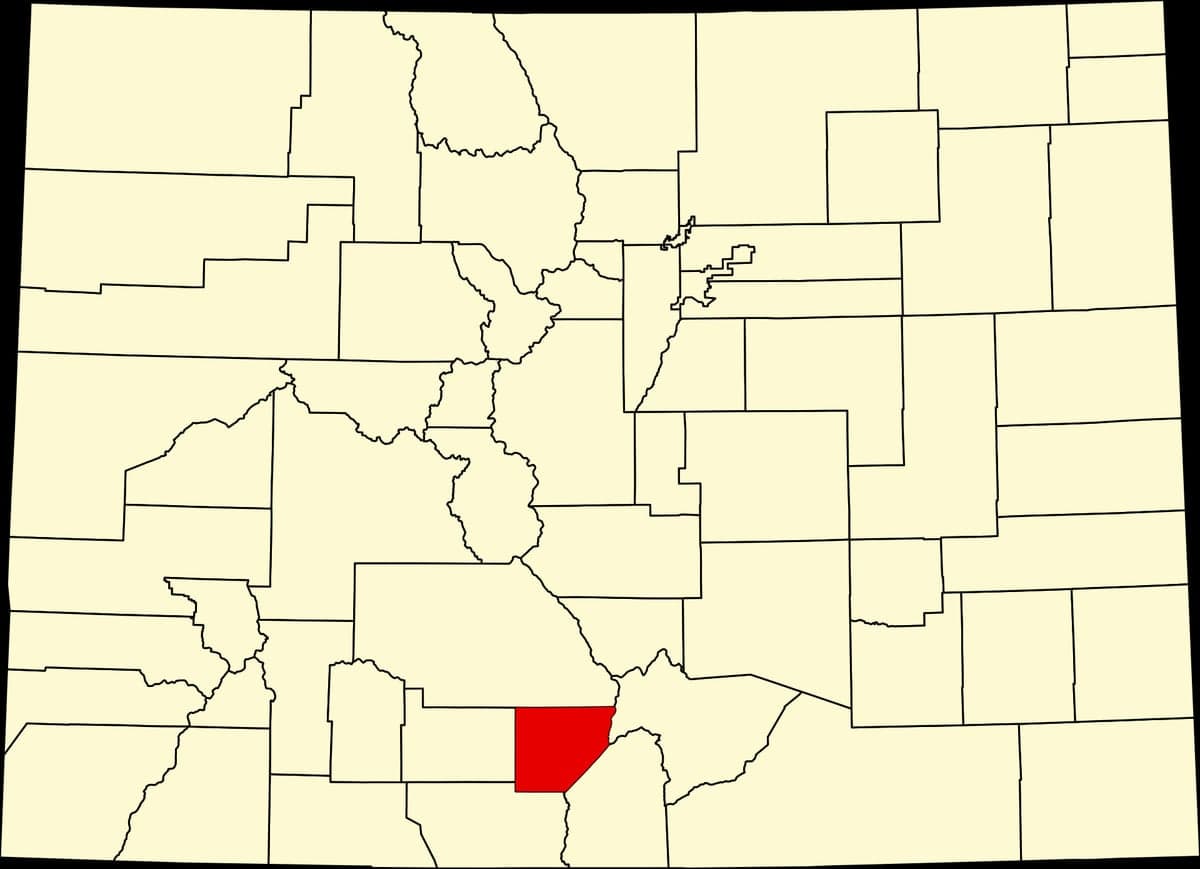
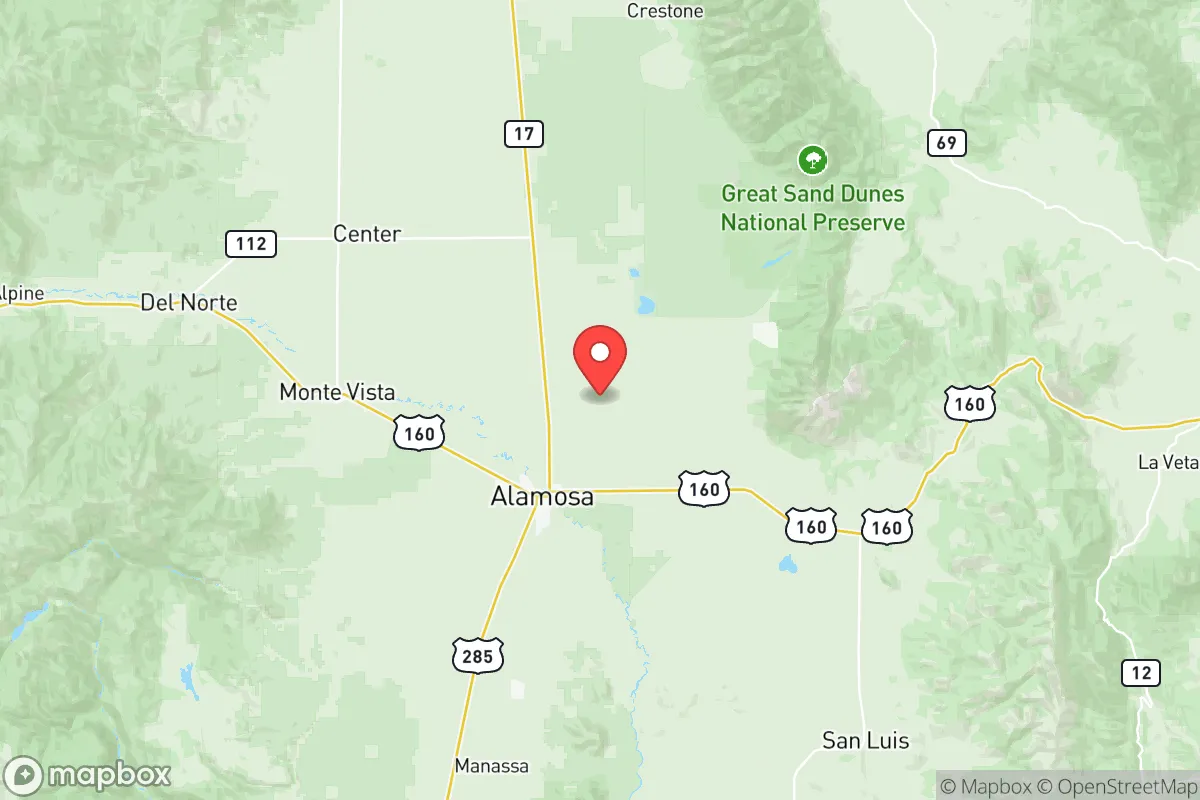
Photo: Wikipedia
Political ClimatePolitical Climate in Alamosa County
Showing district-level results — no local-only data available.
Local Political AnalysisPolitical Analysis of Alamosa County
Alamosa County is a political outlier in Colorado, leaning Republican with a Cook PVI of R+5 while the state as a whole has shifted decisively blue at D+6. This isn't a deep-red stronghold, though—it's a classic swing county where local dynamics, especially in the city of Alamosa itself, create a more nuanced picture than the partisan label suggests. The county has been drifting rightward over the past decade, but the margin is thin enough that both parties compete seriously here, making it one of the few places in Colorado where a single precinct can flip an election.
How it compares
The gap between Alamosa County's R+5 and Colorado's D+6 is a staggering 11 points, one of the widest such splits in the state. This means Alamosa County votes about as Republican as the rest of the country leans Democratic. Within the county, the city of Alamosa—home to Adams State University—is the blue anchor, with precincts around campus and the downtown core consistently voting Democratic by 10-15 points. In contrast, the rural towns of Mosca and Hooper in the northern part of the county are reliably Republican, often voting +20 to +30 points red. The swing precincts are in the unincorporated areas south of Alamosa, near the Rio Grande, where independent and split-ticket voters decide close races. Statewide, Colorado's blue shift is driven by the Front Range, but Alamosa County's agricultural base and lower population density keep it more aligned with the conservative-leaning San Luis Valley as a whole.
What this means for residents
For conservative residents, the county's R+5 lean means local offices—county commissioners, sheriff, and school board—are typically held by Republicans, and policy tends to favor limited government and agricultural interests. However, they live in a state where Democratic governors and legislatures have passed gun control measures, renewable energy mandates, and expanded Medicaid, creating a constant tension between local preferences and state law. For liberal residents, the city of Alamosa offers a progressive bubble with a strong arts scene and active environmental groups, but they face uphill battles on county-level issues like land-use regulations and water rights. The practical effect is that both sides must engage in coalition-building to get anything done, which fosters a more pragmatic, less polarized local politics than in many other Colorado counties.
Culturally, Alamosa County stands apart from the rest of Colorado in its strong Hispanic heritage—roughly 45% of the population identifies as Hispanic or Latino—which shapes political discourse around immigration, water access, and rural healthcare in ways that don't always align with national party lines. The county's economy is anchored by agriculture (potatoes, alfalfa, and cattle) and Adams State University, so policy debates often center on water rights, federal land management, and higher education funding rather than the tech or tourism issues dominating the Front Range. This creates a distinct political identity: more socially conservative than the state average on issues like gun rights and property taxes, but more pragmatic on immigration and public land access. For anyone moving here, the key takeaway is that Alamosa County is a place where your vote truly matters—local elections are often decided by a few hundred votes, and the county's swing nature means neither party can take it for granted.

State Political ClimatePolitical Climate in Colorado
State Political AnalysisPolitical Environment in the State
Colorado is a classic swing state turned solidly blue, with a Cook Partisan Voting Index of D+6, meaning it leans about six points more Democratic than the national average in presidential elections. The state hasn't voted for a Republican for president since George W. Bush in 2004, and that shift has accelerated dramatically over the last two decades. What was once a purple state defined by libertarian-leaning Western independence is now a state where Democrats control the governorship, both chambers of the legislature, and every statewide office—a reality that has reshaped everything from tax policy to gun laws.
Urban vs. rural divide
The political map of Colorado is a textbook case of the urban-rural split, but with a twist: the urban corridor is so dominant it overwhelms the rest of the state. The Denver metro area—including Denver proper, Aurora, Boulder, Lakewood, and the sprawling suburbs of Jefferson County—contains roughly 60% of the state's population and votes overwhelmingly Democratic. Boulder County is one of the bluest counties in the nation, routinely giving Democrats 75-80% of the vote. The Colorado Springs area (El Paso County) is the state's major conservative stronghold, home to Focus on the Family and a heavy military presence from Fort Carson and the Air Force Academy, but its population of about 750,000 is simply outmatched by the Front Range urban core. The Western Slope, including Grand Junction and Montrose, leans Republican but is sparsely populated. The real story is the suburban shift: Jefferson County (west of Denver) and Arapahoe County (southeast of Denver) were reliably red as recently as 2012 but have flipped blue, driven by college-educated professionals moving in from out of state. Weld County, north of Denver around Greeley, remains a deep-red outlier, voting +30 R in 2024, but its growth is slower than the blue-leaning Front Range.
Policy environment
Colorado's policy environment is a mix of moderate-left governance with some unique wrinkles. The state has a flat income tax rate of 4.4% (set by the Taxpayer's Bill of Rights, or TABOR, which requires voter approval for tax increases and caps revenue growth). Property taxes are relatively low compared to Texas or the Northeast, but recent legislation has increased them for commercial properties. The regulatory posture is generally business-friendly for tech and renewable energy, but strict on oil and gas—the 2019 Senate Bill 181 gave local governments more control over drilling and tightened environmental oversight, a major blow to the industry. Education policy is a flashpoint: Colorado has a school choice system with charter schools and open enrollment, but per-pupil funding remains below the national average, and the state has seen teacher strikes over pay. Healthcare is heavily regulated, with a state-run insurance exchange and Medicaid expansion under the Affordable Care Act. Election laws are among the most accessible in the country: Colorado automatically mails a ballot to every registered voter, offers same-day registration, and has robust early voting. This system is popular across party lines, though it has drawn criticism from some conservatives who worry about ballot security.
Recent policy direction
The last five years have seen Colorado's legislature move aggressively on a range of hot-button issues. On guns, the state passed a 2023 law banning the sale of "assault weapons" (defined broadly to include many semi-automatic rifles) and raising the purchase age to 21, plus a 2024 law imposing a waiting period and requiring safe storage—making Colorado one of the strictest states for gun rights. On parental and education rights, the state has moved in the opposite direction from red states: a 2023 law prohibits school boards from banning books, and a 2024 law requires schools to adopt policies supporting transgender students, including allowing them to use preferred names and pronouns without parental consent. On speech, Colorado has a strong shield law for journalists but has also passed anti-SLAPP protections. On privacy, the Colorado Privacy Act (effective 2023) gives residents control over their personal data, one of the strongest state laws in the nation. On medical and bodily autonomy, Colorado has no gestational limit on abortion and requires insurance to cover it, and a 2024 law protects providers from out-of-state lawsuits. On property rights, the state has tightened short-term rental regulations in mountain towns like Breckenridge and Vail, and a 2024 law limits rent increases to 10% annually statewide. On voting, the state has expanded mail-in voting and automatic registration, but a 2024 law also added signature verification requirements to address security concerns.
Civil unrest & political movements
Colorado has seen its share of political flashpoints. The 2020 protests in Denver over George Floyd's murder were large and occasionally violent, leading to property damage and a lasting debate over police reform. The state has a significant organized activist presence on both sides: the Colorado Democratic Party is well-funded and coordinated, while conservative groups like the Colorado Republican Party and the Independence Institute are active but often fractured. Immigration politics are heated: Denver has been a sanctuary city since 2019, and the state has a 2023 law limiting cooperation with federal immigration enforcement. In 2023-2024, the city saw a surge of migrants bused from Texas, straining shelter resources and sparking backlash. There have been secessionist murmurs in rural counties—Weld County and others have floated the idea of forming a 51st state called "North Colorado"—but it's mostly symbolic. Election integrity controversies flared after 2020, with some rural counties demanding hand recounts, but no widespread fraud was found. The most visible flashpoint for a new resident would be the constant tension between the urban liberal corridor and the rural conservative hinterlands, visible in everything from license plate slogans to local news coverage.
Projection
Over the next 5-10 years, Colorado is likely to become more Democratic, not less. In-migration is heavily skewed toward college-educated professionals from blue states like California and Illinois, who tend to vote Democratic. The Front Range population is growing faster than the rest of the state, and the Republican stronghold of Colorado Springs is growing more slowly and becoming slightly more moderate as tech workers move in. The state's Democratic supermajority is likely to hold, and further leftward moves on gun control, environmental regulation, and social policy are probable. However, the state's TABOR amendment creates a fiscal ceiling that moderates tax increases, and the growing cost of living—especially housing in Denver and mountain towns—could create a backlash. A conservative relocator should expect to be in a permanent minority, but with strong local representation in places like Colorado Springs, Weld County, and the Western Slope. A liberal relocator should expect a friendly environment that continues to push the envelope on progressive policy.
For a new resident, the bottom line is this: Colorado is a blue state with a red minority that is loud but shrinking. If you're conservative, you'll find like-minded communities in Colorado Springs, Pueblo (a blue-collar swing area), and rural towns, but you'll be swimming against the current on state policy. If you're liberal, you'll find a state that largely aligns with your values, especially on environmentalism, social issues, and voting access. The practical takeaway is that your experience will depend heavily on where you live—the difference between Boulder and Grand Junction is as stark as the difference between two different states.
* Values derived from national, state, county, city and local statistics and may differ in a specific area. Last updated: 2026-07-10T08:40:33.000Z
Narrative content on this page is AI-generated and may contain mistakes. Verify any details that matter before acting on them.
ReloMaps may earn a commission from affiliate links at no extra cost to you.

