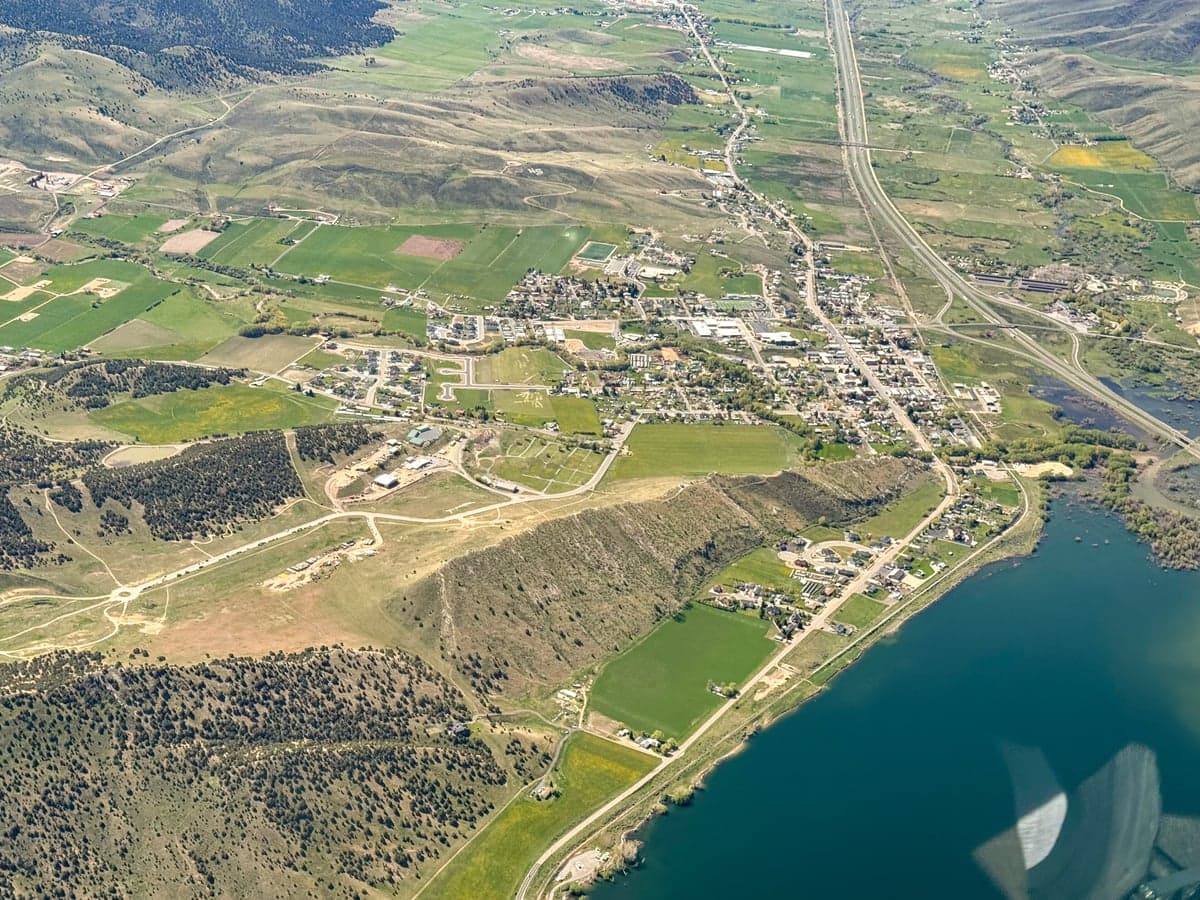
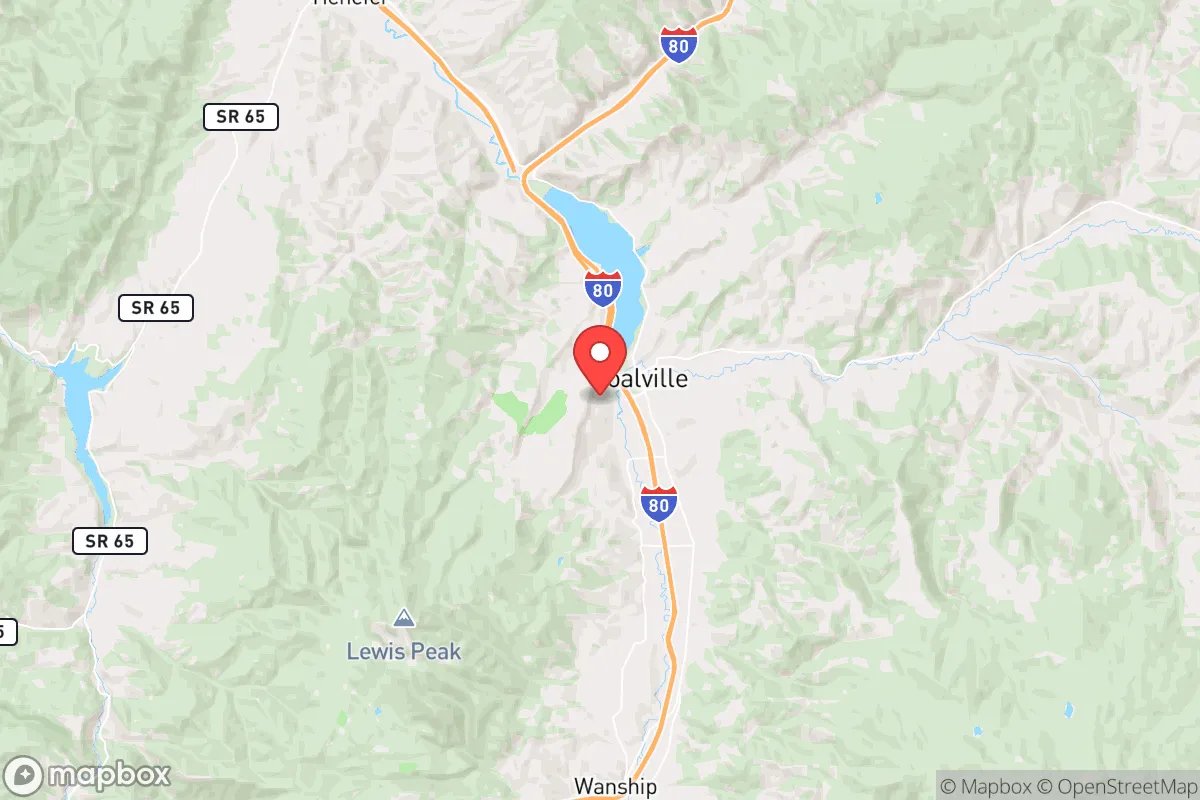
Photo: Wikipedia
Political ClimatePolitical Climate in Coalville, UT
District shown is the primary district for this city’s centroid. Cities may span multiple districts.
Inherited from parent county — no local data available.
* Lean and PVI are calculated from the surrounding county’s 2020 and 2024 presidential results, Cook-style — a finer measure here than its congressional district (UT-3).
Political rankings in Utah
- Most Conservative Cities in Utah
- Most Liberal Cities in Utah
- Best Liberal-Leaning Towns in the Mountain West
- Safest Liberal-Leaning Towns in the Mountain West
- Safest Conservative-Leaning Cities in the Mountain West
- Affordable Small Towns for Conservatives
- Most Affordable Liberal-Leaning Small Towns in the U.S.
- Safest Conservative-Leaning Cities in the U.S.
- Most Conservative Counties in Utah
- Most Liberal Counties in Utah
Local Political AnalysisPolitical Analysis of Coalville, UT
Coalville leans solidly Republican, with a Cook PVI of R+10 that mirrors the deep-red character of Summit County’s rural north. The town’s political trajectory has been remarkably stable over the past decade—unlike the explosive growth and ideological shifts seen in Park City just 20 miles south, Coalville has remained a conservative stronghold where registered Republicans outnumber Democrats by roughly 4 to 1. The 2024 presidential election saw Summit County as a whole split nearly 50-50, but Coalville’s precincts delivered a comfortable 65-70% margin for the GOP candidate, a pattern that has held since at least 2016. This isn’t a place that’s trending purple; it’s a place that’s staying red while the rest of the county gets bluer.
How it compares
Utah as a state carries a Cook PVI of R+11, making Coalville’s R+10 nearly indistinguishable from the statewide baseline. But the comparison gets interesting when you zoom in. The surrounding state of Utah, UT is a broad category—Salt Lake County, for instance, has drifted to R+5, while rural counties like Daggett or Piute push R+30. Coalville sits in a political sweet spot: it’s more conservative than Summit County’s western half (Park City, Snyderville Basin, which lean Democratic), but less conservative than neighboring Morgan County (R+20) or the ranching communities of Rich County to the north. In practice, a Coalville voter’s experience aligns closely with the state’s median—think suburban Utah County (R+12) rather than the deep-red rural south or the liberal Wasatch Front enclaves. The town’s politics feel like a scaled-down version of the state’s: reliably Republican, but with a pragmatic, live-and-let-live edge that comes from sharing a county with one of the West’s most liberal ski towns.
What this means for residents
For conservative residents, Coalville offers a comfortable political home where local offices—mayor, city council, county commission—are held by Republicans who prioritize low taxes, gun rights, and limited regulation. The Summit County Commission, however, is split 3-2 Republican, with the two Democrats representing the Park City area, so conservative residents often feel their voice is diluted on county-level issues like land use and development. For liberal residents, Coalville can feel isolating: there’s no Democratic club, no progressive social scene, and local candidates rarely face serious primary challenges. That said, the town’s small size (population around 1,500) means politics rarely dominates daily life—neighbors help each other regardless of party, and the biggest local debates tend to be about water rights and school funding, not national culture wars. The real friction point is the cultural divide with Park City: Coalville residents often resent being lumped into “Summit County” policies on short-term rentals and environmental regulations that feel designed for the ski resort crowd, not for a working ranching community.
One cultural distinction that sets Coalville apart from much of Utah is its relationship with the LDS Church. While the state is roughly 55% Mormon, Coalville’s population is closer to 70-75% LDS, and the church’s influence is visible in everything from local holiday schedules to the social fabric. Non-Mormon residents—both conservative and liberal—sometimes describe feeling like outsiders, though the town’s small size means most people are known personally, which softens the divide. Looking ahead, the biggest political shift will likely come from development pressure: as the Wasatch Back grows, new residents from Salt Lake and Park City are buying up land, and if that trend accelerates, Coalville’s R+10 could inch toward R+5 within a decade. For now, though, it remains one of the most reliably conservative small towns in a reliably conservative state, with a political culture that prizes stability over change.

State Political ClimatePolitical Climate in Utah
State Political AnalysisPolitical Environment in the State
Utah is a deeply conservative state, with a Cook PVI of R+11 that has held steady for over a decade, but the reality on the ground is more layered than a single number suggests. The dominant political force remains the Church of Jesus Christ of Latter-day Saints (LDS Church), whose cultural influence shapes a distinct brand of pragmatic, family-focused conservatism. Over the last 20 years, the state has shifted from reliably red to a place where a growing libertarian streak and a rapidly diversifying population are creating new fault lines, even as the GOP holds a supermajority in the legislature.
Urban vs. rural divide
The political map of Utah is a story of two corridors. The Wasatch Front—anchored by Salt Lake City, Provo, and Ogden—is where the vast majority of the population lives and where the real political action happens. Salt Lake County, once a GOP stronghold, has been trending purple for a decade; in 2020, Joe Biden won it by 10 points, driven by a growing non-Mormon, younger, and more diverse population in the city proper and suburbs like Millcreek and Cottonwood Heights. Meanwhile, Utah County (home to Provo and Brigham Young University) remains one of the most reliably conservative large counties in the nation, often voting 70%+ Republican. The rural expanse—places like Moab, Cedar City, and the Uinta Basin—is overwhelmingly red, with many counties voting 80-90% GOP. The divide isn't just about party; it's about lifestyle. Urban voters in Salt Lake City care about transit, housing affordability, and environmental issues, while rural voters in St. George (the fastest-growing metro in the state) are laser-focused on water rights, land use, and federal overreach. The state legislature, dominated by rural and suburban Republicans, often clashes with Salt Lake City's more progressive mayor and city council.
Policy environment
Utah's policy environment is defined by low taxes and a hands-off regulatory approach, but with a strong social conservative overlay. There is no state income tax on Social Security benefits, and the flat income tax rate is a low 4.65%. Property taxes are among the lowest in the nation, though they vary significantly by county. The state has a right-to-work law and is a "shall-issue" state for concealed carry permits, with no permit required for open carry. On education, Utah funds its schools at the lowest per-pupil level in the country, but it also has a robust school choice system, including a new universal school voucher program (HB 215, passed in 2023) that gives every family access to state funds for private or homeschool expenses. Healthcare policy is a mixed bag: Utah expanded Medicaid under the Affordable Care Act in 2019, but the state also has some of the strictest abortion laws in the nation, with a near-total ban (trigger law) that took effect after the Dobbs decision, though it's currently blocked by court order. Election laws are moderately restrictive: voter ID is required, same-day registration is not available, and mail-in voting is universal (every active voter gets a ballot automatically). The state has a nonpartisan commission for redistricting, but the legislature retains final approval, leading to gerrymandering lawsuits.
Recent policy direction
The last five years have seen Utah accelerate in a distinctly conservative direction, but with a libertarian twist that surprises outsiders. On gun and self-defense law, Utah became a "constitutional carry" state in 2021, allowing adults to carry a concealed firearm without a permit. Parental and education rights have been a major focus: HB 261 (2024) bans diversity, equity, and inclusion programs at public universities, while HB 374 (2023) restricts how teachers can discuss gender identity and sexual orientation in classrooms. On speech and privacy, the state passed a landmark social media regulation law (SB 152, 2023) requiring parental consent for minors to use platforms like TikTok and Instagram, and it's currently defending a law that bans TikTok on state-owned devices. Medical and bodily autonomy is a flashpoint: the abortion trigger law is tied up in court, but the legislature has also passed a law (HB 467, 2023) banning gender-affirming care for minors, which is also being challenged. Property rights are strongly protected, with a state law (HB 166, 2022) that requires local governments to compensate landowners if zoning changes reduce property value by more than 20%. Taxation has moved steadily downward: the legislature cut the state income tax rate from 4.95% to 4.65% in 2023, with a trigger for further cuts if revenue targets are met. Voting and ballot access saw a tightening in 2024 with SB 54, which requires proof of citizenship for voter registration and bans the use of student IDs as voter ID—a move critics say targets young, transient voters in Provo and Salt Lake City.
Civil unrest & political movements
Utah is not a state known for street protests, but there have been notable flashpoints. The largest recent demonstrations were the 2020 Black Lives Matter protests in Salt Lake City, which drew thousands and led to a police reform package (HB 5001) that banned chokeholds and required body cameras. On the right, the "Sovereign Utah" movement—a loose coalition of anti-federal land control activists—has held rallies in Kanab and Moab, demanding the transfer of federal lands to state control. Immigration politics are relatively muted compared to border states, but there is a persistent tension: the state passed a "sanctuary city" ban in 2015 (HB 497), prohibiting local governments from adopting policies that limit cooperation with federal immigration enforcement, but Salt Lake City has resisted, leading to ongoing legal battles. Election integrity controversies have been minimal; Utah's universal mail-in voting system is widely trusted, though a 2022 audit found no significant fraud. The most visible political movement is the "Utah Compact" coalition—a bipartisan group that advocates for a pragmatic, business-friendly approach to immigration reform, reflecting the state's reliance on immigrant labor in construction and hospitality. A new resident would notice that political activism is generally polite and church-organized; you're more likely to see a "Vote Yes on Prop 2" sign in a front yard than a protest march.
Projection
Over the next 5-10 years, Utah's political trajectory is toward a more complex, less monolithic conservatism. The state is growing fast—adding about 50,000 people per year—and the new arrivals are disproportionately from California, Oregon, and Washington. These transplants tend to be moderate Republicans or independents who are fiscally conservative but socially more libertarian, especially on issues like marijuana legalization (medical use is legal, but recreational is not) and environmental protection. The Wasatch Front will continue to trend purple, with Salt Lake County likely becoming a swing county by 2030, while Utah County remains deeply red. The rural-urban divide will sharpen, especially over water allocation and housing development. The LDS Church's influence is slowly waning among younger generations, which could shift the cultural center of gravity on issues like LGBTQ rights and religious liberty. Expect the legislature to remain Republican-dominated, but with a growing faction of "liberty-minded" Republicans who push for tax cuts, school choice, and reduced government surveillance, even as they hold the line on social issues. A relocator moving in now should expect a state that is still very red, but where the conversation is increasingly about balancing growth with preservation, and where the old certainties are being quietly renegotiated.
For a new resident, the bottom line is this: Utah offers a stable, low-tax, family-friendly environment where conservative values are the default, but the political culture is less combative than in many other red states. If you're a conservative, you'll find a government that largely shares your priorities on taxes, education, and gun rights, though you may chafe at the state's heavy-handed approach to social media and alcohol sales. If you're a liberal, you'll find a vibrant, growing urban core in Salt Lake City that is increasingly progressive, but you'll be living in a state where your vote for state legislature and governor will likely be in the minority. The key is to understand that Utah's politics are not about red vs. blue in the national sense; they're about a unique blend of religious communitarianism, libertarian individualism, and pragmatic growth management. Pick your city wisely—Salt Lake City for urban energy, Provo for family-centric conservatism, St. George for retirement and outdoor access, or Ogden for a more affordable, blue-collar vibe—and you'll find a place that fits your political comfort zone.
* Values derived from national, state, county, city and local statistics and may differ in a specific area. Last updated: 2026-11-07T07:12:17.000Z
Narrative content on this page is AI-generated and may contain mistakes. Verify any details that matter before acting on them.
ReloMaps may earn a commission from affiliate links at no extra cost to you.

