
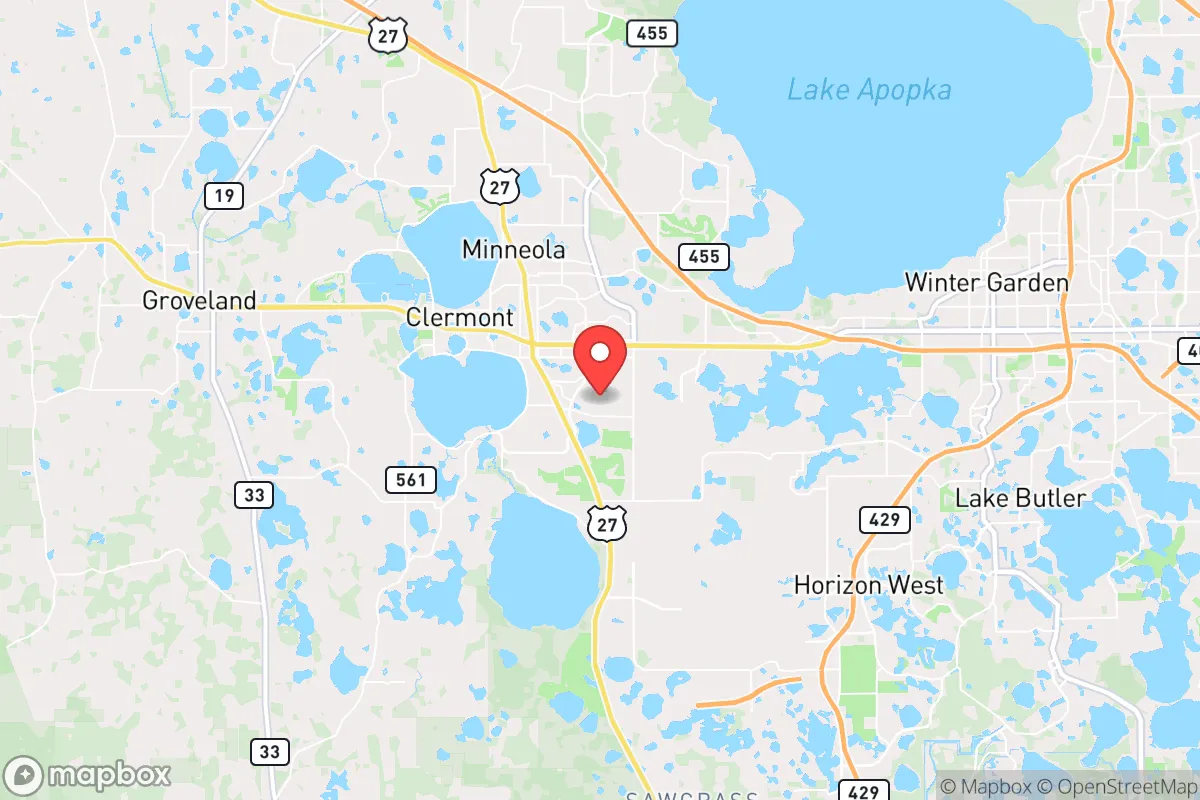
Photo: Wikipedia
Personal Sovereignty in Clermont, FL
Viable for self-reliance. Generally workable, though some barriers may limit total independence.
What does Personal Sovereignty tell us?
Personal Sovereignty measures your capacity for self-reliance and independence with minimal government friction. Higher scores mean fewer barriers between you and the way you want to live... but it assumes you have the space you need and good neighbors.
What does this tell us?
Personal Sovereignty measures your capacity for self-reliance and independence with minimal government friction. Higher scores mean fewer barriers between you and the way you want to live... but it assumes you have the space you need and good neighbors.
State Policy
Energy independence: Importer (12% of energy produced in-state)
Personal Liberty
Homesteading

Personal Liberty Analysis
Clermont, Florida, offers a personal sovereignty environment shaped by Florida’s strong preemption laws and a local culture that leans toward self-reliance, though it sits within a fast-growing Lake County where municipal regulations are tightening. Residents here enjoy broad state-level protections for gun rights, property use, and parental authority, but the city’s suburban expansion means homeowners face more zoning oversight than in rural parts of the county. For a relocation reader prioritizing autonomy, Clermont provides a solid baseline of freedom with the understanding that local ordinances—not state law—are the primary constraint on personal independence.
Tax burden and regulatory posture in Clermont and Lake County
Florida’s lack of a state income tax is the single biggest boost to personal sovereignty in Clermont. Residents keep 100% of their earned wages, and the state’s 6% sales tax (with a 1% local surcharge in Lake County, totaling 7%) applies broadly but exempts groceries and prescription drugs. Property taxes in Clermont run around 1.1% of assessed value, slightly below the national average, and Florida’s $50,000 homestead exemption reduces the taxable value for primary residences. The regulatory posture at the state level is deliberately light: no state-level property tax on business inventory, no estate tax, and a right-to-work law that prevents mandatory union membership. Locally, Clermont’s city government has become more active in land-use regulation as development accelerates. The city enforces a strict comprehensive plan with zoning codes that limit home-based businesses in residential areas and require permits for structures like sheds or fences over a certain height. Lake County itself is less restrictive than the city, but the unincorporated areas still enforce building codes and environmental regulations around the many lakes. For a reader who values minimal government interference, the state framework is excellent, but Clermont’s municipal layer adds moderate friction—especially compared to more rural Florida counties like Sumter or Levy.
Self-defense and gun law specifics in Clermont and Florida
Florida is a constitutional carry state as of July 2023, meaning any law-abiding adult 21 or older can carry a concealed firearm without a permit. This was a major shift that expanded personal sovereignty for self-defense. Open carry is generally prohibited except in limited circumstances like hunting or fishing, but the concealed carry allowance is broad. Florida also has a strong Stand Your Ground law, codified in statute, which removes any duty to retreat before using deadly force if a person reasonably believes it is necessary to prevent death or great bodily harm. Castle Doctrine protections extend to vehicles and occupied structures. Clermont itself has no local gun ordinances that exceed state law—Florida preempts firearm regulation entirely, so cities cannot ban guns in parks or impose waiting periods beyond what the state sets. The practical effect: a resident can carry a concealed firearm in most public spaces, including restaurants that serve alcohol (as long as not consuming), and can store firearms in vehicles on employer parking lots. The only notable restriction is that carrying into a school zone requires a valid concealed weapons license, which is still available for those who want reciprocity with other states. For a self-defense-minded individual, Clermont offers the full spectrum of Florida’s permissive gun laws with zero local interference.
Self-reliance and homesteading viability: lot sizes, zoning, and off-grid feasibility
Clermont’s character as a former citrus town has been largely replaced by master-planned subdivisions, which limits homesteading potential within city limits. Standard residential lots in newer developments range from 5,000 to 10,000 square feet, with homeowners associations (HOAs) governing many neighborhoods. HOAs in Clermont commonly restrict livestock, large gardens, clotheslines, and external structures, which directly conflicts with a self-reliant lifestyle. For readers seeking acreage and fewer restrictions, the unincorporated areas of Lake County east and north of Clermont—near Groveland, Mascotte, or along the Lake Apopka north shore—offer parcels from 1 to 10 acres with agricultural zoning that permits chickens, goats, and small-scale farming. Off-grid feasibility is limited by Florida’s building code, which requires connection to septic or sewer systems and compliance with energy codes, but solar panels are permitted and net metering is available through local utilities. Rainwater collection is legal for outdoor use but not for potable water without treatment. The county does not ban composting toilets outright, but they must meet health department standards. Overall, true off-grid living is not practical within Clermont city limits, but a 5-acre property in unincorporated Lake County offers a realistic middle ground for a self-reliant household that still wants proximity to Orlando’s job market.
Personal liberties: parental rights, medical autonomy, speech, and property
Florida has become a national leader in codifying parental rights in education. The Parental Rights in Education Act (often called the "Don't Say Gay" law by critics) gives parents explicit authority over their child’s health and education decisions, including the right to opt out of any curriculum or school activity. In Clermont, which is served by Lake County Schools, this translates to transparent curriculum review processes and parental notification requirements for any health services offered on campus. Medical autonomy is more mixed: Florida banned gender-affirming care for minors in 2023 and requires parental consent for most medical procedures, which aligns with a conservative view of family sovereignty, but the state also mandates vaccines for school attendance (with medical and religious exemptions available). Free speech is strongly protected under Florida’s constitution and state preemption laws that prevent local governments from regulating speech on public property. Property rights are reinforced by the Private Property Rights Protection Act, which requires government to compensate landowners if a regulation reduces property value by more than 50%. However, Clermont’s active code enforcement means that property use is monitored—untrimmed lawns, inoperable vehicles, and unpermitted structures can draw fines. For a reader who prioritizes personal liberties, the state provides a robust legal framework, but the local enforcement culture in Clermont is more interventionist than in less densely populated parts of Lake County.
Compared to other fast-growing Florida suburbs, Clermont offers a strong but not absolute personal sovereignty environment. The state’s tax-free income, constitutional carry, and parental rights laws create a high baseline of autonomy that surpasses most Northeastern or West Coast metros. The trade-off is that Clermont’s municipal governance and HOA prevalence add layers of restriction that a reader would not encounter in rural Lake County or in less developed parts of the state like the Panhandle. For a single individual or family who values freedom and is willing to choose a lot outside the city limits or in a less restrictive HOA, Clermont’s location—30 minutes from Orlando’s economy but with a small-town feel—makes it a viable choice. The key is to buy property strategically: avoid HOA-governed subdivisions if self-reliance is a priority, and target unincorporated parcels where county zoning is the only constraint.

* Values derived from national, state, county, city and local statistics and may differ in a specific area. Last updated: 2026-11-06T19:39:21.000Z
Narrative content on this page is AI-generated and may contain mistakes. Verify any details that matter before acting on them.
ReloMaps may earn a commission from affiliate links at no extra cost to you.

