
Photo: Wikipedia
Demographics of Clermont, FL
Affluence Level in Clermont, FL
A middle-class area roughly in line with national averages across income, home values, education, and employment.
People of Clermont, FL
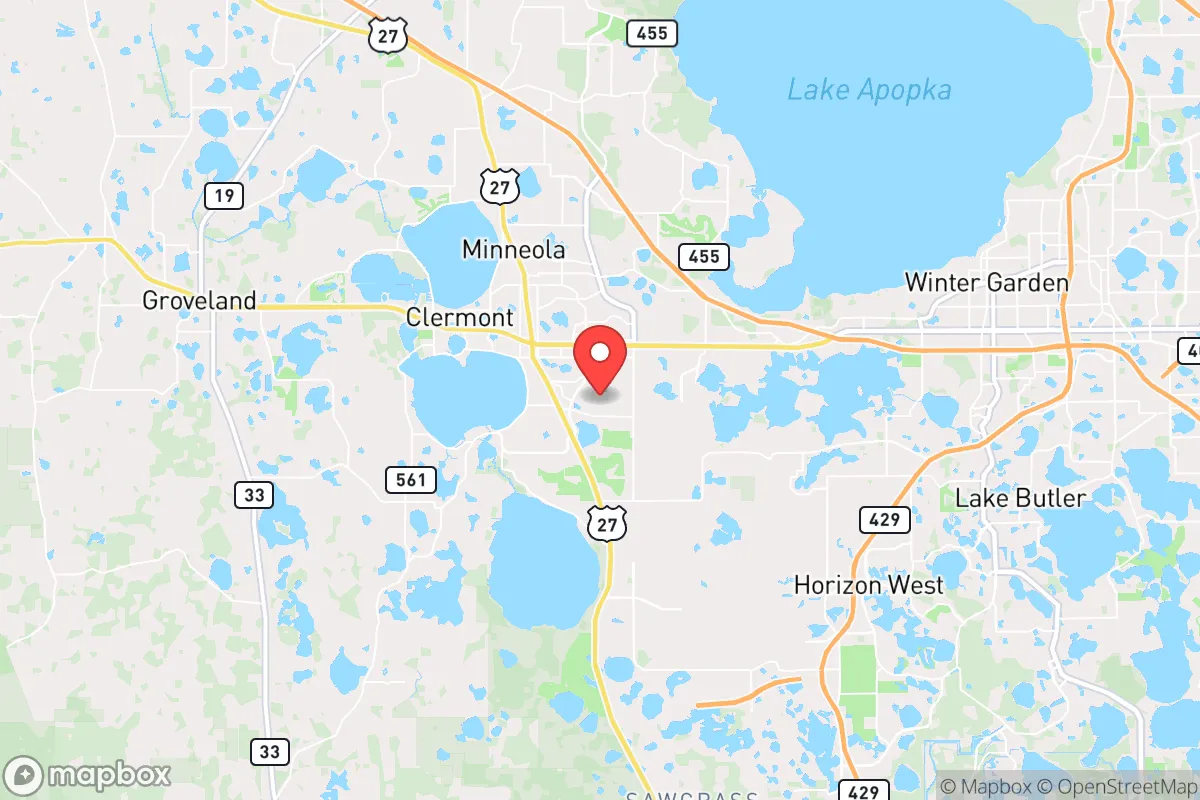
Clermont, Florida, is a rapidly growing city of 44,984 residents that has transformed from a small citrus and health-resort town into a diverse, family-oriented suburb of the Orlando metro area. The city’s population is notably diverse, with a White population of 49.3%, a Hispanic population of 23.8%, a Black population of 13.1%, and a significant Indian-subcontinent community at 2.9%, alongside East/Southeast Asian residents at 1.7%. With 35.7% of adults holding a college degree and a foreign-born share of 6.2%, Clermont today is a middle-class, politically moderate-leaning community defined by its lakefront setting, new housing developments, and a strong sense of civic identity rooted in its historic downtown.
How the city was settled and grew
Clermont’s original population was drawn by the promise of citrus farming and the area’s natural beauty, particularly the rolling hills and chain of lakes. The city was officially incorporated in 1916, but its first significant wave of settlers arrived in the 1880s, largely from the U.S. South and Midwest, attracted by land grants and the newly built railroad. These early residents were predominantly White, Protestant farmers and small business owners who established the Historic Downtown district as the commercial and social hub. By the early 20th century, Clermont gained a reputation as a health resort, drawing visitors with tuberculosis and other respiratory ailments to its dry, elevated climate. This led to the development of the Lake Minneola shoreline area, where sanatoriums and boarding houses catered to a transient population of Northerners seeking recovery. The citrus industry dominated until the devastating freezes of the 1980s, which effectively ended large-scale farming and prompted a shift toward residential development.
Modern era (post-1965)
The post-1965 era brought profound demographic change, driven by the Immigration and Nationality Act and the expansion of the Orlando metro economy. Clermont’s population began to diversify as new waves of domestic and international migrants arrived, attracted by affordable housing and proximity to Disney World and other employment centers. The South Clermont area, particularly around State Road 50, saw the construction of large subdivisions like Lake Louisa and Hartwood Reserve, which absorbed many of the new Hispanic and Black families moving from Puerto Rico, Central America, and other parts of Florida. The East Clermont corridor, near the Florida Turnpike, became a magnet for Indian-subcontinent professionals—many working in tech, healthcare, and hospitality—who established a visible community with cultural institutions and businesses. Meanwhile, the North Clermont neighborhoods, such as Cherry Lake, retained a predominantly White, older population, though they have seen gradual in-migration of younger families. The East/Southeast Asian population, while smaller, concentrated in newer subdivisions like Waterleigh, drawn by the area’s highly rated schools and suburban lifestyle. The city’s Black population, historically small, grew significantly after 2000, with many families settling in the South Clermont and Hartwood Reserve areas, reflecting broader patterns of African American suburbanization from Orlando.
The future
Clermont’s population is projected to continue growing rapidly, with the city’s comprehensive plan anticipating over 60,000 residents by 2040. The trend is toward increasing diversity, driven by continued domestic migration from the Northeast and Midwest, as well as international immigration from Latin America and South Asia. The Hispanic and Indian-subcontinent shares are expected to rise, while the White share will likely decline further, though it will remain the largest single group. New communities are concentrating in the South Clermont and East Clermont corridors, where large master-planned developments like Lake Louisa Reserve and Hartwood Reserve are adding thousands of homes. These areas are becoming more ethnically mixed, with a notable presence of young families and professionals. The city’s cultural identity is evolving from a quiet, historically White resort town to a dynamic, multi-ethnic suburb, though the historic downtown and lakefront areas retain a strong sense of heritage. The next 10-20 years will likely see Clermont become even more integrated into the Orlando metro’s economic and cultural fabric, with a population that is younger, more diverse, and more educated than its current profile.
For someone moving in now, Clermont offers a stable, family-oriented environment with good schools and a growing job base, but it is no longer the sleepy citrus town of the past. The city is becoming a genuinely diverse suburb where no single ethnic group dominates, and where new residents from many backgrounds are shaping the community’s future. The key is to choose a neighborhood that aligns with one’s lifestyle—whether the historic charm of downtown, the lakefront recreation of Lake Minneola, or the newer, more diverse subdivisions of South and East Clermont.

* Values derived from national, state, county, city and local statistics and may differ in a specific area. Last updated: 2026-11-06T19:39:21.000Z
Narrative content on this page is AI-generated and may contain mistakes. Verify any details that matter before acting on them.
ReloMaps may earn a commission from affiliate links at no extra cost to you.

