Photo: Wikipedia
Demographics of Chardon, OH
Affluence Level in Chardon, OH
A middle-class area roughly in line with national averages across income, home values, education, and employment.
People of Chardon, OH
Chardon, Ohio, is a predominantly white, family-oriented community of 5,246 residents, characterized by a high college attainment rate of 43.3% and a notably low population density that preserves its small-town, rural character. The city’s population is overwhelmingly non-Hispanic white (94.7%), with a very small Hispanic (2.0%) and Black (1.3%) presence, and a foreign-born population of 0.0%. This demographic profile reflects a community that has remained remarkably stable in its ethnic composition since its founding, with recent growth driven by domestic in-migration from other parts of Geauga County and the broader Cleveland exurbs rather than international immigration.
How the city was settled and grew
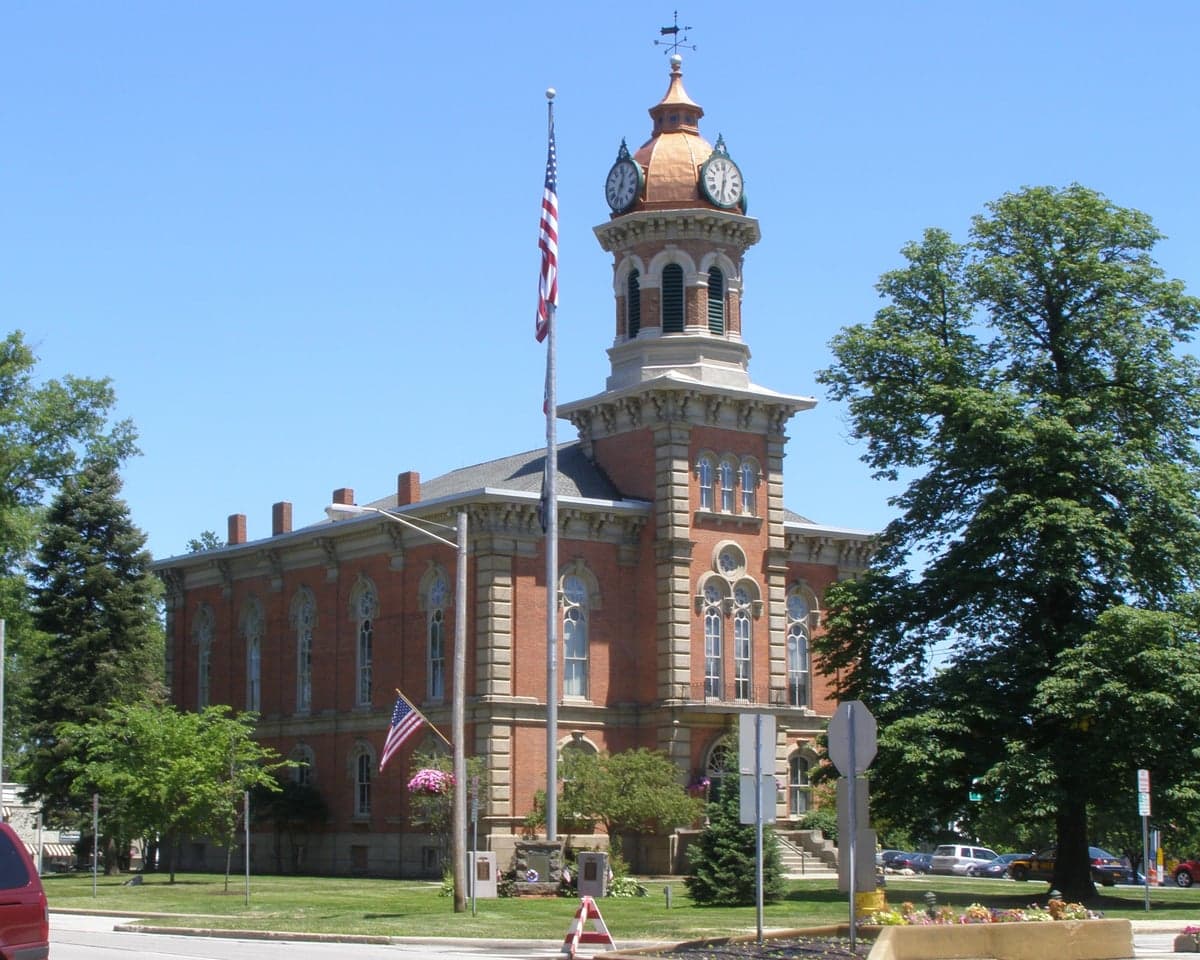
Chardon was founded in 1812 by a group of settlers from Connecticut, part of the Western Reserve land grant that drew New England families to northeastern Ohio. The original population was almost entirely of English and Scots-Irish descent, and they established the town around the public square, which remains the historic and commercial heart of the city. The earliest neighborhoods, such as Water Street and the area around Chardon Square, were built by these Yankee settlers, who constructed the iconic white-clapboard homes and the Geauga County Courthouse. The arrival of the railroad in the 1850s brought a second wave of European immigrants, primarily German and Irish, who settled in the South Street and North Street corridors, working in the town’s growing lumber and dairy industries. By the early 20th century, Chardon had become the commercial and governmental hub of Geauga County, with a population that was nearly 100% white and native-born, a pattern that persisted through the mid-20th century as the city’s economy shifted from agriculture to light manufacturing and professional services.
Modern era (post-1965)
Following the 1965 Hart-Cellar Act, Chardon saw virtually no change in its racial or ethnic composition, as the city’s distance from major urban centers and lack of industrial employment opportunities did not attract the new immigrant waves that reshaped cities like Cleveland or Akron. Instead, the post-1965 period was defined by domestic suburbanization, as families from Cuyahoga County and eastern Cleveland suburbs moved to Chardon for its lower crime rates, highly rated school system, and larger lots. This in-migration concentrated in newer subdivisions such as Maplewood Estates and Timber Ridge, which were developed on former farmland along the city’s eastern and southern edges. These neighborhoods remain predominantly white and middle-to-upper-middle-class, with home values significantly higher than the Geauga County median. The city’s Black and Hispanic populations, while small, are dispersed evenly across these newer subdivisions rather than concentrated in any single area, reflecting a pattern of low-density integration rather than ethnic clustering.
The future
Chardon’s population is projected to remain overwhelmingly white and native-born for the foreseeable future, with demographic change likely to come from continued domestic in-migration of families from the Cleveland metro area rather than international immigration. The city’s 0.0% foreign-born rate is among the lowest in Ohio, and there are no signs of this shifting, as the local economy—anchored by healthcare, education, and professional services—does not attract the labor-intensive industries that draw immigrant populations. The Hispanic and Black shares may increase slightly, but from a very low base, and these groups are expected to continue dispersing across the city’s newer subdivisions rather than forming distinct ethnic enclaves. The most significant demographic trend is the aging of the population, with a growing share of retirees choosing to age in place in established neighborhoods like Chardon Lakes and Preston Heights, while younger families are drawn to the more affordable new construction in the Woodin Road corridor.
For someone moving to Chardon now, the city offers a stable, low-diversity, family-oriented environment with strong schools and a high quality of life, but little cultural or ethnic variety. The population is becoming slightly older and more affluent, with new residents primarily coming from other parts of Geauga County and the eastern Cleveland suburbs. Chardon is not becoming more diverse in any meaningful sense; rather, it is solidifying its identity as a white, middle-class exurb where community life revolves around the historic square, local schools, and outdoor recreation. This makes it an attractive option for families seeking safety and stability, but less so for those looking for a multicultural or internationally connected community.

* Values derived from national, state, county, city and local statistics and may differ in a specific area. Last updated: 2026-06-16T09:56:04.000Z
Narrative content on this page is AI-generated and may contain mistakes. Verify any details that matter before acting on them.
ReloMaps may earn a commission from affiliate links at no extra cost to you.

