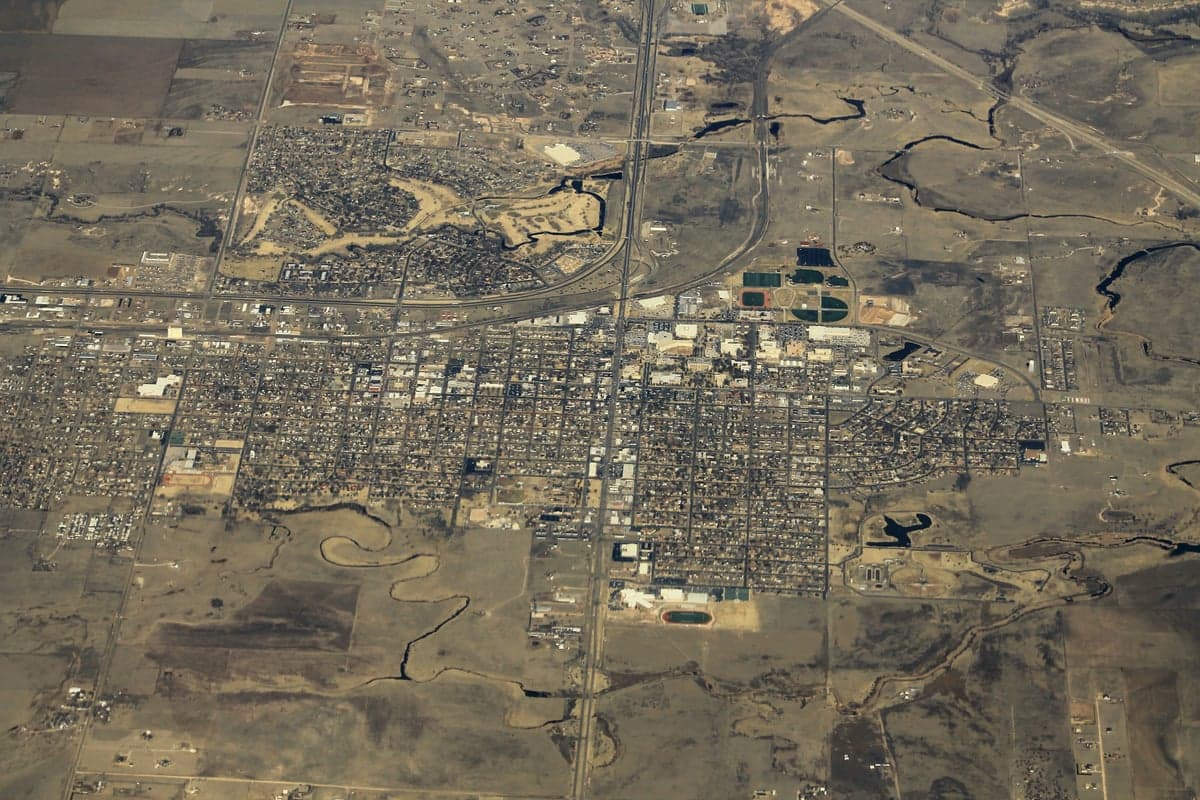
Photo: Wikipedia
Political ClimatePolitical Climate in Canyon, TX
District shown is the primary district for this city’s centroid. Cities may span multiple districts.
Local Political AnalysisPolitical Analysis of Canyon, TX
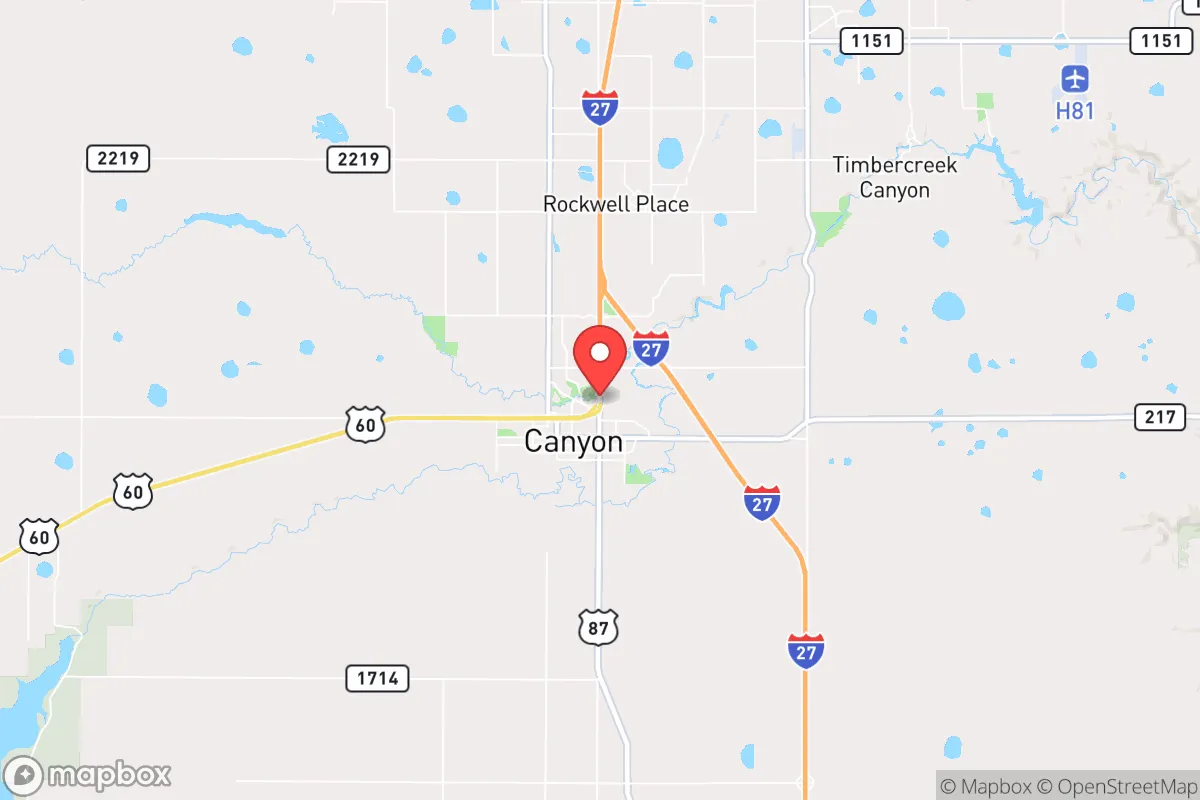
Canyon leans heavily Republican, with a Cook Partisan Voting Index of R+24 that places it among the most conservative corners of the Texas Panhandle. That number means the district votes about 24 points more Republican than the national average in presidential elections, and it's not a recent shift — this area has been reliably red for decades, with local races often decided in the GOP primary rather than the general election. The surrounding state of Texas as a whole doesn't have a single Cook PVI because it's so large and diverse, but for context, the statewide average in 2024 was roughly R+5 or R+6, meaning Canyon is dramatically more conservative than the state as a whole. If you're looking at a map of the Panhandle, Canyon sits in a deep red island that includes Amarillo to the north and extends west toward Hereford and Dumas, all of which vote similarly, while you'd have to drive east toward Childress or south toward Lubbock to find any real variation — and even those areas are still solidly Republican.
How it compares
The gap between Canyon and the rest of Texas is stark. In the 2024 presidential election, Randall County — where Canyon is the county seat — voted about 78% Republican, while Texas statewide landed around 56% Republican. That's a 22-point difference, and it's consistent down-ballot: state representatives from this district routinely win with 75-80% of the vote, while competitive statewide races in Texas are often decided by single digits. The nearest city that offers any political contrast is Amarillo, which is still Republican but slightly less so — Potter County (Amarillo's other half) voted about 68% Republican in 2024, a full 10 points less than Randall County. Go further south to Lubbock and you're back in similar territory, but head east to Childress or west to Dalhart and the numbers stay in the mid-70s. For a true political contrast, you'd need to drive about five hours to the Dallas-Fort Worth metroplex, where suburban Collin County is R+13 and urban Dallas County is D+25 — a world away from Canyon's political reality.
What this means for residents
For conservative residents, Canyon's political climate means their values are reflected in local policy without much friction. The city council, county commission, and school board all lean conservative, and issues like gun rights, property tax limits, and school choice tend to get a sympathetic hearing. For liberal residents, the reality is more isolating — there's no organized Democratic presence to speak of, and local elections are effectively decided in the GOP primary, so a progressive candidate has virtually no path to office. That said, Canyon is a college town (West Texas A&M University brings a younger, slightly more moderate population), so you'll find a small but visible contingent of left-leaning faculty and students who tend to keep their politics private in public settings. The practical effect is that political conversations in Canyon are generally homogeneous — you don't see the kind of yard sign wars or heated city council meetings you'd find in a purple suburb of Dallas or Houston.
Culturally, Canyon's conservatism comes with a strong libertarian streak — people here don't like being told what to do by Austin or Washington, and that sentiment crosses party lines. The city has resisted state-level housing mandates and has kept its own zoning relatively loose, which appeals to both conservative property-rights advocates and liberal-leaning residents who want affordable housing options. The biggest policy distinction from blue parts of Texas is probably in education: Canyon's school board has focused on local control and parental rights, while avoiding the culture-war battles that have consumed districts in Austin or Dallas. For a newcomer, the takeaway is simple: if you're conservative, you'll feel at home immediately; if you're liberal, you'll find a small community of like-minded people at the university and in the arts scene, but you'll need to accept that your vote won't change much in local races.

State Political ClimatePolitical Climate in Texas
State Political AnalysisPolitical Environment in the State
Texas has been a solidly Republican state for the past three decades, but the margin has been shrinking. In 2024, Donald Trump won the state by about 9 points, down from the 10-point margin in 2020 and the 16-point margin in 2012. The dominant coalition is still conservative, anchored by rural and exurban voters, but the state's explosive population growth—driven largely by transplants from California and the Northeast—is slowly shifting the ground beneath the GOP's feet. The long arc is a slow, uneven drift toward competitiveness, though Texas remains a state where Republicans control every statewide office and both chambers of the legislature.
Urban vs. rural divide
The political map of Texas is a study in contrasts. The big metros—Houston, Dallas-Fort Worth, San Antonio, and Austin—are the Democratic strongholds, with Austin being the bluest major city in the state. Harris County (Houston) and Dallas County have been reliably blue for years, while Tarrant County (Fort Worth) flipped to Biden in 2020 and stayed blue in 2024. Meanwhile, the rural and exurban counties are overwhelmingly red. Lubbock, Amarillo, and Midland-Odessa are deep red, with Republican margins often exceeding 40 points. The suburbs are the real battleground: places like Collin County (north of Dallas) and Denton County are still red but trending purple, while Williamson County (north of Austin) flipped blue in 2020. The Rio Grande Valley, once reliably Democratic, has shifted right, with counties like Starr and Hidalgo moving double digits toward the GOP in recent cycles.
Policy environment
Texas has no state income tax, which is the single biggest policy draw for relocators. Property taxes are high to compensate—among the highest in the nation—but the state offers a homestead exemption and a 10% cap on annual appraisal increases for homeowners. The regulatory posture is famously business-friendly: no state-level occupational licensing for many trades, weak union protections, and a tort reform system that caps non-economic damages in medical malpractice cases. Education policy is dominated by the school choice debate; the state has a private school voucher program that passed in 2023 after years of failure. Healthcare is a mixed bag: Texas has the highest uninsured rate in the country, having refused Medicaid expansion under the ACA. Election laws have tightened since 2021, with new voter ID requirements and restrictions on mail-in voting. The state also has a permitless carry law for handguns, passed in 2021, and a near-total abortion ban that took effect after the Dobbs decision.
Recent policy direction
The last few legislative sessions have pushed Texas sharply to the right on several fronts. The 2023 session saw the passage of SB 14, which bans gender-affirming care for minors, and SB 15, which restricts drag performances in public. On guns, the 2021 permitless carry law (HB 1927) allows adults to carry handguns without a license or training. On education, the 2023 voucher program (HB 1) provides state funds for private school tuition, though it faces ongoing legal challenges. Property rights were strengthened with the 2023 passage of SB 2039, which limits the ability of homeowners associations to restrict certain uses of property. On voting, SB 1 (2021) added new ID requirements for mail ballots, banned 24-hour and drive-through voting, and gave poll watchers more access. Privacy and surveillance saw a mixed bag: the state passed a data privacy law (HB 4390) in 2023, but also expanded the use of license plate readers by law enforcement. Medical autonomy is heavily restricted: the abortion ban has no exceptions for rape or incest, only for the life of the mother. On the tax front, the 2023 session passed a $18 billion property tax cut, funded by the state's budget surplus, which includes a higher homestead exemption and a temporary rate compression for school districts.
Civil unrest & political movements
Texas has seen its share of political flashpoints. The 2020 protests in Austin over George Floyd's death were among the largest in the country, leading to clashes between police and demonstrators and a subsequent backlash that fueled the 2021 "defund the police" debate. The state's border with Mexico is a constant source of tension: Governor Greg Abbott's Operation Lone Star, launched in 2021, has deployed state troopers and National Guard to the border, bused migrants to northern cities, and installed razor wire and buoys in the Rio Grande. This has led to legal battles with the Biden administration and a surge in immigration-related activism on both sides. The "Texas secession" movement, while loud on social media, has no serious political traction; a 2023 poll found only about 20% of Texans support it. Election integrity remains a hot-button issue: the 2020 election in Texas was widely seen as secure, but the 2021 voting law was driven by Republican claims of fraud, which Democrats and voting rights groups dispute. The state has also seen a rise in organized activist groups on both sides, from the left-leaning Texas Organizing Project to the conservative Texas Eagle Forum.
Projection
Over the next 5-10 years, Texas will continue to trend purple, but the shift will be uneven. The suburbs of Dallas, Houston, and Austin will keep moving left, driven by educated, moderate transplants. The Rio Grande Valley's rightward shift may continue, but it's unlikely to fully flip. Rural areas will stay deep red. The key demographic wildcard is the Hispanic vote: Texas's Hispanic population is growing fast, but it's not monolithic—younger, more secular Hispanics lean left, while older, more religious ones lean right. The state's in-migration from blue states will likely accelerate the leftward trend in the suburbs, but the GOP's structural advantages—gerrymandered districts, low turnout among young and minority voters, and a strong rural base—will keep the state competitive but not blue for at least another decade. A new resident moving in now should expect a state that remains conservative on most policy fronts, but where the political conversation is increasingly dominated by the tension between the fast-growing, diverse cities and the shrinking, white, rural hinterlands.
For a new resident, the practical takeaway is this: Texas offers a low-tax, low-regulation environment that appeals to conservatives, but the state's politics are in flux. If you're on the right, you'll find a government that largely aligns with your values, especially on guns, abortion, and education. If you're on the left, you'll find strong communities in the cities and a growing political movement that is slowly gaining ground. Either way, you'll be living in a state where the political debate is loud, engaged, and consequential—and where your vote will matter more than it did a decade ago.
* Values derived from national, state, county, city and local statistics and may differ in a specific area. Last updated: 2026-10-23T20:59:54.000Z
Narrative content on this page is AI-generated and may contain mistakes. Verify any details that matter before acting on them.
ReloMaps may earn a commission from affiliate links at no extra cost to you.

