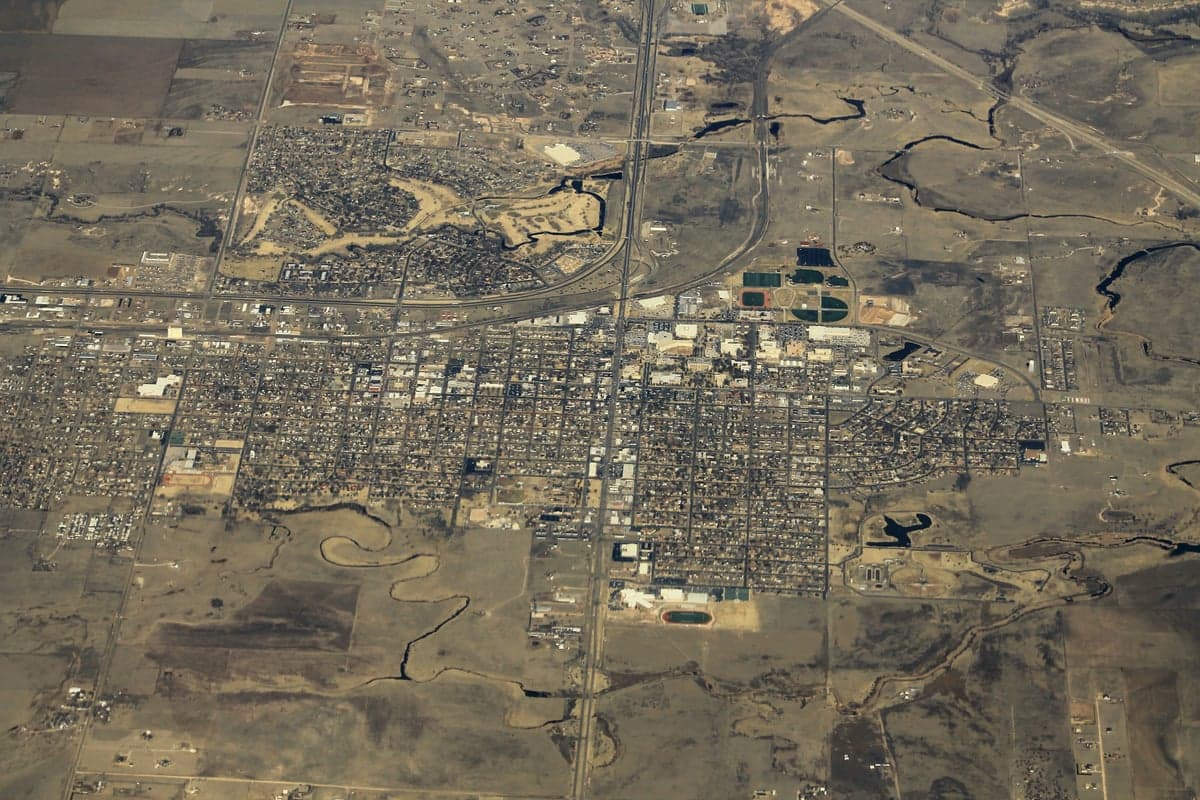
Photo: Wikipedia
Personal Sovereignty in Canyon, TX
Viable for self-reliance. Generally workable, though some barriers may limit total independence.
What does Personal Sovereignty tell us?
Personal Sovereignty measures your capacity for self-reliance and independence with minimal government friction. Higher scores mean fewer barriers between you and the way you want to live... but it assumes you have the space you need and good neighbors.
What does this tell us?
Personal Sovereignty measures your capacity for self-reliance and independence with minimal government friction. Higher scores mean fewer barriers between you and the way you want to live... but it assumes you have the space you need and good neighbors.
State Policy
Energy independence: Net exporter (220% of energy produced in-state)
Personal Liberty
Homesteading

Personal Liberty Analysis
Canyon, Texas, offers a personal sovereignty environment shaped by Texas’s strong tradition of limited government, low taxation, and expansive individual liberties, making it a compelling option for those prioritizing autonomy. Located in the Texas Panhandle, Canyon combines the legal framework of a deep-red state with the practical realities of a small, rural community where self-reliance is not just valued but expected. For single individuals and families who want maximum control over their lives, finances, and property, Canyon provides a regulatory climate that is notably light-touch compared to urban or coastal alternatives, though it operates within the constraints of county and municipal codes that still require attention.
Tax burden and regulatory posture in Canyon and Randall County
Texas imposes no state income tax, which immediately gives residents of Canyon a significant financial autonomy advantage over residents of states with high income taxes. The primary local tax burden falls on property taxes, which in Randall County are moderate by Texas standards. The combined city and county property tax rate in Canyon typically hovers around 2.0% to 2.2% of assessed value, which is lower than many urban Texas counties like Travis or Dallas but higher than some rural Panhandle counties. Sales tax in Canyon is 8.25%, comprising the state’s 6.25% rate plus local additions. The regulatory posture in Canyon is generally permissive: there is no city-level rent control, no local minimum wage above the federal floor, and no burdensome business licensing requirements for most small operations. Zoning exists but is not aggressively enforced against standard residential uses; homeowners can typically keep vehicles, trailers, and recreational equipment on their property without facing the strict HOAs common in suburban subdivisions. The city does enforce basic building codes and health regulations, but the overall administrative overhead for residents and small business owners is low, aligning with the area’s ethos of personal responsibility.
Self-defense and gun law specifics in Canyon and Texas
Texas has some of the most permissive self-defense and gun laws in the United States, and Canyon residents benefit fully from this legal environment. Since 2021, Texas has allowed permitless carry (constitutional carry) for individuals aged 21 and older who are legally eligible to possess a firearm, meaning no license or training is required to carry a handgun openly or concealed in most public spaces. For those who still want a License to Carry (LTC), the process involves fingerprinting, a background check, and a short training course, but it also grants reciprocity with many other states. Texas’s “Stand Your Ground” law eliminates any duty to retreat before using deadly force in self-defense, provided the individual is lawfully present and not engaged in criminal activity. The Castle Doctrine extends this protection to one’s home, vehicle, and workplace. Canyon itself has no additional local firearm ordinances that restrict possession beyond state law; there are no city-level bans on magazine capacity or specific weapon types. The local culture is strongly pro-gun, and gun ownership is common and socially normalized. For a relocation reader prioritizing self-defense sovereignty, Canyon offers a legal framework that places maximum discretion in the hands of the individual, with minimal government interference.
Self-reliance and homesteading viability in Canyon
Canyon’s semi-arid climate and available land make it a viable location for those interested in self-reliance and homesteading, though with important practical constraints. Residential lots within city limits typically range from 0.25 to 1 acre, while unincorporated Randall County land can be purchased in parcels of 1 to 40 acres or more at relatively low per-acre prices compared to national averages. Zoning in the city allows for standard livestock like chickens and goats on residential lots, subject to setback and nuisance ordinances, but larger animals like cattle or horses generally require more acreage and are better suited to county land. Off-grid living is legally feasible in Randall County: there is no county-level mandate to connect to municipal water or sewer if a property has a permitted well and septic system. Solar panels are permitted and increasingly common, though net metering policies with local utility Xcel Energy are less generous than in some states. Rainwater harvesting is legal and encouraged by Texas state law, and Canyon’s average 20 inches of annual rainfall can support supplemental garden irrigation with proper storage. The growing season is about 190 days, suitable for warm-season crops like tomatoes, peppers, and melons. The primary limitation is water availability: the Ogallala Aquifer supports irrigation but is a finite resource, and new well permits are subject to groundwater district regulations. For a family wanting to grow food, keep small livestock, and reduce dependence on supply chains, Canyon offers a workable environment with fewer regulatory hurdles than more densely populated or environmentally restricted regions.
Personal liberties in Canyon: parental rights, medical autonomy, speech, and property
Personal liberties in Canyon are broadly protected under Texas state law, which has increasingly prioritized parental rights and medical autonomy in recent legislative sessions. Texas law guarantees parents the right to direct the upbringing, education, and healthcare of their children, including the right to opt out of public school curriculum or activities without penalty. Homeschooling is legal with minimal state oversight: no notification requirement, no standardized testing mandates, and no teacher certification requirements, making it one of the most homeschool-friendly states in the country. Medical autonomy is a mixed picture: Texas has not expanded Medicaid and does not mandate COVID-19 or other adult vaccines, but it does require certain childhood immunizations for school attendance unless a parent claims a medical or conscientious exemption. The state has enacted laws restricting government mask and vaccine mandates, which aligns with a pro-choice (in the medical sense) environment. Free speech is robustly protected under both the U.S. and Texas constitutions, and Canyon’s small-town culture generally supports open expression of political and religious views without social or legal retaliation. Property rights are strongly protected: Texas has no state-level property tax on business inventory or intangible assets, and eminent domain is limited to public use projects with fair compensation. The absence of a state income tax and the presence of strong property rights protections mean that residents retain a larger share of their earnings and have greater control over their land than in many other states.
Overall, Canyon, Texas ranks highly for personal sovereignty relative to most U.S. locations, particularly for those who value low taxation, permissive gun laws, and minimal government intrusion into family and medical decisions. The regulatory environment is light but not absent, and the practical realities of semi-arid homesteading require planning around water and climate. For a relocation reader who prioritizes autonomy and self-reliance, Canyon offers a legal and cultural foundation that supports individual decision-making across the key domains of tax burden, self-defense, homesteading, and personal liberties, making it a strong contender among small-town Texas options.

* Values derived from national, state, county, city and local statistics and may differ in a specific area. Last updated: 2026-10-23T20:59:54.000Z
Narrative content on this page is AI-generated and may contain mistakes. Verify any details that matter before acting on them.
ReloMaps may earn a commission from affiliate links at no extra cost to you.

